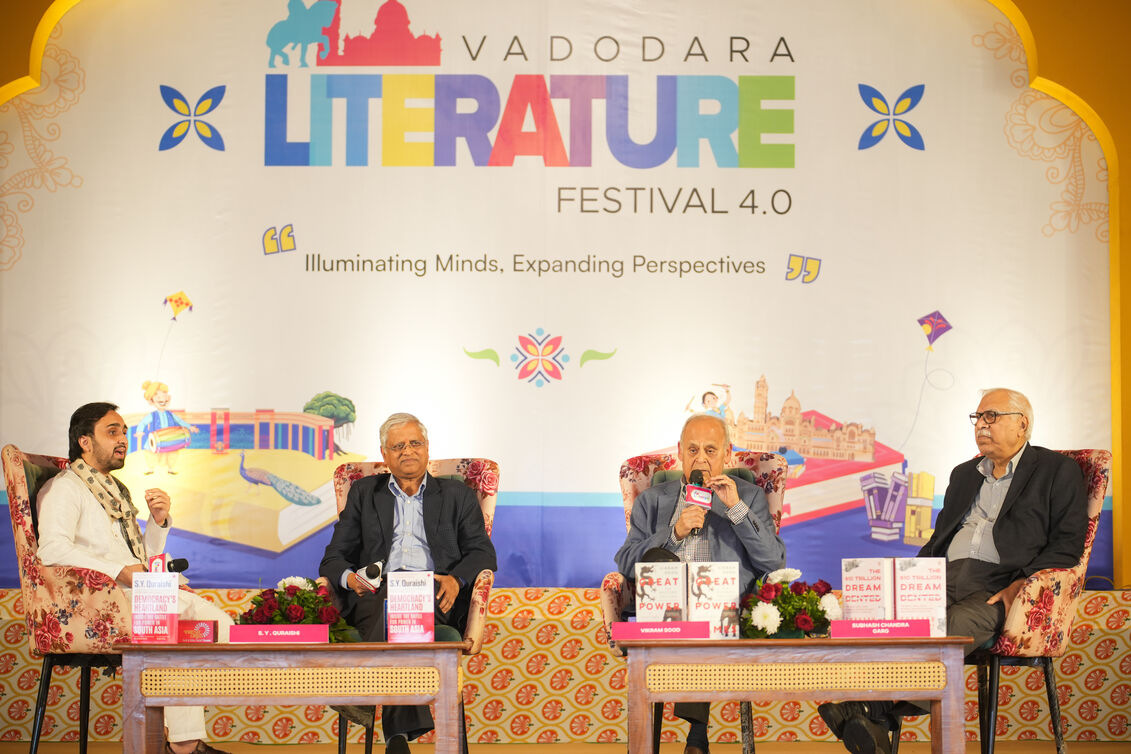
In January 2026, something markeable happened at Vadodara Literature Festival 4.0 at Parul University. Three eminent speakers who are among the most powerful figures in the Indian state – each operating in a domain that rarely allows for public candour – sat in a courtyard in Gujarat and talked openly with students about democracy, courage, and why institutions fail.
Subhash Chandra Garg served as Finance Secretary of India and has since authored Viksit Bharat 2047, a detailed blueprint for India’s development trajectory. Vikram Sood led the Research and Analysis Wing, India’s external intelligence agency, during a period that included the Kargil aftermath and the restructuring of India’s strategic posture. S.Y. Quraishi served as Chief Election Commissioner of India and has written extensively on South Asia’s democratic experiments in India’s Experiment with Democracy.
The session was moderated on January 27, 2026, at Tagore’s Shantiniketan. What follows is not a summary of three speeches. It is a synthesis of the intellectual thread that ran through one of VLF – Vadodara Literature Festival 4.0’s most substantive conversations.
Leadership Is Not What You Announce – It’s What You Demonstrate
Subhash Chandra Garg opened the leadership discussion with a distinction that sounds simple until you think about how rarely it’s applied. “Real leadership, he said, is not about authority or position. It is about personal conduct. A leader leads by example, and what that means practically is that the values a leader holds must be visible in how they act when no one is watching – and when everyone is.”
His second quality of effective leadership was the ability to provide direction: a clear vision, the capacity to identify obstacles, and the willingness to show a structured path forward. He was direct about what he saw missing among India’s younger leaders – not intelligence or ambition, but clarity. Not the inability to see problems, but the underdeveloped skill of designing responses to them.
“Youth participation in democracy should not stop at voting,” he told the audience. “It should extend to social issues, policy discussions, community service, and ethical leadership.” The challenge of Viksit Bharat 2047 – India’s aspiration to become a developed nation within the century – will not be met by institutions alone. It requires a generation of citizens who understand that governance is not something that happens to them.
Key principles from Garg’s portion of the session:
- Lead by example: behaviour is more persuasive than instruction
- Policymaking requires willingness to abandon outdated practices – adaptability is not weakness
- Economic policy that doesn’t account for sustainability (EV transition, trade diversification) is policy that will need to be redone
- Long-term development requires consistent policy over decades – not electoral cycles
What the Head of RAW Taught a Room About Courage- Vikram Sood
For students at Parul University – many of them
Vikram Sood is not a man accustomed to public forums. Intelligence work is, by design, the opposite of literature festivals. And yet his contribution to the VLF – Vadodara Literature Festival 4.0 session on leadership carried a directness that comes precisely from someone who has had to make consequential decisions under conditions the audience would never face.
Leadership, he said, is tested in crisis – not in comfort. The qualities he named were not abstract: resilience in the face of uncertainty; the refusal to abandon the people working alongside you; personal accountability for outcomes, whether those outcomes are triumphs or failures. He referenced historical wars and intelligence operations – deliberately without naming classified specifics – as contexts where these qualities were not philosophical positions but operational necessities.
His most striking observation was about technology. “Technology is the new king,” he told the audience. Not in the breathless, optimistic sense that dominates most conversations about innovation – but as a warning. Leaders who do not understand technology, who cannot adapt to it, and who assume that strategic intelligence or institutional authority will substitute for technical literacy are leaders who will be outmaneuvered.
“A leader must take responsibility for both success and failure,” he said. “Personal accountability strengthens credibility, builds trust, and reinforces ethical leadership.” In a culture where shifting blame is common across hierarchies – from classroom to cabinet – the bluntness of that statement carried weight.
Strategic insights students and young professionals can apply:
- Resilience is a leadership quality that is built through practice, not inherited
- Loyalty to your team during crisis is what distinguishes a leader from a manager
- Technology literacy is no longer optional for anyone in a leadership role
- Accountability – including for failures – is what builds lasting institutional credibility
The Election Commissioner Who Said ‘Sab Neta Chor Hote Hain’ Is the Wrong Answer
S.Y. Quraishi’s contribution to the session was, in some ways, the most politically urgent. As a man who oversaw the mechanism by which India’s 1.4 billion people exercise collective democratic choice, his concern about civic disengagement was not abstract – it was operational.
He opened this portion of the discussion with a diagnosis: India’s youth are not apathetic. They are uninformed. The distinction matters. Apathy suggests indifference; ignorance suggests a system failure. The KBP survey he referenced revealed that substantial numbers of young citizens were unaware of basic voter rights, registration processes, and electoral timelines. This is not, he argued, a moral failing on the part of the youth – it is evidence of a civic education system that has not treated democratic participation as a skill worth teaching.
He had particular patience for the phrase that circulates among disillusioned young voters: “Sab neta chor hote hain.” All politicians are corrupt. He acknowledged the emotional logic of the sentiment – corruption exists, impunity exists, and disappointment is rational. But the political conclusion that the sentiment produces – withdrawal from the system – makes things worse, not better. When the informed and the principled disengage, those who fill the vacuum are not principled.
“Voting is the most accessible mechanism through which citizens can exercise control over governance,” he said. “Every vote carries value and has the potential to influence leadership choices and policy direction.” He noted that January 25 is National Voters’ Day – a fact most of the audience did not know – and used their ignorance not as a rebuke but as an illustration of the gap his work has long sought to close.
What students can do today – practical takeaways from Quraishi’s session:
- Register to vote and understand the process before election season
- Treat civic literacy as a skill: read about electoral systems, constitutional rights, and policy debates
- Critique politicians critically – not uniformly, but through evidence
- Recognise that democratic disengagement is itself a political choice with consequences
- National Voters’ Day (January 25) exists as a formal moment for civic renewal – use it
The Longer Arc: What India’s Governance History Teaches About the Present
What made this panel distinctive at VLF – Vadodara Literature Festival 4.0 was the length of institutional memory in the room. Collectively, Garg, Sood, and Quraishi had served India across five decades that included economic liberalisation, strategic repositioning after Kargil, the transition to electronic voting, the negotiation of major trade agreements, and the design of health and welfare policy at national scale.
The through-line that connected their perspectives was not optimism or pessimism about India’s trajectory – it was responsibility. Each speaker, in their own domain, argued the same essential point: institutions do not maintain themselves. Democracy does not run on autopilot. Economic development does not happen because it is projected. These things require people – specifically, people who have prepared themselves to contribute, who understand how systems work, and who are willing to do the harder and quieter work of governance rather than the more visible work of spectacle.
For students at Parul University – many of them studying law, business, engineering, public policy, or the humanities – the message carried direct relevance. The systems these speakers had worked within will need successors. The question VLF – Vadodara Literature Festival 4.0 implicitly posed is whether the next generation will be equipped to enter them with clarity about what they actually demand.
VLF – Vadodara Literature Festival 4.0 as a Civic Education Platform
Sessions like this one represent a particular kind of educational value that literature festivals, at their best, can provide. Textbooks describe institutions. This session showed what it looks and feels like to inhabit them – the pressures, the ethical dilemmas, the moments where personal courage intersected with institutional constraint.
IIMUN’s curation of VLF – Vadodara Literature Festival 4.0, and Parul University’s commitment to providing a campus where these conversations could take place without a paywall or metropolitan barrier, made it possible for students from Gujarat and beyond sitting across from people who had shaped the architecture of modern India – and to ask them direct questions. That access is not a small thing. It is, in fact, precisely the kind of democratic participation S.Y. Quraishi spent an hour urging the audience to exercise.


