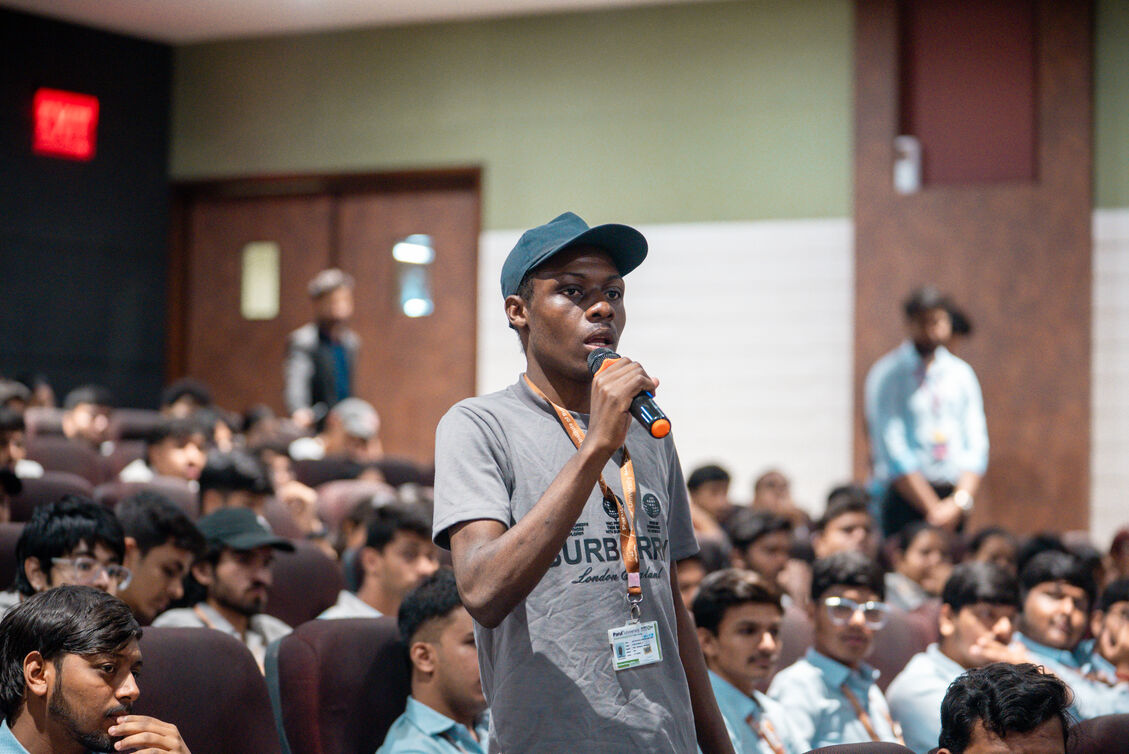
Udyam Management Fest 2026 at Parul University is a multi-day management festival designed to bridge the gap between classroom theory and live industry practice. The fest combined expert-led seminars, interactive Q&A sessions, and a student entrepreneurship marketplace all under one institutional umbrella.
The IIMUN Collaboration
Parul University organised Udyam in association with India’s International Movement to Unite Nations (IIMUN). IIMUN’s involvement brought structured event formats and access to a network that will inspire and help them grow, positioning the fest as more than a campus-only affair.
The Exposure-to-Execution Bridge (Parul University Framework)
Udyam operates on what Parul University internally calls the Exposure-to-Execution Bridge – a three-stage experiential model unique to its management programs:
- Stage 1: Exposure: Students get to meet and listen directly to the C-suite leaders operating at a national and global scale.
- Stage 2: Engagement: Interactive Q&A, reverse mentoring discussions, and audience-driven questioning.
- Stage 3: Execution: Student-run stalls on Day 2 translate observation into real-time business operation, pricing, and customer handling, giving students first-hand experience of businesses.
This three-stage sequence turns passive attendance into active skill-building – the core design principle behind Udyam’s structure.
Day 1 - Leadership, Digital Payments & Market Realities
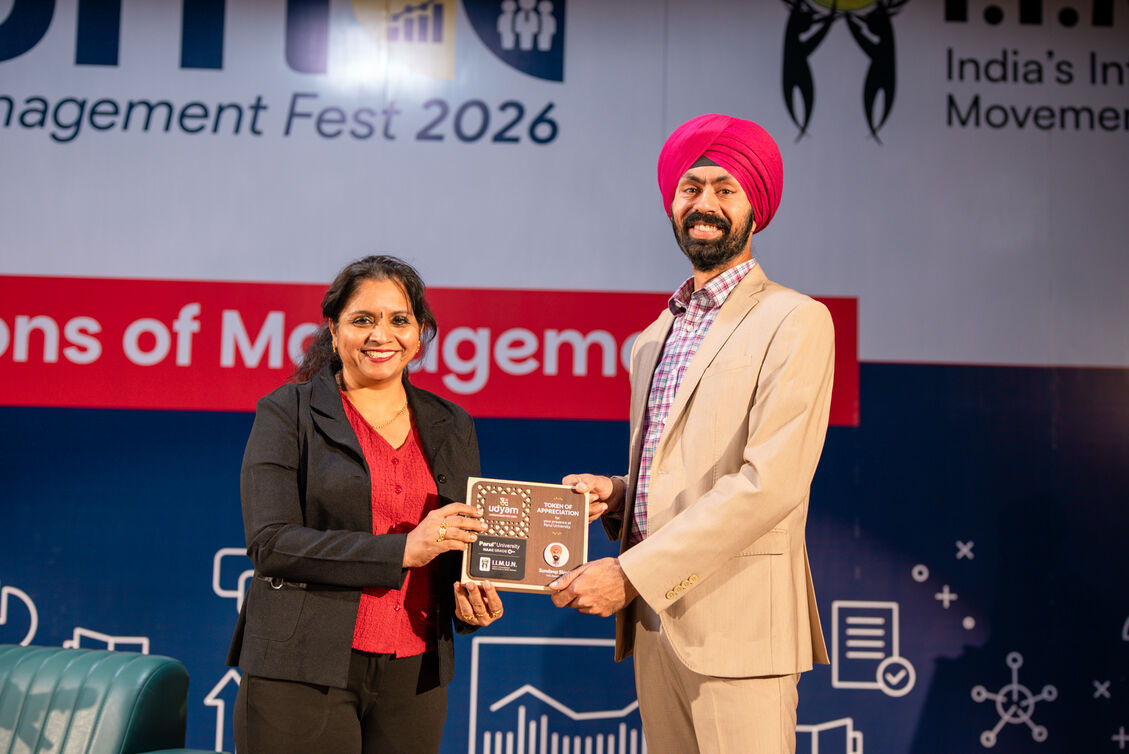
Sundeep Singh, Managing Director at Accenture: Adaptive Leadership & Soft Skills
Sundeep Singh opened Udyam with a session anchored in the realities of consulting. He described how his role at Accenture daily focuses on client meetings, long-term strategy, and team guidance, which requires constant reassessment.
His core message: soft skills now outweigh hard skills in hiring decisions. He told students that professional networks, clear communication, and genuine relationship-building determine career trajectory more than technical competence alone.
- Constant adaptation matters more than static knowledge in the corporate and consulting environment.
- Networking and communication create more career opportunities than domain knowledge.
- Self-discipline outside work, he cited daily 21 km runs – reinforces professional performance.
- His one-word definition of success: perseverance.
Vijay Thakral, Chief of Compliance at Razorpay: India's Digital Payments Ecosystem
Vijay Thakral walked students through the consolidation of payment infrastructure in India. Unified Payments Interface (UPI), card processing, and online banking now operate under integrated platforms rather than separate tools.
He stressed that compliance and adherence to RBI regulations, PCI-DSS standards, and ISO benchmarks – must be embedded from day one, and shouldn’t be left for the later stages. He also flagged a behavioural side effect of digital payments: reduced visibility of spending can lead to overspending.
Sunil Ramrakhiani, Chief Business Officer at BSE: India's Post-COVID Investor Boom
Sunil Ramrakhiani presented data on India’s investor growth. Before COVID, the country had approximately 3.8 crore investors accumulated over nearly three decades. Post-pandemic, approximately 25 lakh new investors now join each month, pushing the total close to 10 crore.
He outlined that roughly a quarter of current investors are under thirty. His advice: financial literacy must precede investment. Following social media trends without research leads to losses, not returns. He cited Warren Buffett’s principle – save first, spend what remains.
| Pro Tip: Ramrakhiani’s point applies directly to finance students: learn market mechanics through structured courses before opening a trading account. Parul University’s BBA and MBA programs embed financial literacy modules for this reason. |
Day 2 - Student Stalls, Consumer Feedback & Hidden Demand (Feb 20)
14 Student-Run Stalls: What Sold, What Surprised
Day 2 moved to BBA Ground, where fourteen student-run stalls operated across categories: food, fashion, wellness, merchandise, and astrology. Interns on-site collected real-time consumer feedback through casual interviews.
The stall market was not a simulation. Students handled pricing, inventory, customer service, and foot traffic independently. Several stalls surfaced insights that a classroom case study cannot replicate.
Top 6 Stalls That Stood Out at Udyam 2026
TOP X LIST.
• Bhutan Bowl-Bhutanese cuisine by international students; sold out Ema Datshi by 3 PM.
• Radha Astrocare-Most crowded stall; live palm readings generated the highest unprompted reactions.
• Sip Theory-Six cold coffee varieties; consumers repeatedly praised customer service unprompted.
• Fluffy Flames-Soya wax candles; the owner’s explanation of paraffin health concerns created informed buyers.
• Kuch Khatta Meetha Ho Jaye-a chaat stall that accidentally surfaced a real gap in campus food options.
• HET’S Ice Cream-Healthy homemade dairy ice cream; received unsolicited faculty endorsement.
| Common Mistake: Many student entrepreneurs at fests default to competing on price alone. Udyam’s standout stalls succeeded on differentiation: unique cuisine (Bhutan Bowl), a health-informed product narrative (Fluffy Flames), or service quality (Sip Theory). Pricing mattered less than positioning. |
Day 2 Session - Reimagining Talent with P.V. Ramana Murthy
Former CHRO, IHCL (Tata Group): People Before Profit
P.V. Ramana Murthy, former Chief Human Resources Officer at Indian Hotels Company Limited (IHCL, Tata Group) and Hindustan Coca-Cola, anchored his session around one principle: strong organizations are built on purpose, not profit alone.
He discussed that talent bifurcation should reward the top 20–25% while investing in development across all tiers. And mentioned that hiring should prioritize attitude and emotional intelligence (EQ) over technical knowledge and that humanity is a leadership strength, not a weakness.
Culture, AI & the Evolving HR Function
Murthy positioned HR as an important part of the organizational ecosystem not an administrative add-on. He admitted the fact that AI will assist and help in the technical HR work but emphasized that human thinking and emotional depth remain irreplaceable. He referenced Ratan Tata’s leadership culture as a model of empathy-driven management.
Day 3 - Technology, Data & Real-World Business Building
Mukesh Jain, CTO of Capgemini India: Data Is the New Sunshine
Mukesh Jain, CTO of Capgemini India: Data Is the New Sunshine
Mukesh Jain opened Day 3 by discussing data as the engine for powerful business in the current era. He took Uber as an example of a company that is succeeding specifically because it understood and leveraged its data.
He talked about his journey, explaining how financial constraints prevented him from completing higher education initially, but he returned later in life to finish his studies. This framing reinforced his message: education is a lifelong process, not a fixed window.
- Data drives strategy, customer understanding, risk reduction, and personalization.
- AI has the potential to double business output when applied correctly.
- Students should learn Python basics and algorithmic thinking regardless of their specialization.
- LinkedIn presence and active networking create career differentiation.
Neeraj Agarwal, COO of Tata Projects: Human Capital as the Biggest Asset
Neeraj Agarwal described entering business by circumstance rather than choice. He took an engineering degree, switched to banking, and reached infrastructure. He emphasized that infrastructure projects demand operational thoroughness, cultural awareness, and the ability to manage diverse teams under extreme conditions.
His leadership advice: own your mistakes first, then delegate. Autocratic styles fail in complex environments. Build trust through predictability, patience, and polite communication.
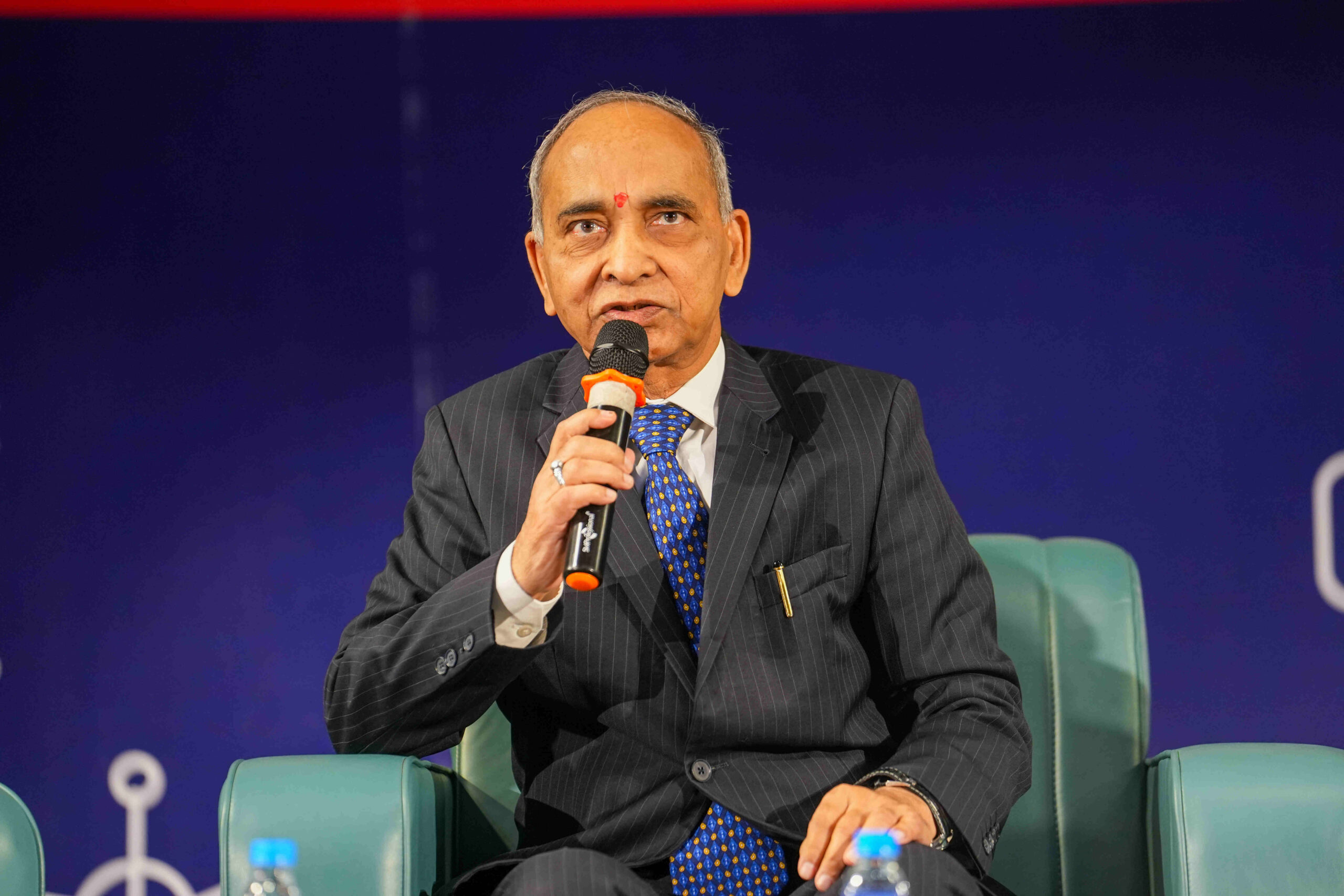
Suresh Goel, CEO of Bikanervala: From Bikaner to a Global Brand
Key Takeaways from Udyam Management Fest 2026
- Soft skills and networking now outweigh technical credentials in hiring decisions.
- Financial literacy must precede investment; social media tips are not strategy.
- Compliance and data profiling separate scalable businesses from fragile ones.
- Student entrepreneurship works best when it solves a real gap, not when it copies trends.
- Humility, adaptability, and continuous learning define modern leadership across industries.
Who This Article Is For
- Prospective MBA and BBA students evaluating Parul University’s industry exposure model.
- Parents assessing how Parul University connects students to working professionals.
- Faculty and academic administrators benchmarking management fest formats.
- Management professionals interested in what current industry leaders are telling students.
FAQ - Udyam Management Fest 2026
What is Udyam Management Fest at Parul University?
Udyam is an annual management festival organised by Parul University in collaboration with IIMUN. It brings together industry leaders for seminars and Q&A sessions and includes a student-run stall marketplace. The 2026 edition ran from February 19 to 21 at the Central Auditorium and BBA Ground in Vadodara, Gujarat.
Who were the speakers at Udyam Fest 2026?
The 2026 edition featured Sundeep Singh (MD, Accenture), Vijay Thakral (Chief of Compliance, Razorpay), Sunil Ramrakhiani (CBO, BSE), P.V. Ramana Murthy (former CHRO, IHCL/Tata Group), Mukesh Jain (CTO, Capgemini India), Neeraj Agarwal (COO, Tata Projects), and Suresh Goel (CEO, Bikanervala).
What topics were covered across the three days?
Sessions spanned adaptive leadership, soft skills in hiring, digital payment compliance, post-COVID investor growth, talent management, HR strategy, AI's impact on business, data as a business asset, infrastructure operations, and building Indian brands for global markets.
What is the Exposure-to-Execution Bridge?
The Exposure-to-Execution Bridge is Parul University's three-stage experiential learning framework used at Udyam. Stage 1 exposes students to industry leaders. Stage 2 engages them through Q&A and discussion. Stage 3 lets them execute real business operations through student-run stalls.
How many student stalls were at Udyam 2026?
Fourteen student-run stalls operated on Day 2 at the BBA Ground. Categories included food (Bhutan Bowl, chaat, ice cream), fashion (Dream Attire), wellness (Fluffy Flames candles, Net Ayurveda), and services (Radha Astrocare palm readings).
Is Udyam only for management students?
While MBA and BBA students form the core audience, Udyam draws attendees from multiple disciplines. The 2026 edition included nursing students, international faculty, and students from non-business programs who attended both the sessions and the stall marketplace.


