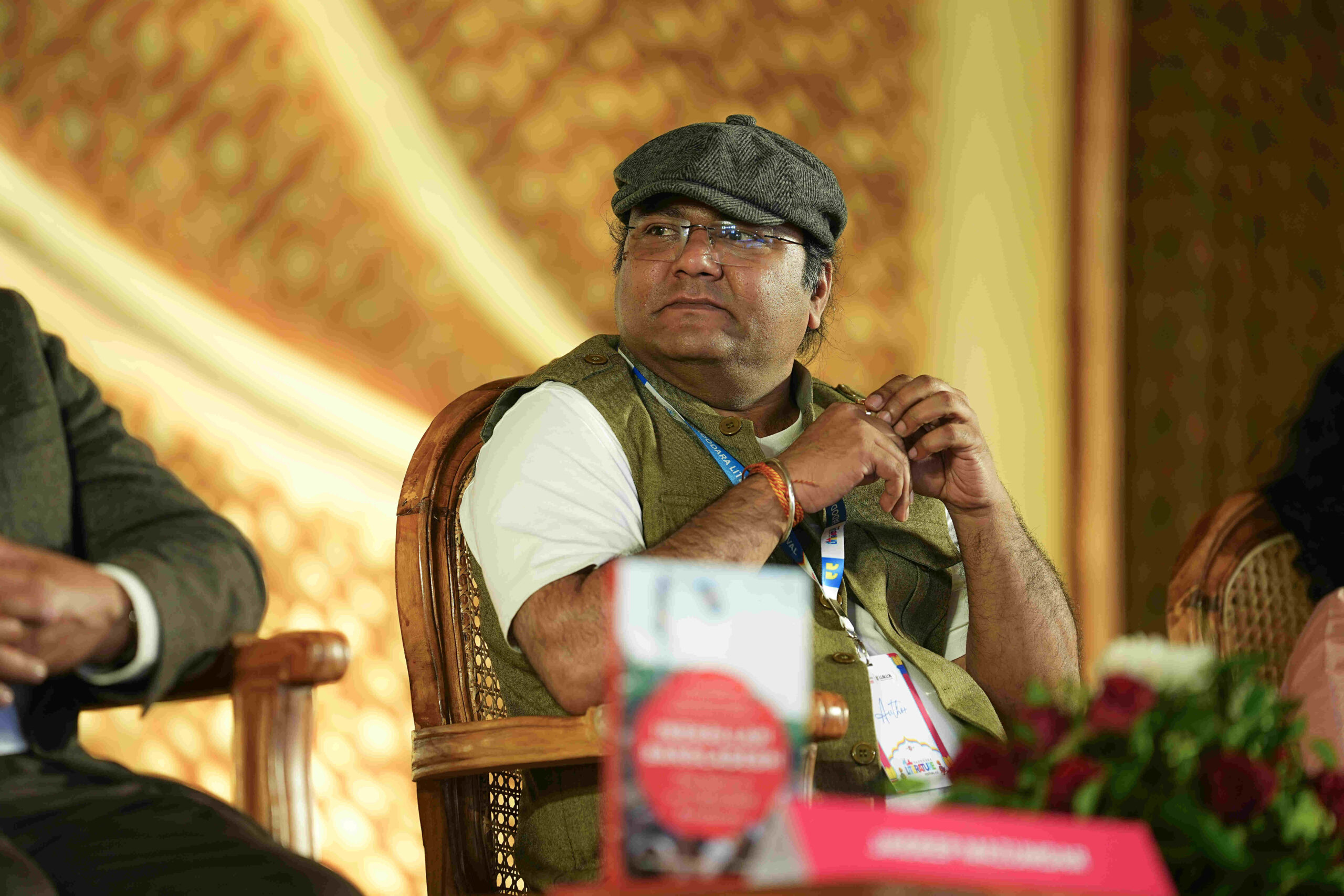
A Pencil, a Sister, and the Lens through Which Everything Is Written
< p class=”mt-3″>Before Geet Chaturvedi spoke about incompleteness at VLF – Vadodara Literature Festival 4.0, the audience needed to understand where the idea came from.He told them.
< p class=”mt-3″>
- Before Geet Chaturvedi spoke about incompleteness at VLF as known as Vadodara Literature Festival 4.0, the audience needed to understand where the idea came from.
- In 1993, during the Bombay bombings, his sister died. Before she passed, she gave him a pencil.
- He told the audience at the Regional Literature Panel on January 27, 2026 that he writes everything, every poem, every novel, every line through her lens, with the instrument she gave him, in her awareness.
- This is not a footnote to Geet Chaturvedi’s literary biography. It is the foundation of it.
- The poet later won the PEN/Heim Translation Fund Grant for his novel Simsim, was named one of the Ten Best Writers of India by The Indian Express, and received the Bharat Bhushan Agrawal Award for poetry.
- He began his writing life with grief transformed into purpose.
- That transformation is, in compressed form, the subject of the philosophy he came to VLF – Vadodara Literature Festival 4.0 to discuss.
Adhoori Chizo ka Devta: The God of Unfinished Things
The concept at the heart of Chaturvedi’s session at VLF – Vadodara Literature Festival 4.0 is deceptively simple. He calls it ‘Adhoori Chizo ka Devta’ – the God of Unfinished Things. It is a way of understanding growth fundamentally different from the model most educational systems are built on.
He illustrated it with two figures whose lives are usually narrated as stories of completion and mastery.
Mahatma Gandhi considered his life ‘complete’ when he had become a successful barrister. The qualifications were in order. The career was established. By every conventional measure, he had arrived. And then he began his work in South Africa – and discovered that what he had completed was, in fact, only the first stair of a longer journey. The man who changed the direction of a nation’s history did so by recognising that his first form of completeness was merely the threshold of a new incompleteness.
Rabindranath Tagore is celebrated as a poet, novelist, and playwright – the first non-European to win the Nobel Prize in Literature. He took up painting in his late sixties. At an age when most people are managing the legacy of what they have built, Tagore was beginning something he had not yet mastered. The paintings are now considered significant works in their own right. But more importantly for Chaturvedi’s argument: they are evidence that Tagore understood incompleteness as the permanent condition of a creative life.
The first stair, Chaturvedi said, is never the destination. It is always the beginning of the next journey. What this means for students under pressure to perform and appear already-complete:
● Achievement is a threshold, not an endpoint – the moment of completion is the moment of readiness for the next level
● Mastery in one domain creates the conditions for meaningful incompleteness in another.
● The pressure to be ‘finished’ – in education, in career, in identity – is based on a misunderstanding of how growth actually works.
● Learning to live usefully with incompleteness is a skill that can be cultivated, not a deficiency to be managed.
- Achievement is a threshold, not an endpoint – the moment of completion is the moment of readiness for the next level
- Mastery in one domain creates the conditions for meaningful incompleteness in another.
- The pressure to be ‘finished’ – in education, in career, in identity – is based on a misunderstanding of how growth actually works.
- Learning to live usefully with incompleteness is a skill that can be cultivated, not a deficiency to be managed.
Why This Matters Most for Students Under Exam Pressure
The educational environment that most students in Chaturvedi’s VLF – Vadodara Literature Festival audience inhabited – exam-driven, completion-oriented, structured around fixed milestones – is almost precisely the opposite of the model his philosophy describes. In that environment, incompleteness is a problem. The unfilled credit. The unsecured placement. These are experienced as deficits – evidence that something has gone wrong.
Chaturvedi’s reframe is not that these things do not matter. It is that the relationship between completion and growth is the inverse of what most students have been taught. The arrival at one stair – the earned degree, the cleared exam, the first job – is not the place where growth happens. It is the place from which the next growth becomes possible.
- For a student who has just failed an exam, this is not comforting in the conventional sense. Chaturvedi was not offering comfortHe was offering a framework:
– Failure
– Incompleteness
– Experiences of not-yet-knowing
The Language of Incompleteness: How Chaturvedi Writes It
The philosophy did not arrive in a vacuum. It is encoded in Chaturvedi’s literary work – particularly in his poetry collections Khushiyon Ke Guptchar (‘The Secret Agents of Happiness’) and Nyoonatam Main (‘At My Minimum’).
- The second title is worth pausing on: ‘At My Minimum.’ It describes a state – the moment of greatest depletion, of fullest incompleteness – that most poets would treat as a crisis to move through quickly. Chaturvedi named a collection after it.
- The implication is that the minimum is not a failure condition. It is a condition of particular clarity, from which certain kinds of writing, and certain kinds of growth, become possible that are not available from positions of comfort or achievement.
- His novel Simsim, which won the PEN/Heim Translation Fund Grant and received JCB Prize longlist recognition, deals with themes of loss, memory, and the way the past shapes present consciousness.
- For a Hindi-language novel to reach these circuits of international literary attention requires work that is genuinely consequential in what it says and how it says it.
- What Chaturvedi’s work demonstrates, across multiple forms and decades, is that the philosophy of incompleteness is not a workshop idea. It is a practice.
'Language Is the Light Through Which We See the World'
Chaturvedi’s contribution to the Regional Literature Panel was also a sustained argument for the value of regional language and literature – specifically Hindi – in a national conversation that still tends to privilege English.
“Language is the light through which we see the world,” he told the audience. “Without it, we have no lens.” The statement is both poetic and precise: language is not a container for thought that could exist independently of it. Language is the medium through which thought becomes possible. Different languages do not merely translate the same thoughts into different sounds. They make different thoughts possible.
For a country where 98% of citizens speak regional languages, and where the dominant language of literary prestige is English, this argument has structural implications. The audience at VLF – Vadodara Literature Festival 4.0 – students from multiple disciplines, many reading and writing primarily in English – heard this argument in a context where it carried particular force. The festival itself, by including this panel and these voices, was making the same argument: that literature worth engaging with is not confined to any single language or tradition.
Key Takeaways: The Most Useful Thing He Left Behind
The most immediately useful thing Chaturvedi’s VLF – Vadodara Literature Festival 4.0 session gave students was a framework for understanding their current situation that does not require them to be further along than they are.
The philosophy of incompleteness does not ask students to be patient while waiting to become complete. It asks them to recognise that the feeling of incompleteness – the sense that there is more to learn, more to become, more to understand – is not a sign that something has gone wrong. It is a sign that growth is occurring.
This is a more demanding philosophy than it initially appears. It requires the capacity to function meaningfully from a position of not-yet-knowing – to act, to create, to contribute, while remaining genuinely open to the next stair. For young people under pressure to perform, to achieve, to appear already-complete, this is the harder thing to hold. But it may also be the more honest description of what a meaningful life actually requires.


