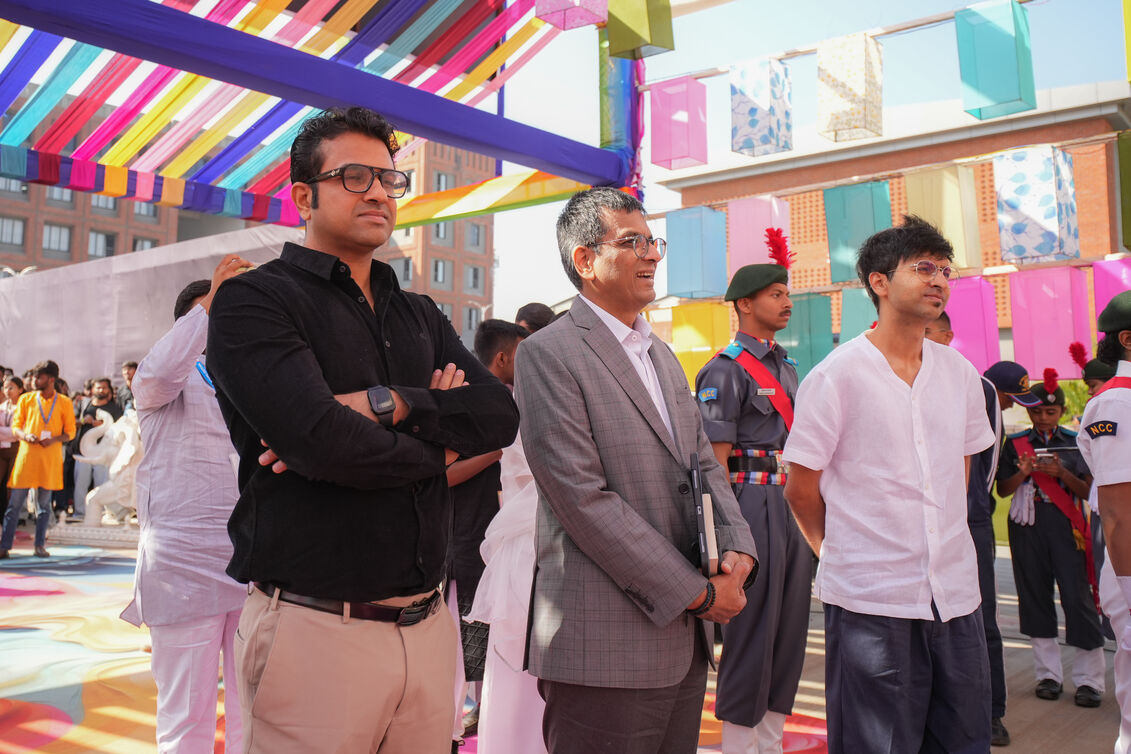
The room feels the air of respect for such an honorable person. Someone who has genuinely shaped the country they’re speaking in. On January 28, 2026, that silence settled over Vivekananda Vedanta Bhavan at Parul University when Justice Dhananjaya Yeshwant Chandrachud, the 50th Chief Justice of India, arrived and took his seat at the VLF 4.0
He was introduced by IIMUN moderator Ayushi as “the Chief Justice of a nation that holds as many differences as possible, yet wakes up every day as one country.” It was a line that could have felt rehearsed. What followed made it feel earned.
The session that rolled out for the next hour was not a lecture on constitutional law. It was something different: an honest conversation about what law means in the lives of real people – women asking for equal opportunity in the armed forces, children with disabilities navigating inaccessible footpaths, and citizens whose voting rights exist on paper but nowhere else.
The Accident That Wasn’t: From Economist to Chief Justice
The first surprise of the session came early. Moderator Ayushi – noting that much of the audience consisted of students who had grown up comparing themselves to ‘Sharma ji ka beta’ – asked Justice Chandrachud whether he had always planned to be a lawyer. His answer was direct: he had never wanted to become a lawyer.
He had wished to become an economist. His plan was to pursue a master’s degree in development of economics at the Delhi School of Economics, as he was motivated by a desire to work at the grassroots level, to serve villages, and to understand the communities that occupy the margins of India’s story. As the law school began fifteen days before the economics, he enrolled in both; he said with a quiet smile that they would not let him go.
To work and know the country at the deepest levels of economics and law, these can be the courses students can take up at Parul University.
“I do not believe in accidents,” he told the audience. “Looking back at 66, while human beings often think events happen by chance, I feel there is a deeper design guiding whom we meet, what we do, and the major turns our lives take.” It was an unexpectedly philosophical opening from a man known for landmark judgments – and it set the tone for everything that followed.”
Key takeaways from this portion of the discussion that students found particularly useful:
- Career pivots are not failures – they are often the mechanism through which purpose reveals itself
- Combining fields of interest (economics + law, science + policy) can create a unique professional lens
- The path that “chooses you” is often the one you will excel in most deeply
Indirect Discrimination and the Gap Between Equality and Justice
The session’s most intellectually rigorous exchange came when Justice Chandrachud addressed gender justice and what he called ‘feminist judging.’ Over 50% of the audience were women or aspiring female lawyers – a fact the moderator named explicitly before asking him to explain a concept that has defined much of his judicial writing: the gap between laws that are equal and systems that are fair.
He began with an anecdote from a recent visit to the National Defence Academy in Khadakwasla. While stepping off the stage, the commanding officer told him that several women cadets in the audience would soon enter permanent service in the Indian Army, Navy, and Air Force – directly because of Supreme Court judgments his bench had authored. These women, he noted, were not given concessions. They were completing the same training as male cadets. In several cases, where male cadets completed 60 push-ups, women completed 75.
But the real lesson came next. When the Supreme Court ordered permanent commissions for women in the armed forces, the government applied the same physical standards used to assess male officers in their late twenties – to women who had already served 15 years and were now in their mid-to-late 40s. Women who had gone through childbearing. Women who had experienced menopause. Women who, had they been assessed at 20, would have met every requirement.
“That is indirect discrimination,” Justice Chandrachud explained. “Laws that appear facially neutral – applying equally to men and women – can still be discriminatory in effect. Discrimination can be both direct and indirect, and the law must be sensitive to lived realities.” The Court intervened again. The standard was adjusted.
The principle has broader applications that students in multiple fields – business, medicine, education – can carry forward:
- Equality of rules does not guarantee equality of outcomes when starting conditions differ
- Designing fair systems requires understanding the lived experience of those being evaluated.
- Institutions that want to be truly inclusive must ask: does this policy protect everyone equally, or only those for whom the system was originally designed?
The Social Construction of Disability
One of the most quietly powerful words of the session came when Justice Chandrachud spoke about his two adopted daughters, Mahi and Priyanka, both of whom live with nemaline myopathy and use electronically operated wheelchairs.
He did not speak about this to gain sympathy. He spoke about it to make a specific analytical point: that the burden of disability, in most cases, is not medical – it is social. It is the inaccessible footpath. The bus with no ramp. The exam hall without a reader. The medical college that rejected a student with 88% disability because the physical standards had not been designed to accommodate her.
“She was admitted after the Supreme Court intervened and referred the matter to a disability board,” he told the audience. “She later performed exceptionally well”. His conclusion was precise: persons with disabilities do not need charity. They need equal opportunity and their rightful entitlements. As a nation, no section of society should be excluded from contributing to national growth.
For students in architecture, medicine, law, or public policy – fields that literally design the environments people inhabit – this framing carries direct professional relevance.
Journalism, Echo Chambers, and the Courage to Be Uncomfortable
The session’s sharpest cultural commentary came in response to a question about journalism and democracy. The moderator framed it with a reference to the phrase “the nation wants to know” – a familiar critique of a certain style of Indian television discourse – and asked what happens to democracy when journalism prioritises outrage over inquiry.
Justice Chandrachud’s analysis was structural rather than personal. Technology, he said, has fundamentally changed what journalism can be. Long-form writing requires time, patience, and a willingness to sit with complexity – qualities that short-form platforms actively work against. The algorithm does not reward nuance; it rewards reaction. The result is what he called “echo chambers” – information environments where content reinforces existing belief rather than challenging it.
“India’s strength is its pluralism,” he said. “Protecting diversity does not require abandoning your faith, culture, or identity. It requires mutual respect and the willingness to understand a viewpoint that differs from your own.”
He recommended Chimamanda Ngozi Adichie’s The Thing Around Your Neck to the audience – a collection of stories that, in his words, “challenge readers and help them evolve as citizens and human beings.” Literature, he argued, is one of the few remaining spaces that asks its reader to be genuinely unsettled. VLF – Vadodara Literature Festival, he said, was exactly the right place to make that argument.
Students found his rapid-fire responses particularly memorable:
• One habit every law student should build: Listening
• One thing lawyers should stop doing: Being judgmental
• A book on democracy: The End of History and the Last Man by Francis Fukuyama
• A case he wished he could have argued as a lawyer: Marital rape – still not recognised as an offence in India
He recommended Chimamanda Ngozi Adichie’s The Thing Around Your Neck to the audience – a collection of stories that, in his words, “challenge readers and help them evolve as citizens and human beings.” Literature, he argued, is one of the few remaining spaces that asks its reader to be genuinely unsettled. VLF – Vadodara Literature Festival, he said, was exactly the right place to make that argument.
Students found his rapid-fire responses particularly memorable:
• One habit every law student should build: Listening
• One thing lawyers should stop doing: Being judgmental
• A book on democracy: The End of History and the Last Man by Francis Fukuyama
• A case he wished he could have argued as a lawyer: Marital rape – still not recognised as an offence in India
Constitutional Morality Over Popular Morality: The Judicial Philosophy
In the Q&A session, a student asked Justice Chandrachud about the tension between constitutional morality and popular morality – a question that goes to the heart of judicial independence. His answer was among the clearest articulations of his philosophy available on record.
Judges, he said, must always uphold constitutional morality. Not because popular opinion is wrong – but because popular opinion shifts with political weather, and the Constitution is the most stable guide available for navigating that weather. Judicial decision-making anchored in constitutional values, even when unpopular, is what protects minority rights, upholds due process, and ensures that the most vulnerable sections of society retain access to justice.
When asked how young people should approach decision-making, his advice was equally precise: avoid rigidity. Prioritise dialogue. The journey, he said – echoing Paulo Coelho’s The Alchemist – is as important as the destination. Growth, learning, and the willingness to be changed by what you encounter are not peripheral to a meaningful life.
What VLF – Vadodara Literature Festival 4.0 Proved About the Value of These Conversations
Justice Chandrachud’s session at VLF – Vadodara Literature Festival 4.0 was significant not just because of who he is – one of the most consequential jurists in contemporary India – but because of what it demonstrated about what a literature festival can do when it operates at its best.
The session did not simplify. It did not reduce a complex legal career to a few motivational quotes. It asked the audience to sit with the tension between equality and fairness, between free speech and responsibility, between the letter of the law and the lives it touches. And the audience – largely students and young professionals – leaned in.
That is the particular contribution of festivals like VLF – Vadodara Literature Festival: they create the conditions for the kind of intellectual engagement that shapes how people think about institutions, citizenship, and their own responsibilities within both. For students at Parul University and the 65,000+ who move through its campus, encountering ideas at this depth – delivered not from a textbook but from the lived experience of someone who has navigated them at the highest levels – is an education that does not appear on a syllabus but may prove to be the most durable of all.


