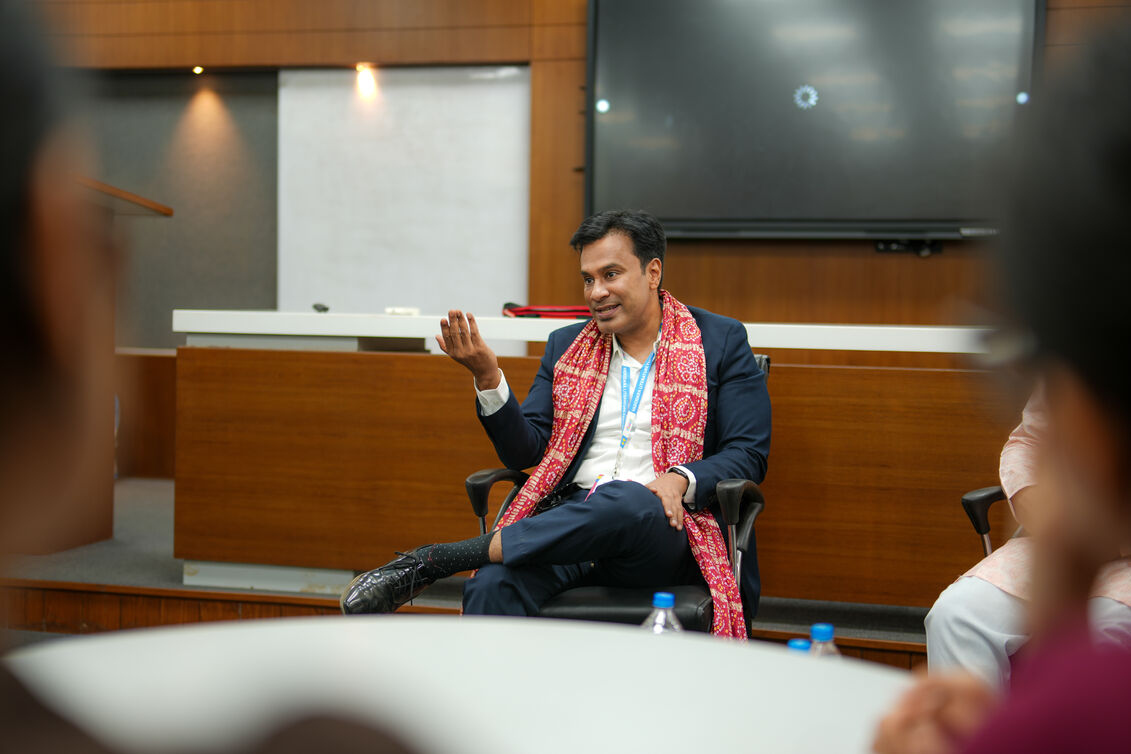
RJ Rohit opened the Swasth Bharat panel on January 29, 2026, with the bluntest possible question: Is the medical system now out of reach for the middle class?
Dr. Debraj Shome – facial plastic surgeon, director of The Esthetic Clinics, and author of Doctors Are Not Murderers– answered with a structural analysis that refused easy conclusions. India performs world-class surgeries at scale, often at one-tenth the cost of equivalent procedures in the West. Primary healthcare remains fragile. Tertiary care is genuinely strong. The system is not collapsing and it is not mature. It is somewhere in between – and pretending otherwise in either direction serves no one.
He used an analogy the audience received immediately: you cannot put kerosene in a Lamborghini and expect it to run like one. Society expects premium healthcare outcomes while systematically underinvesting in the infrastructure – medical education, primary care facilities, rural health centres, physician salaries in public hospitals – that healthcare quality actually depends on. The complaint about cost exists alongside a political unwillingness to fund the system that would reduce it.
Dr. Divya Jain added specificity: only 20% of a medical bill typically goes to the physician. The remaining 80% is consumed by the machinery of modern medicine – equipment, diagnostics, pharmaceuticals, facilities. The narrative of ‘doctors overcharging’ misses the structural reality of what sophisticated medical care actually costs.
The God Complex, Moral Injury, and the Weight of the White Coat
The session’s most emotionally dense passages came when the panellists addressed what it actually feels like to be a doctor in India – the gap between the institutional image of the physician and the human reality of the person wearing the coat.
Dr. Shome introduced the concept of ‘moral injury’ – the psychological damage that accumulates when doctors are placed in systematic conditions that prevent them from providing the care they know patients need. The perceived lack of empathy in overworked doctors is not, he argued, a character failure. It is the predictable outcome of asking people who entered medicine to heal to work eighteen-hour shifts, manage over a hundred patients a day, and be held personally responsible for outcomes that biology ultimately determines.
Tripti Saran, a healthcare practitioner and panellist, moved many in the audience when she described what she called the ‘Doctor‘s Holiday’ – three years during which she had not celebrated Diwali or Holi, spending them instead within hospital walls. She described a specific moment: a patient dying in front of her during a festival, her internal panic, and the immediate requirement to gather herself because the next patient was already waiting. The capacity to compartmentalise emotion in that way is not coldness. It is a professional survival mechanism that has a cost.
Dr. Samir Parikh offered a prescription that surprised the medical students in the audience: read literature. “To be a good psychiatrist, you must understand the human condition through art.” Empathy is not innate in sufficient quantities to survive a medical career. It is a muscle that must be actively developed. Literature provides a form of access to interior human experience that clinical training does not. What a final-year medical student said after this passage of the session: ‘I came in feeling burnt out, but hearing Dr. Shome talk about moral injury made me realise my exhaustion isn’t a failure – it’s a systemic reality.’
'If Money Alone Could Save Lives, the Rich Would Never Die'
Dr. Shome’s most quotable line came in response to the persistent cultural assumption that outcomes in medicine should be guaranteed by the combination of patient faith and physician skill.
Biology is inherently unpredictable. The bestsurgeryin the world, performed by the most skilled surgeon, on a patient with the best available aftercare, can produce an outcome no one wanted – because biology operates on its own logic, not on the logic of effort and intention. The family that blames the doctor for a death that resulted from years of unmanaged chronic disease is engaging in displacement: transferring grief and guilt onto the nearest available professional.
This does not mean doctors are never at fault. Medical error exists and accountability is necessary. Dr. Shome’s point was more specific: the binary of Doctor as God (who should prevent all death) and Doctor as Murderer (who is responsible for any death) is both factually wrong and profoundly harmful – to doctors who carry impossible expectations, and to patients who are encouraged to think of their health as something that happens to them rather than something they actively participate in shaping.
Social Media Doctors and the Information Ecosystem That Can Kill
All four panellists engaged, with varying intensity, on the question of social media and medical misinformation. Dr. Parikh’s position was the bluntest: unqualified ‘Instagram doctors’ are genuinely dangerous, and the failure of qualified professionals to occupy digital health spaces has created a vacuum that misinformation fills with extraordinary efficiency
The mechanism is not complex: people making health decisions based on sixty-second videos created by someone without medical training, validated by follower counts rather than clinical expertise, are making decisions on the basis of entertainment rather than knowledge. The consequences range from missed diagnoses to active harm from unproven treatments.
But the panel also noted something more uncomfortable: experts who speak in clinical jargon will not reach the audiences that social media doctors reach. If the goal is genuinely to reduce health misinformation, the response cannot be to maintain the high ground of institutional credibility while ceding the actual communication channels to the misinformed. “If experts don’t speak,” Dr. Shome said, “influencers will write history.”
Democracy, Voting, and the Healthcare We Keep Not Demanding
One of the session’s most politically pointed passages came when the moderator asked students on what basis they vote. The answers ranged across future planning, basic needs, and clean air. Dr. Shome used this to identify a structural irony: we vote for political systems that produce pollution and poor public health – and then ask doctors to ‘fix’ the biological consequences. Public health in India is determined by political choices. Yet health is rarely the primary consideration in how people actually vote.
The panel’s collective message was a call for a different social contract: one in which citizens take personal responsibility for their health choices, hold political systems accountable for the public health infrastructure those choices depend on, and give doctors the trust and structural support needed to do the work they entered medicine to do.
Key takeaways:
- Indian healthcare is complex, not broken – but primary care and prevention need urgent political attention
- Health insurance is not optional: buy it young, before premiums become inaccessible
- Doctors need trust, not pedestalisation – both extremes (God and murderer) are harmful
- Social media health content is not equivalent to medical expertise – verify before acting
- Democracy must demand accountability for public health – vote with your health infrastructure in mind
- Prevention over treatment: ‘We treat illness, not health‘ is a system failure we can each help fix


