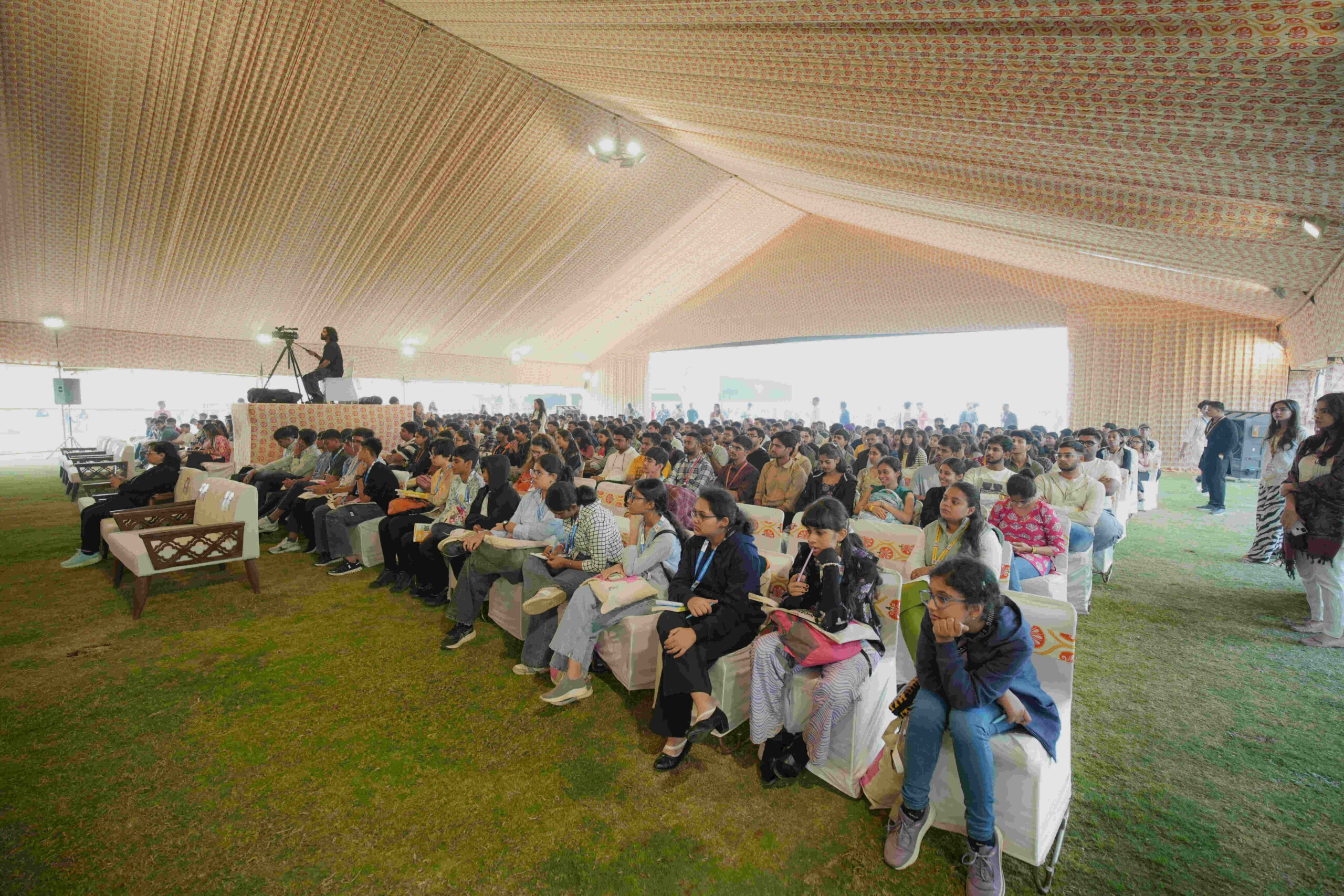
There is a version of corporate wisdom that deals in abstractions: be resilient, build trust, stay authentic. It is not useless advice. But it leaves a gap – the gap between knowing what to do and understanding what it actually feels like when you do it. Kaushik Mitra’s workshop at VLF – Vadodara Literature Festival 4.0 was designed to close that gap.
The afternoon session at Parul University drew students from across disciplines – engineering, business, humanities, and the health sciences. They arrived with the questions that don’t fit neatly onto a syllabus: What do you do when you’re genuinely stuck and there is no one above you to ask? How do you build trust with people who don’t know you yet? What does resilience look like in a moment when it doesn’t feel possible?
Mitra answered them with stories. Not case studies. Stories – specific, personal, and uncomfortable enough to be useful.
Vietnam: The Story of Sixteen Failures
The workshop’s central narrative was the Vietnam incident – an IT systems failure that, in Mitra’s telling, became the most instructive professional experience of his career.
He had been posted in Vietnam when the IT infrastructure his work depended on failed completely. There was no local support. No colleague to call. No institutional mechanism for the situation he found himself in. What there was, initially, was the problem – and the instinct to be consumed by it.
He described his first response as problem-focused thinking: cataloguing what was wrong, cycling through the implications, remaining trapped in the reality of the failure rather than moving toward a response. The shift came when he asked himself a different question. Not ‘why has this happened?’ but ‘if I don’t do this, who will?’
What followed was sixteen attempts at resolution. Not sixteen minutes. Sixteen actual attempts, each one failing, each one producing a different understanding of where the problem lay and what had not yet been tried. On the seventeenth attempt, the system came back online – not just for his company, but for multiple organisations whose infrastructure had been similarly affected.
“Failure is not about falling,” he told the workshop audience. “It is about getting back up, avoiding shortcuts, and gathering learnings through longer, more meaningful paths.” The number sixteen is the detail that stays with students – not because sixteen is unusual, but because most people stop at three.
The Trust Account: Building Credibility in a World That Tests It
The workshop devoted significant time to Mitra’s ‘trust account’ framework – a model for thinking about professional credibility that he argued most institutions fail to teach explicitly.
The trust account begins with self-trust. Not self-confidence in the motivational sense – but the practical reliability of your own word to yourself. If you tell yourself you will complete something, do you? If you commit to a standard, do you hold it? The account is built or depleted by the answers to these questions, before anyone else is watching.
From there, it extends outward. Trust with colleagues is built through consistency – being the same person in private and in public, maintaining positions under pressure, following through on commitments even when inconvenient. Mitra described authenticity in terms that were deliberately not soft: “You should be the same person in an empty room as in a crowded one.” This is not about likeability. It is about legibility – being a person whose behaviour can be predicted, and therefore relied upon.
He also spoke about relationship-building as what he called the “magic sauce” of professional life – not networking in the transactional sense, but the genuine construction of trust over time. He had, he mentioned, recently taken up guitar. His earlier session co-speaker [ Apekshit Khare ] had taken up sitar in his twenties. Both used these examples to make a point about learning: there is no age at which acquiring new capacities stops being valuable, and the willingness to be a beginner in one area strengthens the character you bring to every other.
Practical applications of the trust account framework:
• Begin with self-trust: keep promises to yourself before expecting to keep them to others
• Consistency builds trust faster than any single impressive action
• Authenticity means being legible – predictable in your values – not performing openness
• Relationship-building requires time and attention, not just intention
• Learning new skills at any age reinforces the willingness to be vulnerable – which is what trust ultimately requires
The Education System’s Blind Spot: Why Brilliance Is Taught and Resilience Isn’t
The workshop’s most direct critique – and the one that generated the most conversation among students – was Mitra’s observation about what the Indian education system prepares young people for, and what it leaves entirely unaddressed.
“All of you here will fail,” he had said in the earlier session. He returned to this in the workshop with more precision. The education system, he argued, optimises for brilliance: the right answer, the highest mark, the fastest completion. These are real skills with real value. But they are not the skills that determine what happens to people in the decade after they leave campus.
What determines that is something closer to what he called resilience – the capacity to encounter failure, confusion, and uncertainty without collapsing into them. This capacity is not inherited. It is built. And it is built precisely through the failures that the education system has trained young people to avoid.
He referenced the move from Gurgaon to Chennai in his own career – the language barrier, the cultural adjustment, the initial impulse to blame the environment for his discomfort. The change that made the difference, he said, came from within: improving his communication, adapting his approach, recognising that the problem was not Chennai. This experience became a chapter of Career Edge on adaptability. But first, it was just a difficult few months during which he had to choose between resentment and growth.
“Life will take you from 7 degrees to 30 degrees and back to 5 degrees,” he told the audience. Whether the temperature is comfort, pressure, or uncertainty, the competency that matters is the ability to keep functioning across all of it. Stability is not the natural condition of a working life. The ability to function in the range – to remain useful and clear-headed across varying levels of temperature – is the real professional competency.
What Students Can Do Now: Taking the Workshop Off Campus
Workshops at literature festivals occupy an unusual space: they are more intimate than large sessions, more interactive, and more directly actionable. Mitra’s workshop was designed to leave students with something they could use – not a framework to admire, but a practice to begin.
His closing recommendations were specific:
• Start building your trust account today – with yourself, before anyone else
• The next time you fail, count the attempts rather than the outcomes
• Identify one domain – professional or personal – where you are choosing comfort over growth
• Read Career Edge for the specific chapter on adaptability that came from the Chennai experience
• Find your equivalent of learning guitar: a capacity that has nothing to do with your job but everything to do with your character
The session ended with sustained applause. But the more important sound was what came after: the conversations that continued in small clusters outside the workshop room, students comparing notes on their own versions of sixteen failures, their own trust accounts, their own Vietnams.


