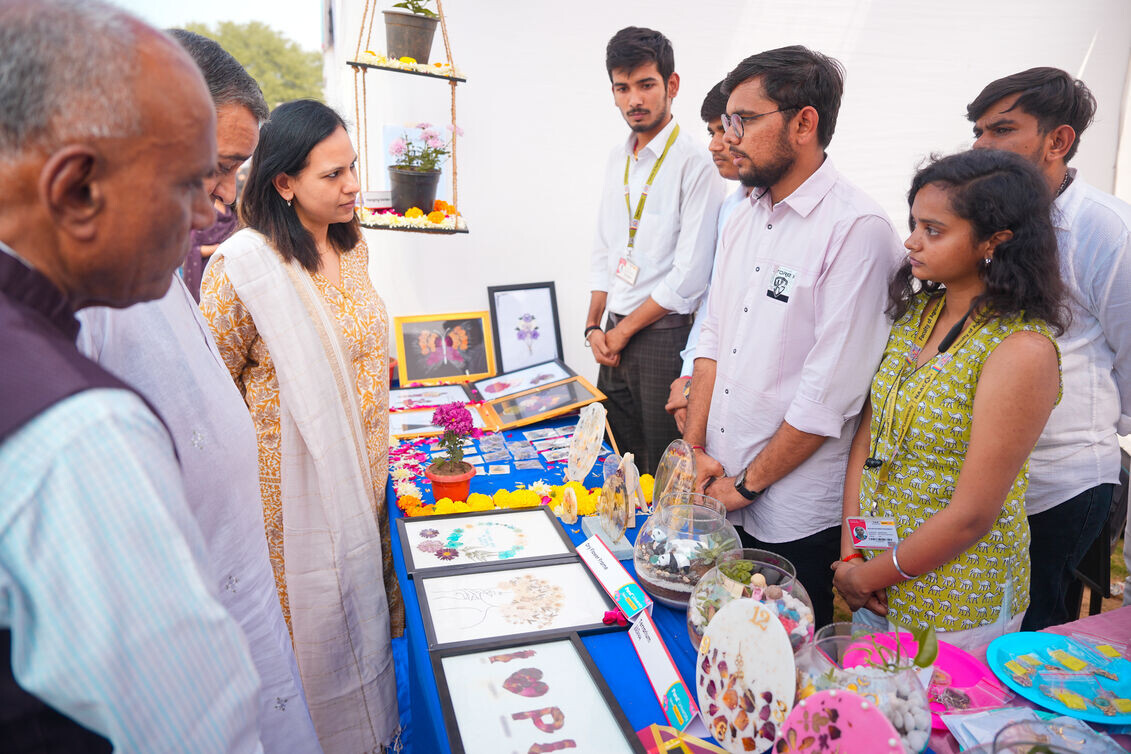
AgriFest is held every year by the Faculty of Agriculture at Parul University, and its 2026 edition marked six years of consistent growth – both in physical scale and in the depth of value it delivers to students, farmers, and the broader agricultural community. This is not a college exhibition. It is a working ecosystem where academic research meets marketplace reality, where farmers receive scientific assistance on the same campus where students develop products from raw farm produce, and where innovation is measured not in abstractions but in jars of mushroom powder, bottles of guava juice, and soil test reports handed to small-scale farmers.
Horticulture students of the Agriculture department took full ownership of the fest in terms of planning, coordination, and execution. From inviting the small-scale farmers to the guest speakers, it was they who made the event smooth. Participants witnessed ELP, which is the Experiential Learning Program. The event featured 36+ agricultural innovation pavilions from student ventures, government agencies, and established agribusinesses, including a student-managed plant nursery, and demonstrations of hydroponics, organic pest control, and sustainable farming practices.
Student Ownership: The Experiential Learning Programme Behind AgriFest
The backbone of AgriFest is student participation — not as attendees, but as organisers. The Experiential Learning Programme (ELP) engages students from the beginning to the end of the event. Horticulture students are given complete control, from creative development and planning to logistics and final execution on the day of the fest.
These practical experiences, from planning to implementation, train students in teamwork, leadership, real-world skills, responsibility, and problem-solving. It also serves as a significant value addition to the projects undertaken by students in the final year of their BSc Hons Agriculture programme.
Such fests bring together multiple streams of agriculture under one roof. Students from horticulture, irrigation, sustainable agriculture, farming, soil science, agri-based management, entomology, and organic and natural farming collaborated, demonstrating the interdisciplinary learning approach!
Value Addition: From Harvest to Market
A major highlight of AgriFest is the value-addition projects by final-year students. As part of their academic practicum, students convert raw farm produce into market-ready products – and showcase them at AgriFest. Products displayed this year included orange nectar, guava juice, multi-flavor juice, mushroom powder, pickles, millet cookies, whey-protein cookies, omega-3 enriched chocolates, and natural skincare formulations.
Every product was developed without harmful chemicals and made in college laboratories under high safety and hygiene standards. This is not theoretical research presented on a poster – it is entrepreneurial practice, where students learn how to take an idea from the lab bench to the consumer’s hands.
Soil Testing for Farmers: Science That Reaches the Field
Soil fertility is very necessary for good planting. The Soil Science Department’s contribution played an important role in soil testing; the samples were collected from the small-scale farmers who were invited to the fest. The soil was tested at the university’s on-site laboratories. Students analyzed the pH levels, electrical conductivity (EC), and nutrient composition provided by the farmers and made decisions based on the experience and data.
This initiative fills the gap between traditional agriculture and modern soil science. It gives more data based on information to the farmers through access to the diagnostic labs, and the information is largely available for commercial operations.
Expert Session: Dr. Raju M. Thakkar - The Walkman of India
AgriFest 2026 was attended by the expert Dr. Raju M. Thakkar also known as the “Walkman of India,” and a national resource person in natural farming. He focused on the immediate need to shift from chemical dependency to natural farming in Indian agriculture. The key points he gave during the session were based on the interconnection between yoga, natural food, and environmental conservation as pillars of Indian culture. He introduced the Lakshpati Farming Model, which explains the potential of up to ₹1 lakh through organic and natural farming. This is a framework to deliver chemical-free agriculture and will be economically best for small-scale farmers.
This is the National Mission on Natural Farming – Government of India directly connected to the Government of India, which aims to cluster fifteen thousand natural farms all over the country.
Innovation Beyond Soil: Hydroponics, Art, and Sustainability
AgriFest 2026 extended well beyond conventional agriculture. Students demonstrated soilless cultivation through hydroponics, resin-based art products like keychains and decorative frames, and waste-to-best models in organic farming. Organic pest control formulations like Neemastra and Brahmastra were showcased, with students educating farmers about harmful versus beneficial insects and eco-friendly pest management techniques. Additional exhibits covered honey production and silkworm farming.
The Student-Managed Plant Nursery
One of the most visually engaging sections of AgriFest was the student-managed nursery, a dedicated space showcasing indoor plants, outdoor plants, exotic and rare species, flowering plants, and tree saplings. Organized with the active participation of students pursuing BSc in Agriculture at N. M. College of Agriculture, Navsari Agricultural University (NAU), Navsari, the nursery highlighted both creativity and practical agricultural learning.
Beyond exhibition, the nursery served as an interactive learning area where visitors could gain knowledge about plant care, maintenance, and sustainable cultivation practices, while also having the opportunity to purchase live plants. Rare and high-value plants that are not typically accessible to small-scale farmers were made available to both farmers and the general public, making the initiative both educational and economically beneficial.
Farmers at the Heart of AgriFest
AgriFest is grounded in farmer well-being. Local small and marginal farmers are invited through extensive outreach programs, and the fest carries a powerful empathetic message: you are not alone. Students and Faculty of Agriculture – Parul University come together to provide scientific assistance – including organic input solutions suitable for specific crop challenges such as banana farming – and to connect farmers with resources they would not otherwise access.
The fest is closely linked to an ongoing Extension Education initiative, under which students visit villages, conduct field surveys, build personal connections with farmers, identify grassroots-level challenges, and provide solutions or connect farmers with experts. Students act as a bridge between academic knowledge and field realities.
PIERC: From AgriFest Ideas to Viable Enterprises
AgriFest aligns strongly with the Government of India’s Mission Organic initiative. Students with innovative ideas in organic and sustainable agriculture are supported through financial grants, mentorship, and technical guidance – facilitated through the PIERC – Parul Innovation & Entrepreneurship Research Centre. PIERC connects students directly with industry stakeholders, enabling ideas showcased at AgriFest to evolve from prototypes into viable commercial enterprises.
FAQ - AgriFest 2026 at Parul University
1. What is Parul University's AgriFest?
AgriFest is an annual fest conducted by the Department of Agriculture at Parul University. This is the sixth year since its inception. The fest has free soil testing, innovation, expert sessions, and a student-managed plant nursery. Also, it gives practical learning through the Experiential Learning Program (ELP).
2. When was AgriFest 2026 held?
AgriFest 2026 was held on Friday, 6 February 2026, at the Parul University campus in Vadodara, Gujarat.
3. Who was the chief guest at AgriFest 2026?
Dr. Raju M. Thakkar, known as the 'Walkman of India' and a national resource person in natural farming, was the chief guest. He spoke about the Lakshpati Farming Model and the shift from chemical to natural farming.
4. Does Parul University offer agriculture courses?
Yes. Parul University's Faculty of Agriculture - the first private agricultural college in Gujarat - offers a 4-year B.Sc. (Hons.) Agriculture program covering soil science, horticulture, plant biotechnology, agribusiness, and sustainable farming. The faculty is designated as a Centre of Excellence by the Government of Gujarat.


