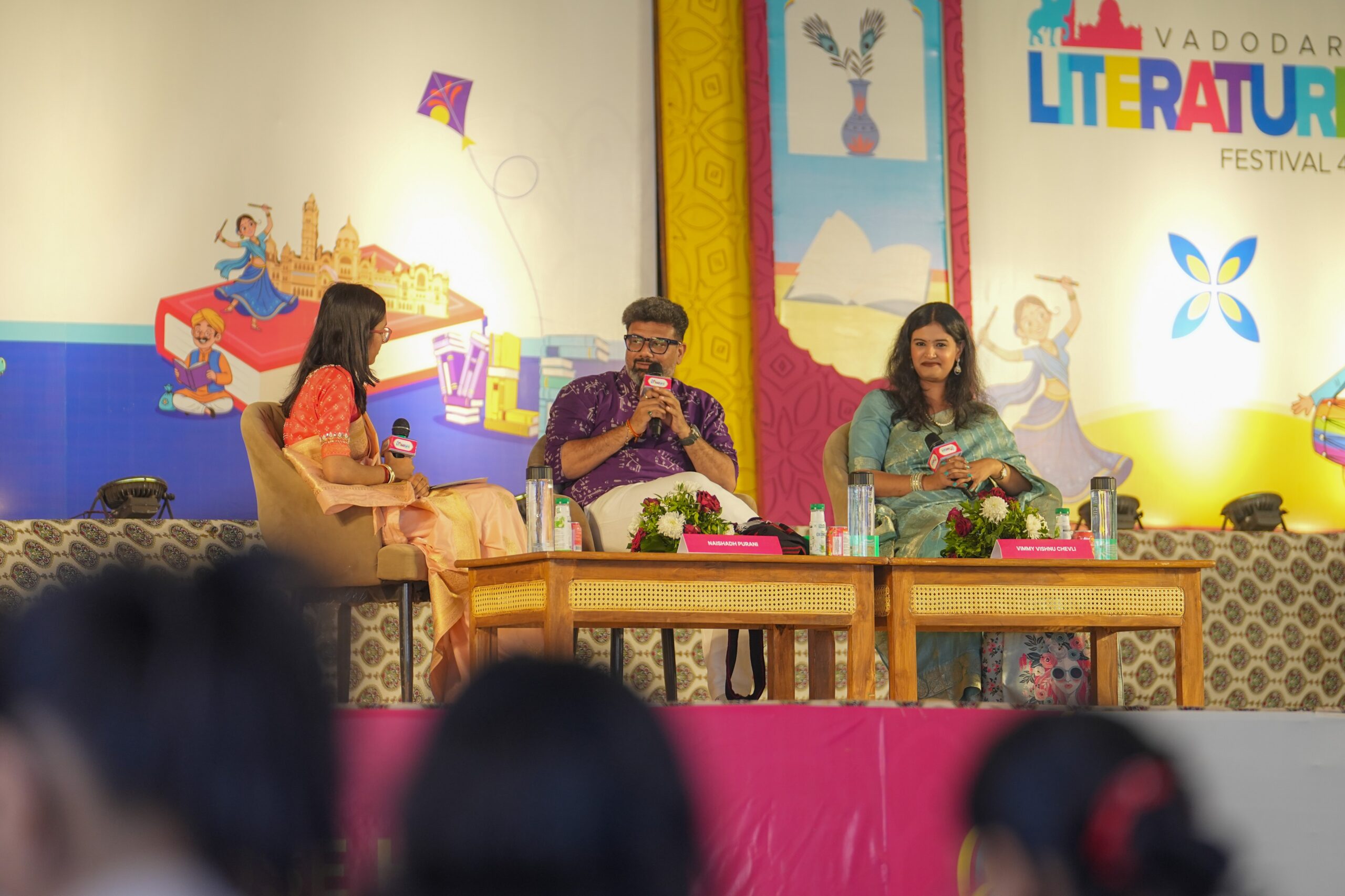
The session opened on January 28, 2026 with a provocation the audience recognised immediately: in an era of nine-second attention spans and infinite scroll, what chance does a long-form story have?
Vimmy Vishnu Chevli answered first. ‘Concentration’, she said, “is a choice – not a capacity that some people have and others don’t.” She spoke about growing up listening to long stories from her parents, how that practice naturally built her ability to focus, and how she is actively doing the same with her seven-year-old son. The attention span is a muscle. It weakens when untrained and strengthens when used. A generation raised on short-form content has not lost the capacity for sustained attention. It has simply stopped exercising it.
Naishadh Purani, whose weekend radio show Mehfil has built a devoted audience through the power of conversation alone, pushed the argument further. Humans, he said, are naturally conditioned for long conversations. The intimacy, the layered meaning, the emotional resonance that builds across a long narrative – these are not features of a format that technology has made obsolete. They are features of human connection that technology has temporarily displaced but cannot replace.
His challenge to the students was specific: see your attention span not as a fixed limitation but as an active challenge. The ability to sit with a story for two hours, to let it build, to experience the accumulation of meaning that short-form content structurally cannot provide – this is a skill worth developing. Not for its own sake, but because the emotional experiences it enables are qualitatively different from anything a reel can offer.
Radha Krishna na Prem Patro: The Mythological Gap as Creative Freedom
Vimmy Vishnu Chevli’s book – Radha Krishna na Prem Patro, or Radhakrishna’s Love Letters – is the kind of literary project that requires a particular form of creative courage. It imagines the eternal romance of Radha and Krishna as an epistolary exchange: love letters between two figures whose actual words are not recorded in any canonical text, written by an author who must inhabit both voices with sufficient conviction that the reader forgets the letters are imagined.
She explained her approach through what she calls the ‘mythological gap.’ “Radha is not described in detail in the ancient texts – her presence is everywhere in devotional literature, in Mirabai’s bhajans, in Surdas’s poems, in the Bhagavata Purana’s accounts of the gopis – but the specific texture of her inner life, her voice, her way of expressing love and separation, is largely unrecorded. This gap, which might seem like a limitation, is actually the space in which genuine creative work becomes possible.”
She bridged the gap with modern emotional themes – viraha (separation longing), surrender, and devotion that exists independently of physical presence – themes that connect directly with the emotional lives of young readers in ways that more literal mythological retellings often cannot. The book is, she told the audience, completely based on imagination. But while reading, it feels entirely real.
The reason Gen Z is particularly drawn to Lord Krishna, she observed, is that his personality is multifaceted in a way that maps onto contemporary complexity. He is a lover and a warrior, a trickster and a philosopher, a deity and a very human figure navigating difficult choices. He is, in the language the audience immediately understood, relatable. The most ancient figure in the pantheon is also, in some ways, the most modern.
Mehfil: What a Radio Show Taught About Human Connection
Naishadh Purani’s path to literary recognition was unusual. He is an RJ – a radio jockey – whose weekend show Mehfil (the word means ‘gathering,’ a space where people come together to share stories and experience) began as a risk. He launched it on weekends, when conventional wisdom said audiences wanted rest, not radio. He was wrong about conventional wisdom. The audience came.
He described the specific moment he understood what he had built. A person he admired deeply told him, without prompting, that they loved listening to Mehfil. The praise was not for his performance or his voice. It was for the feeling the show created – the sense of a gathering, of being in a room with people who were sharing something true. That feedback told him his instinct had been right: the form of the gathering, not just the content, was what people were responding to.
His book – a collection of life-experience essays from his years as an RJ – emerged from the same impulse. The radio show had created connection through voice and conversation. The book attempted to create the same connection through the written record of what voice and conversation had taught him. Mehfil with Naishadh is not a novel or an essay collection in the conventional sense. It is, as he described it, life-oriented: rooted in the specific texture of ordinary human experience, in the questions that a 5-year-old and a 45-year-old can both ask, and in the unexpected depth of what people reveal when they feel genuinely heard.
The insight that running Mehfil had given him – that the person telling the story matters as much as the story itself – is one that applies far beyond radio. Stories told by someone near to your heart land differently than the same stories told by a stranger. The craft of storytelling is, in part, the craft of becoming someone the audience wants to be near.
Reading as the Foundation: Where to Start and Why It Matters
The session’s most practically useful passage for students came when both panellists addressed the question of how to build a reading habit when you have not yet found your way into literature.
Naishadh’s prescription was gentle and specific: start with what genuinely interests you. Do not begin with what you feel you should read. Do not force yourself into heavy philosophical texts before you have found the pleasure that reading can produce. If you love fiction, start with a small fiction book. If you love short stories, begin with Dhumketu Ni Shretha Vartao – the best stories of Dhumketu, a Gujarati literary pioneer whose writing is among the finest entry points into the tradition and whose stories are short enough to finish in one sitting, rich enough to stay with you for weeks.
The logic is simple: reading builds its own momentum once it begins. The reader who starts with what genuinely interests them discovers, in time, that they have developed the tolerance and the taste for more demanding work. The person who forces themselves into heavy literature before they are ready often abandons reading entirely. The goal is not to read the right things immediately. It is to build the habit first, and let the taste develop from there.
Vimmy introduced her Point System – a self-accountability framework she originally developed for her child and then found herself applying to her own creative practice. The system is simple: reward good work and record mistakes. The act of self-accounting, of maintaining an honest ledger of what you have done well and where you have failed, builds the kind of disciplined self-awareness that a creative career requires. She urged students to ‘point yourself’ – to be as honest with themselves about their creative development as she is with her son. Key takeaways from the Gujarati Panel:
- Concentration is a choice and a muscle – build it deliberately rather than accepting algorithmic erosion as permanent
- Long-form stories create emotional depth that short-form content structurally cannot – seek them out
- The ‘mythological gap’ is creative freedom: what texts don’t say is where original imagination lives
- Krishna’s multifaceted personality is relatable to Gen Z precisely because complexity resonates with complexity
- Start reading with what genuinely interests you – start with Dhumketu if you haven’t begun Gujarati literature yet
- The Point System: hold yourself accountable with a personal ledger of what you do well and where you fall short
- In storytelling, WHO is telling the story matters as much as the story itself – build the reader’s trust in you
Authenticity, Phones, and the First Step of Any Revolution
The panel’s closing message was one that had been building throughout the session, and that the audience had already begun to demonstrate without being asked. Several students who had arrived with phones in hand had put them away during the conversation about attention spans. Others had stopped taking notes and simply listened. The irony was quiet and precise: a session about the power of sustained attention had, without coercion, produced exactly that.
Naishadh closed with the observation that had guided the Mehfil show from the beginning: if you speak with authenticity, you will never be alone. The audience for genuine human expression does not disappear. It waits, distracted but not destroyed, for the person willing to offer it something real.
Vimmy closed with an insight about starting: the hardest part of any revolution – literary, entrepreneurial, personal – is simply the first step. The dots of your life will connect, she told the students, but only if you have the discipline to keep drawing them. The connection comes later. The drawing must begin now.
For students sitting in Chanakya’s Courtyard who had arrived skeptical that a panel on Gujarati literature could offer them anything relevant to their contemporary lives, the session had made a quiet argument: the tradition that produced Narsinh Mehta, Mirabai, and Dhumketu is not a relic. It is a living resource, tended by practitioners who understand both its depth and its most natural contemporary audience – a generation that is, in more ways than it has been told, ready for exactly the stories it has been too distracted to find.


