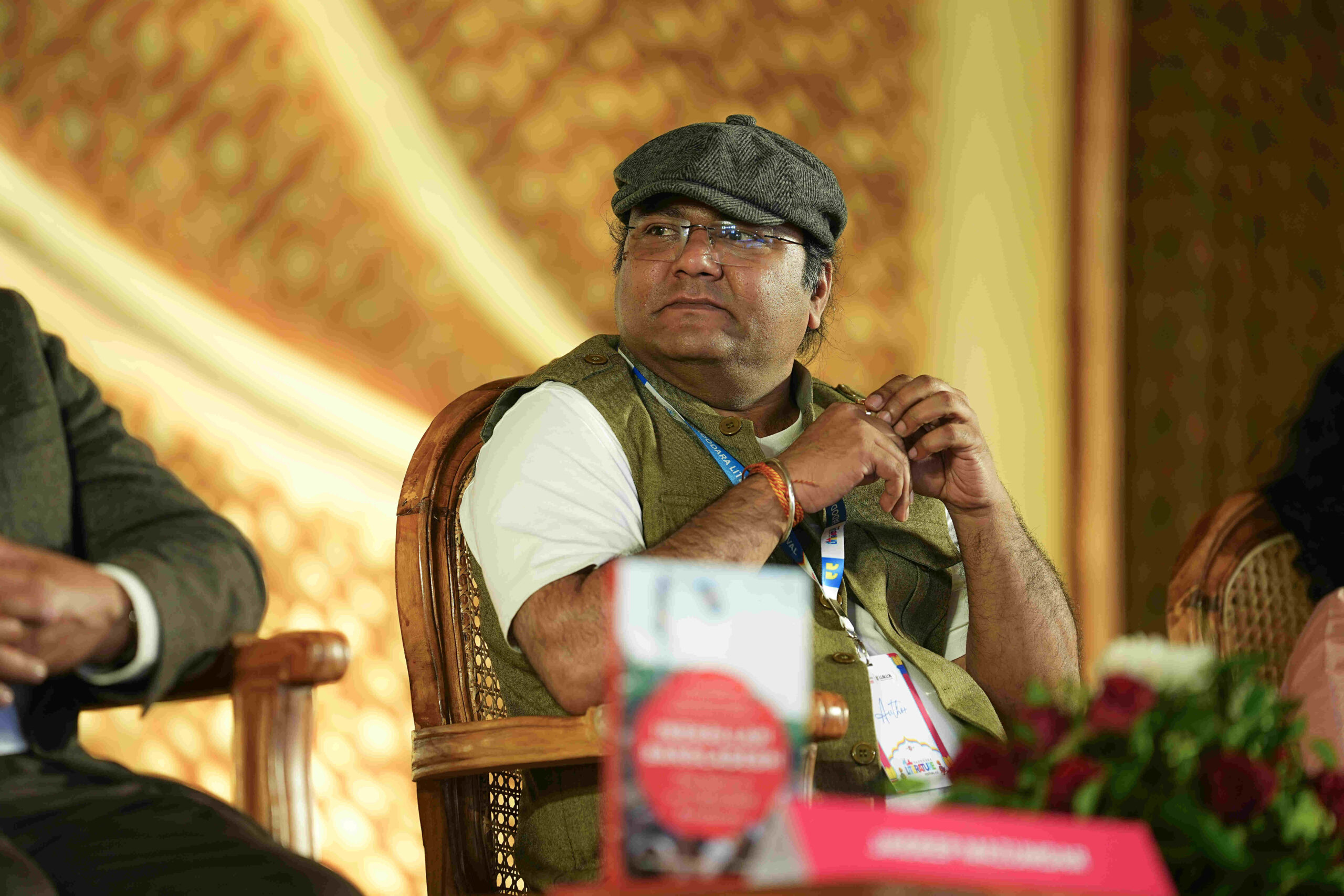
The panel that gathered at Vivekananda’s Vedanta Bhavan on January 27, 2026, looked, from the outside, like a study in contrast. Geet Chaturvedi, a Hindi poet and novelist whose work has been translated into global literary circuits. His novel Simsim won the PEN/Heim Translation Fund Grant and was longlisted for the JCB Prize for Literature.
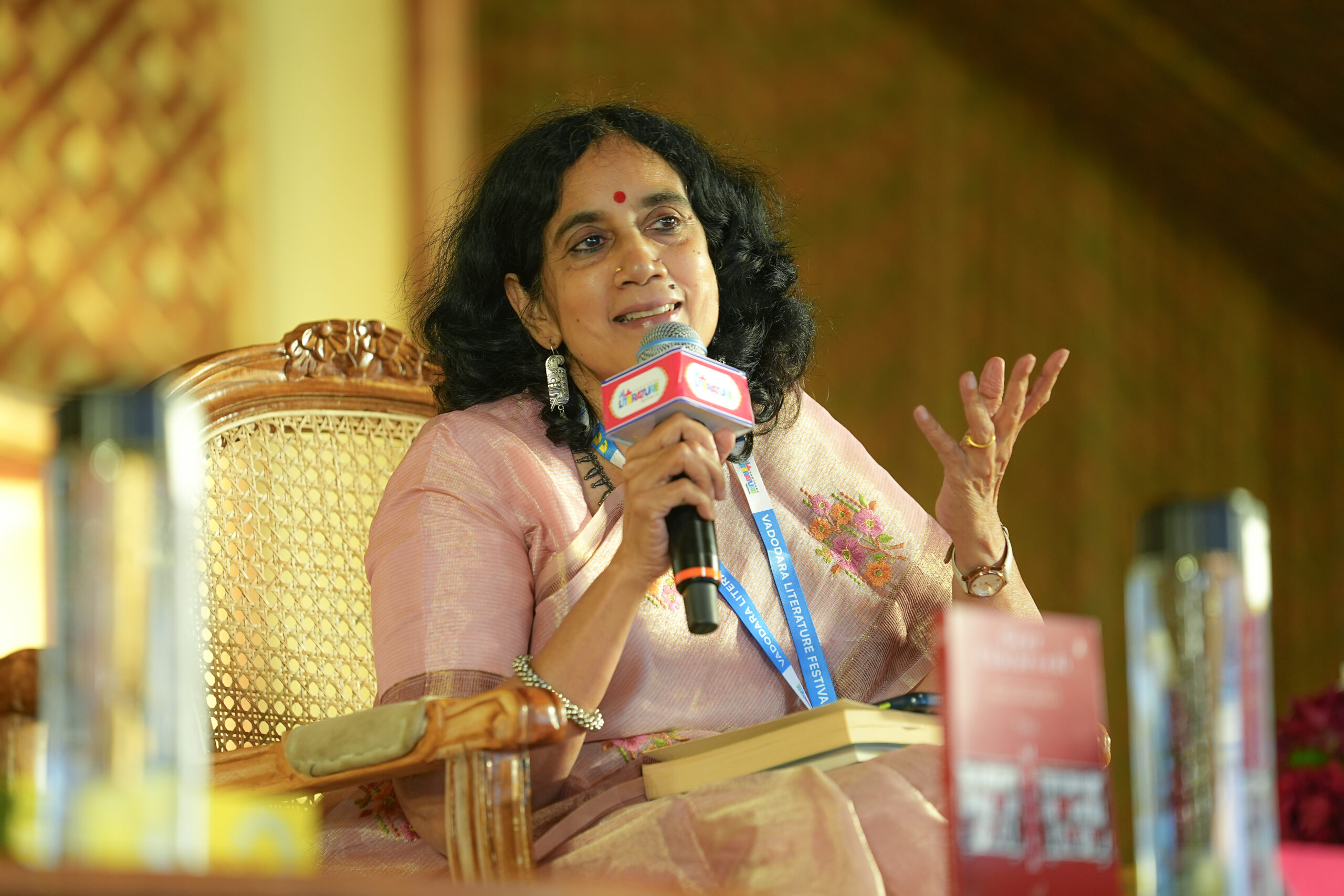
Dr K. Srilata is a professor of literature at IIT Madras. Her debut novel was longlisted for the Man Asian Literary Prize, and her recent work focuses on disability, gender, and the “unseen” perspectives of the Mahabharata
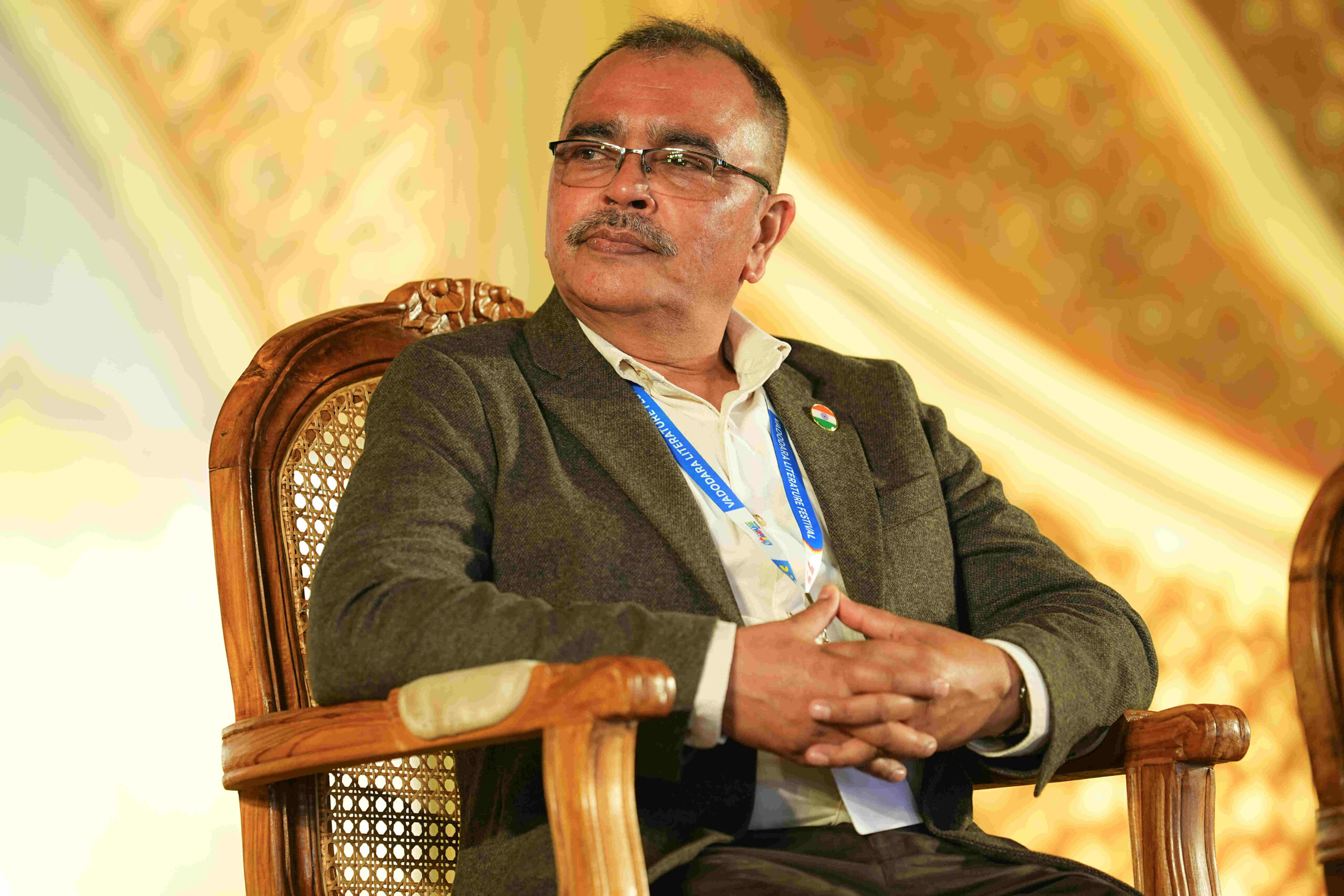
Jaideep Mazumdar is a political journalist and veteran correspondent. His most recent book, Inshallah Bangladesh, is a firsthand account of the 2024 student uprising that ended the Sheikh Hasina government.
What connected them was the central theme of the session, framed in Chaturvedi’s opening statement: “Language is the light through which we see the world; without it, we have no lens.”
The panel’s argument – developed across an hour of discussion and audience interaction – was both literary and political: that India’s diversity is not a logistical challenge to be managed. It is a resource to be engaged with, and regional literature is where most of that resource lives.
The panel was moderated by Kahani Shah, an anchor whose skill at connecting technical literary discussion to the lived concerns of a student audience was, across the session, consistently evident.
The 98% Problem: Why Translation Is Not Optional
Dr. Srilata opened with a statistic that grounded the panel’s most abstract claims in concrete reality: 98% of Indians speak regional languages. The corollary is that any framework of Indian literature that privileges English-language writing – as most national and international critical discourse does – is, by definition, discussing a fraction of what is actually being written, thought, and felt.
Her argument for translation was not nostalgic. It was structural: if the intellectual and emotional inheritance of India’s regional literary traditions is to be part of national culture rather than provincial sub-culture, translation is the mechanism by which that happens. But, she and Mazumdar both agreed, it must be translation done by people – not by AI. The distinction was not technological snobbery. It was an argument about what translation is for. If a translation maintains the grammatical content of a text but loses its emotional context, it becomes a cultural irony; it has not translated the book. It has produced a different, lesser book.
Mazumdar added a further dimension: his work on Bangladesh, a country where language has historically been both a political battleground and a site of profound cultural pride, gives him a particular susceptibility to what is lost when regional literary cultures are subordinated to dominant-language supremacy. The 2024 Bangladesh uprising, in his account, was not only a political revolution. It was also, in part, a cultural one.
Key arguments from the translation discussion:
• 98% of Indians speak regional languages – a national literature that ignores these is not representative
• Translation is a creative act, not a mechanical one – it requires human understanding of cultural and emotional context
• AI translation can replicate grammar; it cannot replicate voice
• Regional literature in India has produced some of the country’s most significant work – JCB Prize longlists increasingly reflect this.
Dr. Srilata: The Personal Stories That Become Literature
The panel included a sequence that was unusual for a literary discussion – each speaker describing the specific personal experience that turned them into a writer. The effect was to make visible the emotional origins of what often appears, in publication, as purely intellectual work.
Dr. Srilata spoke about raising a daughter with dyslexia – the experience of navigating a school system that responded to her child’s difficulty with complaint rather than accommodation, and the gradual understanding that her daughter’s experience was not unusual, merely unwritten. She described writing as the development of a “kinder lens” – a way of seeing that begins in personal pain but extends outward into empathy for others whose experiences occupy the margins of official narratives.
Her academic work draws on this personal history. Her exploration of disability in the context of the Mahabharata – specifically the lesser-known traditions that complicate the epic’s treatment of women, including the revelation of Draupadi’s scholarly life – is not merely an exercise in feminist revisionism. It is an attempt to recover what canonical readings have systematically overlooked. What is true of the Mahabharata, she argued, is true of most literary canons: the dominant reading is not the only reading, and the suppressed readings are often where the most complex human truth lives.
Geet Chaturvedi and the God of Unfinished Things
The panel’s most philosophically substantial passage came from Chaturvedi, who introduced a concept from his own literary practice that the audience received with what can only be described as recognition: the idea of ‘Adhoori Chizo ka Devta’ – the God of Unfinished Things.
He explained the concept with two figures whose lives are most commonly framed as stories of completion: Mahatma Gandhi, who considered his life ‘complete’ as a barrister until he began social work – at which point he understood that what he had completed was merely the first stair of a longer journey; and Rabindranath Tagore, who took up painting in his late sixties, long after he had been celebrated as one of the world’s great literary figures.
The concept is not about celebrating incompleteness for its own sake. It is about understanding that reaching a stage of achievement – finishing a degree, establishing a career, publishing a book – is not an endpoint. It is a threshold. The person who crosses it is not finished; they have simply become qualified for the next level of incompleteness.
For students in an educational environment that structurally frames completion as success – the passed exam, the earned degree, the secured placement – this reframe was among the most useful gifts the panel offered. The pressure to be finished is, in Chaturvedi’s framing, based on a misunderstanding of what a life is. Growth is a continuous cycle. ‘Complete’ is just the word we use for ‘ready to begin the next thing.’
Pain as the Origin of Writing: Three Catalysts
The highlight of the session was when speakers shared their transformation, the experiences that led them to become writers rather than readers.
Chaturvedi shared that it was his sister who made him a writer. The death of his sister during the 1993 Bombay bombings. She had given him a pencil before she died. He writes everything, he said, through her lens – with the instrument she gave him and in the awareness that her absence created. Literature, in this account, is not primarily a career. It is a form of conversation with people who are no longer present.
Dr. Srilata described the challenges of her childhood – being raised by a single mother, going through circumstances that gave her an early familiarity with the experience of being unseen. This became the foundation for a literary perspective focused on the invisible: the perspectives, experiences, and people that mainstream narratives consistently fail to include.
Mazumdar described growing up in between ethnic conflicts in 1970s Shillong. An editor advised him to ‘shape his feelings into writing’ as a response to injustice. The advice held. His journalism – and, eventually, his books – have been a sustained attempt to give form to the complex, often violent, always human stories that political history tends to flatten into ideological categories.
What these three origin stories share is the transformation of personal wound into literary capability – the specific process by which literature justifies its claim to be more than entertainment.
What the Panel Proved About VLF – Vadodara Literature Festival 4.0’s Intellectual Range
A literature festival that includes a Regional Literature Panel alongside sessions on constitutional law, corporate resilience, and healthcare is making an implicit argument: that literature is not a separate domain of culture but the connective tissue through which all other domains become human.
The session at VLF – Vadodara Literature Festival 4.0 ended with the panelists responding to ‘Gen Z slang’ questions – correctly identifying terms like ‘Delulu’ and ‘No Cap’ with visible enjoyment – and demonstrating that the people who have spent decades thinking seriously about language have not, in doing so, become inaccessible. They have simply become more capable of recognising what language does, in any register, at any moment.
The final takeaway was the panel’s last collective statement: that revolution – in society or in a personal story – begins with the courage to be unfinished, and the stubbornness to keep writing.


