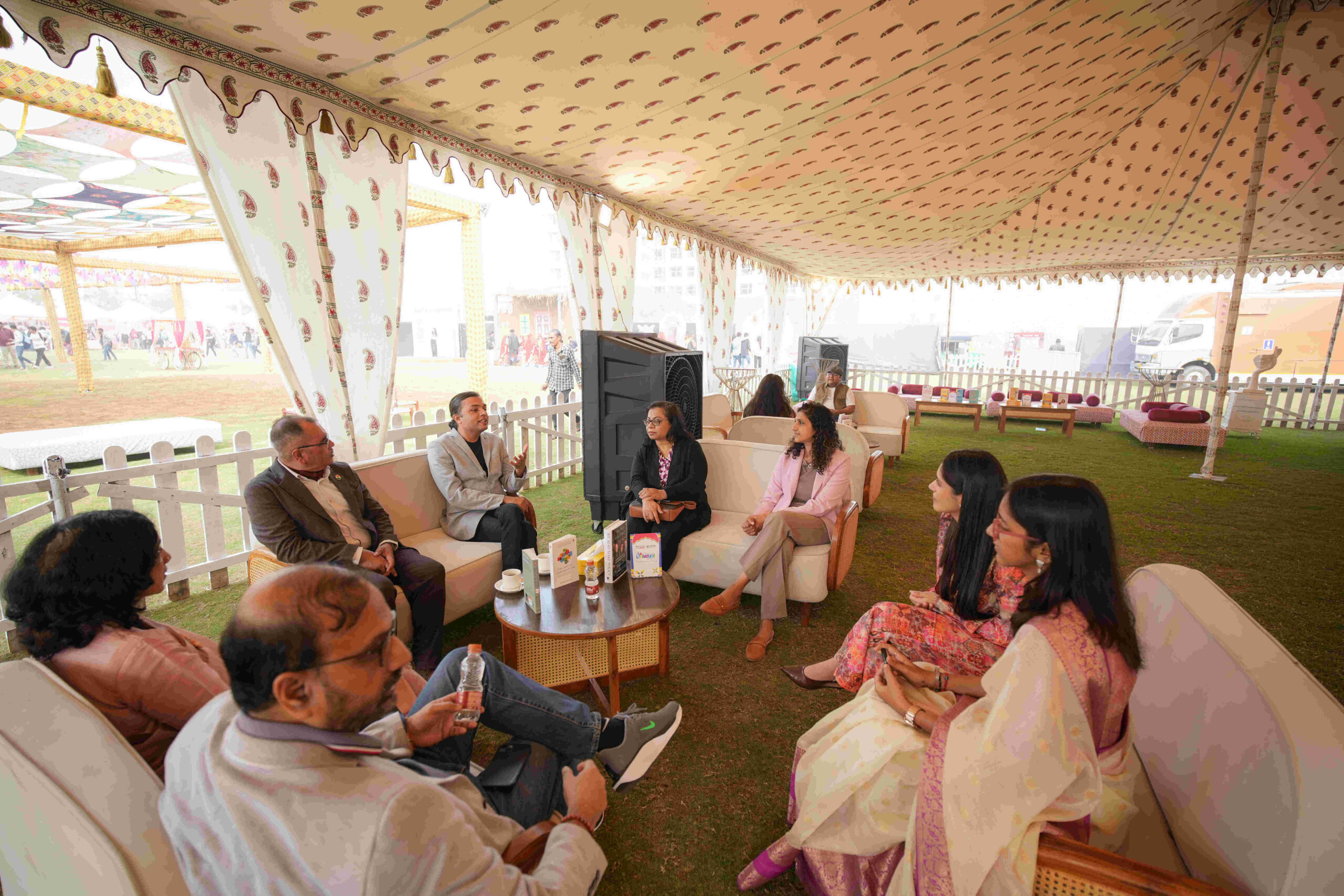
The session at Tagore’s Shantiniketan on January 27, 2026, opened with a facilitator question that cut directly to the point: Were you bored of the corporate world, which led you to become writers?
It was the kind of question that could have been dodged with practiced ease. Instead, it produced two of the most honest opening statements of VLF – Vadodara Literature Festival 4.0. Kaushik Mitra – whose career in finance has spanned 35 years and multiple countries – said simply, “I like words but got stuck juggling numbers.” Apekshit Khare – whose career in human resources has put him at the intersection of people, systems, and productivity – said the constant observation of how teams work and don’t work gave him a recurring problem he eventually needed to write his way through.
What followed was not a conversation about two books. It was a conversation about a broader cultural phenomenon: the growing number of senior professionals in India who have reached the upper levels of their industries and found that the most important things they have learned are not in any report, not on any dashboard, and not transmissible through a PowerPoint presentation.
The Trust Account: Kaushik Mitra on the Currency Nobody Teaches
Mitra’s book, Career Edge, is rooted in something he identified early in his professional journey: the absence of mentors. Without a guide, he navigated the corporate world largely by experience – including the kinds of experience that leave marks.
He introduced the concept of a ‘trust account’ to the audience – a framework that begins with self-trust and extends outward to professional relationships.
Trust, he argued, is not an automatic feature of institutional membership. It is something consciously built through consistency, authenticity, and the willingness to remain the same person whether in an empty room or a boardroom.
The incident that crystallised this for him came during a posting in Vietnam. An IT system failure left him in a professional void – no one to call, no institutional backup, no clearly mapped pathway. His initial response, he admitted, was entirely problem-focused. He was left in the reality of what had gone wrong rather than what could be done about it.
The shift came when he reframed the situation: if he didn’t act, no one would. He attempted a resolution. Failed sixteen times. Eventually solved the problem – not just for his company, but for multiple companies whose systems had been affected. The lesson was not about IT.
“Failure is not about falling. It is about getting back up, avoiding shortcuts, and gathering learnings through longer, more meaningful paths.”
The audience – largely students used to being told that failure is a stepping stone – recognised that they were hearing something more specific: a description of what that stepping stone actually feels like when you’re on it.</p.
Core principles from Mitra’s session:
• The trust account – build it consciously, with yourself first, then with others
• Authenticity is not a personality trait; it is a decision to eliminate other options
• Resilience is more valuable than brilliance – education teaches brilliance; life teaches resilience
• Growth requires discomfort: ‘Life will take you from 7 degrees to 30 degrees and back to 5 degrees.’
• Relationship-building is the ‘magic sauce’ – not strategy, not brilliance, not connections
The Time-Energy Toolkit: What Apekshit Khare Observed About How People Actually Work
Apekshit Khare‘s book, The Time Energy Toolkit, emerged from a different kind of observation – the persistent gap between the people in any team who perform exceptionally and those who merely complete tasks. As an HR professional who has spent decades watching this gap play out across organizations, Khare became interested not in the obvious question (why do some people perform better?) but in the less obvious one: what does that performance cost?
He opened his portion of the session by engaging the audience directly: How many of you have pulled all-nighters before exams? Most hands went up. His point was not to judge the practice but to use it as a diagnostic – a visible symptom of what happens when people operate without understanding their own energy cycles.
“Every individual has a unique body clock,” he explained. “Society imposes a standard clock that people follow blindly. If individuals truly understood their personal energy cycles, they would no longer need unhealthy habits like all-nighters.” His book, he said, is built around practical exercises – not motivational advice but actual experiments that help readers identify when they are functioning at their best and how to protect those periods.
He shared a personal anecdote about learning to play the sitar at 23 – not because he was musical, but because he had identified his peak energy rhythm and used it to pursue something he had previously thought was beyond him. The lesson was about self-knowledge: “Do you pause and reflect on your day? Ask yourself when you performed at your best.”
His framework for sustainable productivity:
- Time + Energy = Productivity – both variables matter equally
- Understand your personal energy rhythm before committing to schedules
- Experimentation is essential – learning happens through trying, not through caution
- Forgive yourself: ‘Only through self-forgiveness can true self-reliance be built’
- Don’t settle – keep adding new dimensions to yourself throughout your career
The Gen Z Question: Rules, Authenticity, and the HR Stereotype
The session’s most animated exchange came when the moderator posed a question that resonated with the younger majority in the room: Gen Z wants to set rules, not follow them. How can experience be brought to them?
Khare challenged the framing: the problem isn’t that Gen Z doesn’t want rules – it’s that they’ve been given too much content and not enough context. The volume of information available to young people today is unprecedented; the ability to distinguish which information is worth their attention is underdeveloped. He also challenged the stereotype, built on years of campus placements and corporate induction programs, that perfectionism and competition are simply what young people want. They don’t, he argued. They want something to believe in. They want systems worth joining.
Mitra took a different angle. He argued that Gen Z does not reject discipline – it seeks the right systems to be part of. The trust account framework he described is, at its core, a response to this: trust does not flow from authority. It flows from demonstrated values. A generation that can spot inauthenticity with unusual precision will follow authentic leaders. The challenge for institutions is to produce them.
On the question of the HR profession’s reputation – stereotyped, misunderstood, reduced to rangoli jokes – Khare was direct. The real work of human resources is not administrative. It is the most important work in any organisation: understanding what human beings actually need to function at their best, and designing systems that enable rather than exhaust them.
The moderator’s closing observation delivered the session’s most useful summary: Khare’s book is about experimentation. Mitra’s book is about experience. Both, he said, are worth reading. The room agreed.
Human resources is a field of management and interactions; a dive into it can lead to great career opportunities.
Why Corporate-to-Author Is a Cultural Shift Worth Watching
The phenomenon that Session 1 at VLF – Vadodara Literature Festival 4.0 was built around – senior professionals choosing to write books – is not coincidental. It reflects something specific about the current moment in India’s professional culture.
The knowledge that has accumulated at the upper levels of Indian industry over the past three decades – in finance, HR, operations, strategy, and beyond – has not been systematically transferred to the next generation. Business schools teach theory. Companies transfer skills through observation and osmosis. But the harder, more personal knowledge – how to navigate institutional resistance, how to build trust across cultures, how to recover from public failure, how to distinguish between the urgent and the important – lives in people’s heads, and it retires when they do.
Books like Career Edge and The Time Energy Toolkit are, among other things, an attempt to interrupt that loss. The decision by Mitra and Khare to appear at a literature festival – rather than a corporate conference or an alumni event – is itself a signal: the audience they most want to reach is not the one that already sits in boardrooms. It is the one that will.
VLF – Vadodara Literature Festival 4.0, by including this session alongside conversations on constitutional law, regional literature, and public policy, made a quiet argument: that professional wisdom is as much a part of India’s intellectual inheritance as its literary and political traditions. The students in the room seemed, by the end of the session, inclined to agree.


