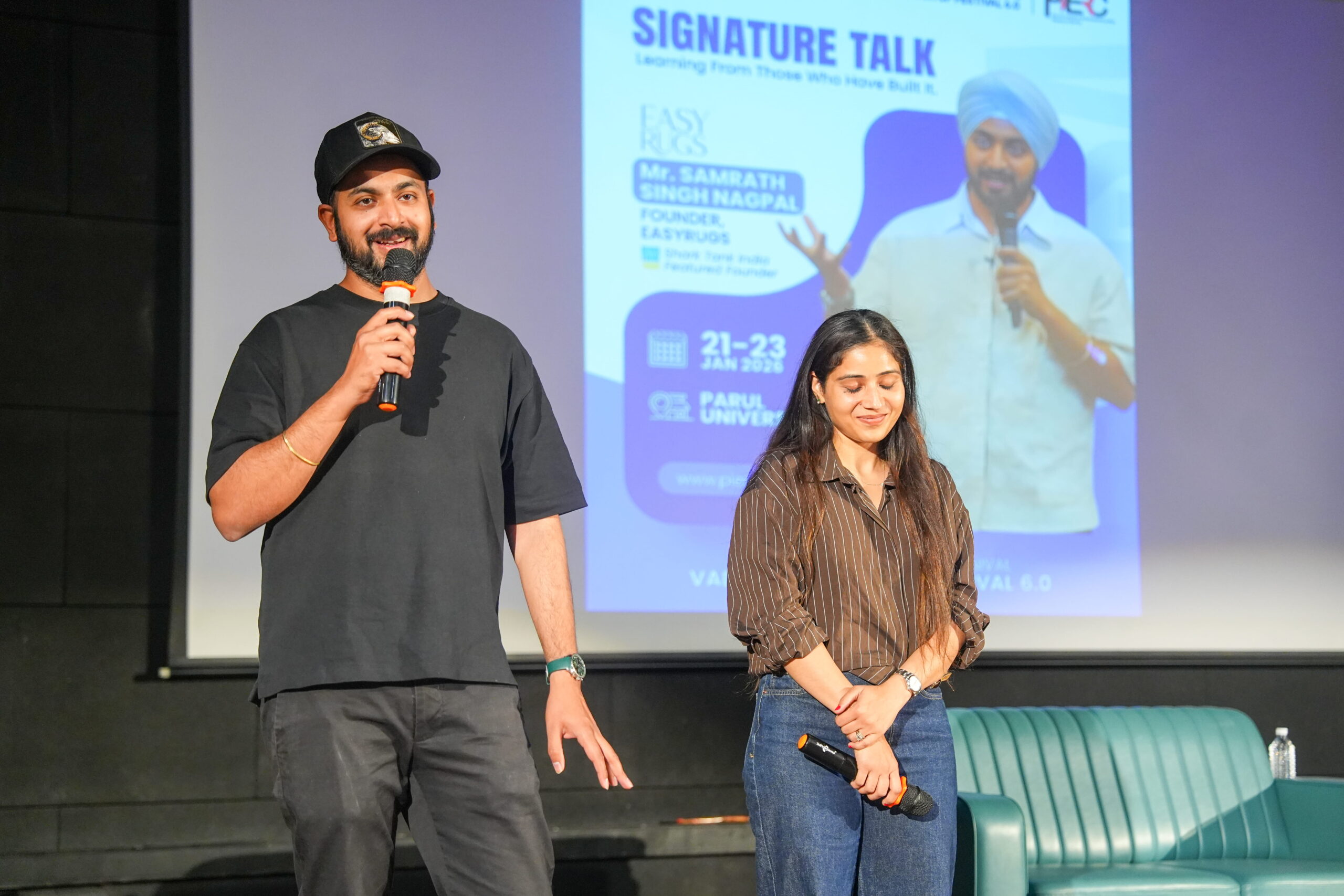

From Law to Home Décor
Samrath Singh Nagpal was trained to argue cases in courtrooms, not design rugs for living rooms.
His legal education gave him skills in research, analysis, argumentation, contract negotiation. Useful capabilities for many careers. Not obviously applicable to home décor.
His wife, Harnaam Kaur, was the interior designer. She understood aesthetics, spatial relationships, material properties, and design principles. Her expertise was an obvious foundation for décor business.
Yet EasyRugs the washable, stain-resistant, anti-skid rug company that secured ₹35 lakh for 5% equity on Shark Tank India Season 4 from Aman Gupta and Vineeta Singh required both skill sets.
Law background and design expertise.
Business operations and aesthetic vision.
E-commerce understanding and product development.
This wasn’t accidental complementarity. It was a deliberate recognition that building companies requires diverse capabilities that rarely exist in a single person.
But the real story isn’t a skill combination. It’s what happens when a lawyer-turned-entrepreneur and designer-turned-founder walk into a décor exhibition, get annoyed by what they see, and decide to build something better.
The Exhibition That Changed Everything
The décor exhibition in Delhi was supposed to be inspirational. Harnaam, being an interior designer, wanted to see the latest trends, discover new products, and meet vendors.
Samrath tagged along. He wasn’t expecting any revelations about rugs.
What they found: rugs ranging from ₹15,000 to ₹50,000. Beautiful designs. Premium materials. Expensive price tags.
What they noticed: something strange about how people displayed and photographed their interiors.
“Despite spending ₹30,000-₹40,000 on rugs, people intentionally cropped them out of photos,” Samrath observed during their VSF – Vadodara Start-up Festival 6.0 signature talk. “Rugs were integral to living spaces but rarely noticed when present. Only their absence was felt.”
That contradiction bothered them. Why spend massive amounts on something you hide in photographs?
They started researching. Talking to homeowners. Asking designers. Understanding the category.
The problems emerged clearly:
- Rugs weren’t pet-friendly – Animal hair embedded in fibers, impossible to clean thoroughly
- Rugs weren’t washable – Professional cleaning required, expensive, inconvenient
- Rugs caused slipping hazards – Anti-skid backing often insufficient, safety concern especially for elderly and children
- Rugs stained easily – Spills became permanent marks, especially problematic with children
- Rugs required constant maintenance – Vacuuming, spot cleaning, professional deep cleaning, significant time investment
Most importantly: rugs hadn’t innovated.
The market sold traditional products with traditional problems. Manufacturers focused on design variations within existing constraints rather than solving fundamental functionality issues.
Traditional product thinking: Make the rug beautiful.
EasyRugs thinking: Make the rug useful AND beautiful.
That distinction solving functionality problems rather than just adding aesthetic variations became their foundation.
The Eight-Month Development Hell
Armed with insight and irritation, they approached rug manufacturers with their vision.
Their pitch: “We want rugs that are washable, stain-resistant, anti-skid, pet-friendly, low-maintenance, and beautiful enough to photograph.”
Manufacturer response: “Here, look at our existing designs. This one’s nice. What about this pattern?”
The communication breakdown was fundamental. Manufacturers thought in terms of inventory they had. Samrath and Harnaam thought in terms of a product that should exist.
“They kept suggesting their existing products,” Harnaam explained at VSF – Vadodara Start-up Festival 6.0. “But we wanted innovation, not variation.”
Development took 8-9 months. Not because prototyping is slow. Because getting manufacturers to understand the vision was nearly impossible.
Every conversation cycle:
Them: “We want machine-washable rug materials.”
Manufacturer: “But traditional rugs aren’t washable. Customers accept this.”
Them: “That’s exactly the problem we’re solving.”
Manufacturer: “Nobody’s asked for this before.”
Them: “That’s why we’ll sell differently.”
This pattern repeated across features. Anti-skid backing that actually worked. Stain resistance that lasted through washing. Pet-friendly materials that released hair instead of trapping it.
Each innovation met resistance because it deviated from industry practice.
But Samrath’s legal training proved unexpectedly valuable. Lawyers are trained to persist through resistance, document positions clearly, negotiate through disagreements. Those exact skills applied to manufacturer negotiations.
Eventually, they found manufacturing partners willing to experiment. Months of iteration produced the first prototype that met their standards.
8-9 months from concept to prototype. Most startups would have quit. Most founders would have accepted “that’s how rugs are made.”
Samrath and Harnaam refused to compromise. Product quality was non-negotiable.
The Pricing Strategy: Affordable Luxury
With the prototype ready, the next question: how to price?
Obvious option: compete on price. Position as a budget alternative to expensive rugs. Undercut traditional markets.
They chose the opposite approach: affordable luxury.
Price points slightly below premium rugs but significantly above budget options. Signal quality through pricing while maintaining accessibility.
“We could have priced lower,” Samrath acknowledged. “But that would have diluted brand value. Instead, we encouraged customers to compare products across brands. We had confidence in what we’d built.”
This pricing strategy required specific positioning:
- Not luxury (₹40,000+ per rug) – Too expensive for mass market
- Not budget (₹3,000-5,000 per rug) – Signals lower quality
- Affordable luxury (₹12,000-18,000 per rug) – Premium features at justifiable price
The strategy works because functionality justifies premium over budget options, while accessibility justifies discount from luxury positioning.
Customers can see they’re paying more than basic rug, but understand why: machine washable, stain resistant, anti-skid, pet-friendly, design quality.
The Logistics Nightmare Nobody Warned Them About
Product development consumed 8-9 months. Website development took 2-3 months. Logistics destroyed everything.
“We completely underestimated the logistics side,” Samrath admitted with refreshing honesty during their VSF – Vadodara Start-up Festival talk. “This is what we want students to learn from: where we completely failed initially.”
The problems:
- Size – Rugs are large. Rolled dimensions often exceed standard delivery vehicle capacities. Carriers couldn’t fit multiple orders in a single trip.
- Weight – Quality materials mean significant weight. Handling difficulties increased delivery time. Some delivery partners refused heavy packages entirely.
- Packaging – Oversized packages didn’t fit through standard doorways. Required special handling. Many damages during transit.
- Last-mile delivery – Even when EasyRugs dispatched perfectly on time, delivery agents took days extra because they lacked appropriate vehicles for large, heavy packages.
- The result: Customer orders met quality promises. Shipping estimates missed reality by weeks.
Samrath and Harnaam could have blamed delivery partners. Could have told customers “not our fault.” Could have accepted logistics as an unsolvable constraint.
Instead, they completely redesigned packaging, negotiated different carrier contracts, built delivery time buffers into customer expectations, and documented every logistic failure to identify patterns.
The legal training helped again. Lawyers document everything. They track problems systematically. They build cases from evidence.
Those same practices applied to logistics optimization. Over months, they reduced delivery inconsistency from major problem to manageable challenge.
Lesson: Product excellence means nothing if logistics fails. Distribution is as important as design.
The Website as Digital Storefront
While solving logistics, they invested heavily in website development. 2-3 months of focused work.
Most entrepreneurs treat websites as a necessity checkbox. Get it functional. Move on.
Samrath and Harnaam treated it as a core business asset. Digital storefront requires the same care as physical retail would.
“If the button doesn’t work or the site loads slowly, customers lose trust,” they emphasized. “A website isn’t just a transaction mechanism. It’s a brand experience.”
Specific considerations:
- Loading speed – Every second of delay reduces conversion. Optimized images, efficient code, fast hosting.
- Navigation clarity – Can customers find what they want in under 30 seconds? If not, redesign.
- Product photography – Professional shoot with multiple angles, zoom capability, lifestyle context.
- Information completeness – Dimensions, materials, care instructions, shipping timelines, return policies everything customers might ask.
- Mobile optimization – Majority of traffic comes from phones. Mobile experience must match desktop quality.
- Trust signals – Reviews, security certificates, clear contact information, about story.
The investment showed. People frequently told them EasyRugs “doesn’t look homegrown.”
They took this as the highest compliment. Looking established without being established meant branding succeeded.
Later, they acknowledged: “We should have hired professional developers earlier. We should have used professional photographers from the start. We should have invested in professional content writers.”
Don’t shy away from hiring expertise you lack. Time spent learning web development is time not spent on business growth. Pay professionals. Focus on what only founders can do.
The Instagram-First Revenue Model
Before the website was fully operational, they received their first order.
Through Instagram.
Social media presence predated e-commerce infrastructure. They built an audience before the product was ready to sell at scale.
This sequence audience before full infrastructure seems backwards. Traditional business thinking says: build a product, create a website, then market.
Digital reality is different: Build an audience while building a product. When the product is ready, the customer base already exists.
Instagram provided:
- Visual platform perfect for design products
- Direct customer communication for feedback
- Early validation through engagement
- Zero-cost marketing during development phase
- Email collection for launch notification
First 100 orders are always the hardest. EasyRugs got those through Instagram, which provided a runway to fix logistics and optimize websites while learning from real customers.
The Hero Product Philosophy
During VSF – Vadodara Start-up Festival 6.0, Samrath shared controversial opinion:
“People say don’t put all your eggs in one basket. I say do it anyway.”
Traditional business advice warns against single-product dependency. Diversify early. Spread risk across categories.
EasyRugs did the opposite. They focused obsessively on getting one product perfect before considering variations.
All energy on hero product:
- Machine-washable functionality
- Stain-resistant performance
- Anti-skid safety
- Pet-friendly materials
- Photography-worthy design
Only after mastering that combination did they consider:
- Different sizes
- Design variations
- Material options
- Price points
Why this worked: Excellent single product builds credibility and funds expansion. The mediocre product line doesn’t.
“You need to put your best work forward,” Samrath explained. “Excellence in one thing beats adequacy in many things.”
This philosophy extended to customer service. Every review is taken seriously. Every complaint is resolved thoroughly. Every suggestion is considered carefully.
The first 100 customers determine whether the next 1,000 customers arrive.
The Branding Obsession
EasyRugs invested disproportionately in branding relative to typical early-stage startups. Micromanaged product photography: Professional photographer. Multiple angles. Lifestyle context. Consistent aesthetic.
Professional content writing: Hired writers for website copy, product descriptions, brand story. Consistent voice across platforms. Visual identity consistency: Color palette, typography, image style maintained rigorously across all touchpoints.
Most founders think: Branding can wait. Focus on the product first.
Samrath and Harnaam believed: Branding IS product. The customer experiences the brand before touching the physical product.
The investment justified itself. Strong brand presence made people assume EasyRugs was an established, non-homegrown brand.
Perception became reality. Customers trusted quality before receiving the product because branding communicated professionalism.
Shark Tank India Season 4: The Validation
Appearing on Shark Tank India provides exposure regardless of funding outcome. For EasyRugs, it provided both.
The pitch:
Home décor brand solving functionality problems traditional rugs ignore. Machine washable, stain resistant, anti-skid, pet-friendly, design quality.
The traction:
Revenue generated. Customer reviews are positive. Clear differentiation. Established manufacturing. Working logistics.
The ask:
₹35 lakh for equity percentage.
The outcome:
Aman Gupta and Vineeta Singh both invested. ₹35 lakh for 5% equity with 5% royalty until ₹52.5 lakh recovered.
Why this deal matters:
₹35 lakh for 5% implies ~₹7 crore valuation. Significant validation for home décor startup.
Aman Gupta (boAt founder) brings consumer electronics branding expertise.
Vineeta Singh (Sugar Cosmetics founder) brings beauty/lifestyle consumer brand experience.
Both built massive D2C brands. Their involvement signals they see similar potential in EasyRugs.
The royalty structure (5% until ₹52.5 lakh recovered) is actually a loan component. But at this stage, access to Aman and Vineeta’s expertise matters more than the financial terms.
The COD Challenge
After Shark Tank, discussing practical challenges, Samrath mentioned: “COD amounts are a major issue.”
Cash-on-Delivery remains popular in India. Many customers prefer paying when a product arrives rather than prepaying online.
For startups, COD creates problems:
- Cash flow: Revenue tied up until delivery completes and payment collected
- Return risk: Easy to refuse delivery, forcing return shipping costs
- Payment collection: Delivery partners sometimes delay remitting collected cash
- Fraud risk: Customers may provide fake addresses or refuse payment on delivery
Despite these challenges, refusing COD means losing a significant customer segment. Many Indian customers, especially in tier-2/tier-3 cities, still prefer COD.
EasyRugs solution: Accept COD but with clear policies. Require phone confirmation before dispatch. Set minimum order values. Build cushion for COD delays into cash flow planning.
The willingness to discuss this operational challenge rather than only celebrating Shark Tank success demonstrates maturity that many founders lack.
The Omnichannel Reality
Asked about their sales strategy, Samrath emphasized: “Being omnichannel-ready is no longer optional.”
EasyRugs sells through:
- Own website (direct, highest margins)
- Instagram (social commerce, high engagement)
- Amazon and Flipkart (marketplace reach, lower margins but higher volume)
- Offline partnerships (limited, testing)
Each channel requires a different approach:
The website prioritizes brand control and customer data.
Instagram prioritizes engagement and community building.
Marketplaces prioritize visibility and reviews.
Offline prioritizes experience and immediate gratification.
Managing all simultaneously is complex. Each platform has different fees, different customer expectations, different logistics, different communication patterns.
“Track and micromanage every channel,” Samrath advised. “One week’s inattention to Amazon reviews can hurt ranking permanently.”
This omnichannel presence accelerated after Shark Tank, when search volume for “EasyRugs” increased dramatically.
The Advice That Matters
At VSF – Vadodara Start-up Festival 6.0, Samrath concluded with advice that transcended tactical business tips:
“If you don’t use your own product, nobody will.”
Sounds obvious. Often ignored.
Founders who don’t personally use their product can’t understand user experience intimately. They rely on feedback rather than felt knowledge. They miss nuances only daily use reveals.
Samrath and Harnaam use EasyRugs in their own home. They wash them. They spill on them. They walk on them barefoot. They photograph them for social media.
Every product decision tested on themselves first.
“Remember that your product should go through you.”
Not just quality control testing. Actual usage in actual life. If you wouldn’t use it, why would customers?
“Start small and then diversify.”
Don’t launch with 50 SKUs. Launch with one perfect product. Add variations after mastering the first.
The deeper message: Excellence requires focus. Focus requires saying no to most opportunities. Success comes from doing a few things extraordinarily well rather than many things adequately.
Lessons from Lawyer to ₹35 Lakh Shark Tank Deal
1. Complementary co-founders multiply capability
Legal training + design expertise + business operations = EasyRugs. No single founder had everything needed.
2. Industry resistance reveals opportunity
When manufacturers said “customers accept traditional rugs,” that signaled unmet need, not impossible market.
3. Functionality can be luxury differentiator
Premium pricing is justified by solving problems, not just aesthetic design.
4. Logistics can destroy perfect products
Eight months on product development, but logistics nearly killed business. Distribution matters as much as design.
5. Website is brand experience, not just transaction mechanism
Investment in professional web development, photography, content writing paid dividends in customer trust.
6. Hero product focus builds credibility
Obsessive excellence in one product beats adequate performance across many products.
7. Branding precedes reality
Looking established before being established accelerates trust and adoption.
From Exhibition Annoyance to Market Validation
Samrath Singh Nagpal started as a lawyer. Not obvious founder profile for home décor startup.
But legal training provided unexpected advantages:
- Persistence through resistance
- Clear documentation of positions
- Negotiation through disagreements
- Systematic problem tracking
- Contract structure understanding
Combined with Harnaam’s design expertise and their shared willingness to question industry norms, they built something the market hadn’t seen: rugs solving functionality problems rather than just offering design variations.
₹35 lakh Shark Tank investment. 5% equity. Aman Gupta and Vineeta Singh as investors. Growing revenue. Expanding distribution.
All starting from getting annoyed at a décor exhibition.
Frequently Asked Questions (FAQs)
1. What makes EasyRugs different
Machine washable, stain-resistant, anti-skid rugs combining design and functionality.
2. How much funding did EasyRugs raise?
₹35 lakh for 5% equity on Shark Tank India Season 4.
3. Who invested in EasyRugs?
Aman Gupta and Vineeta Singh.
4. What was their biggest challenge?
Logistics and delivery management for oversized products.
5. What is their product philosophy?
Perfect one hero product before expanding categories.
Samrath Singh Nagpal and Harnaam Kaur spoke at VSF – Vadodara Start-up Festival 6.0 on January 21, 2026, at Parul University, Vadodara. EasyRugs continues expanding its washable rug line. PIERC accepts startup applications year-round: pierc@paruluniversity.ac.in | www.pierc.org
Focus deeply. Scale confidently.


