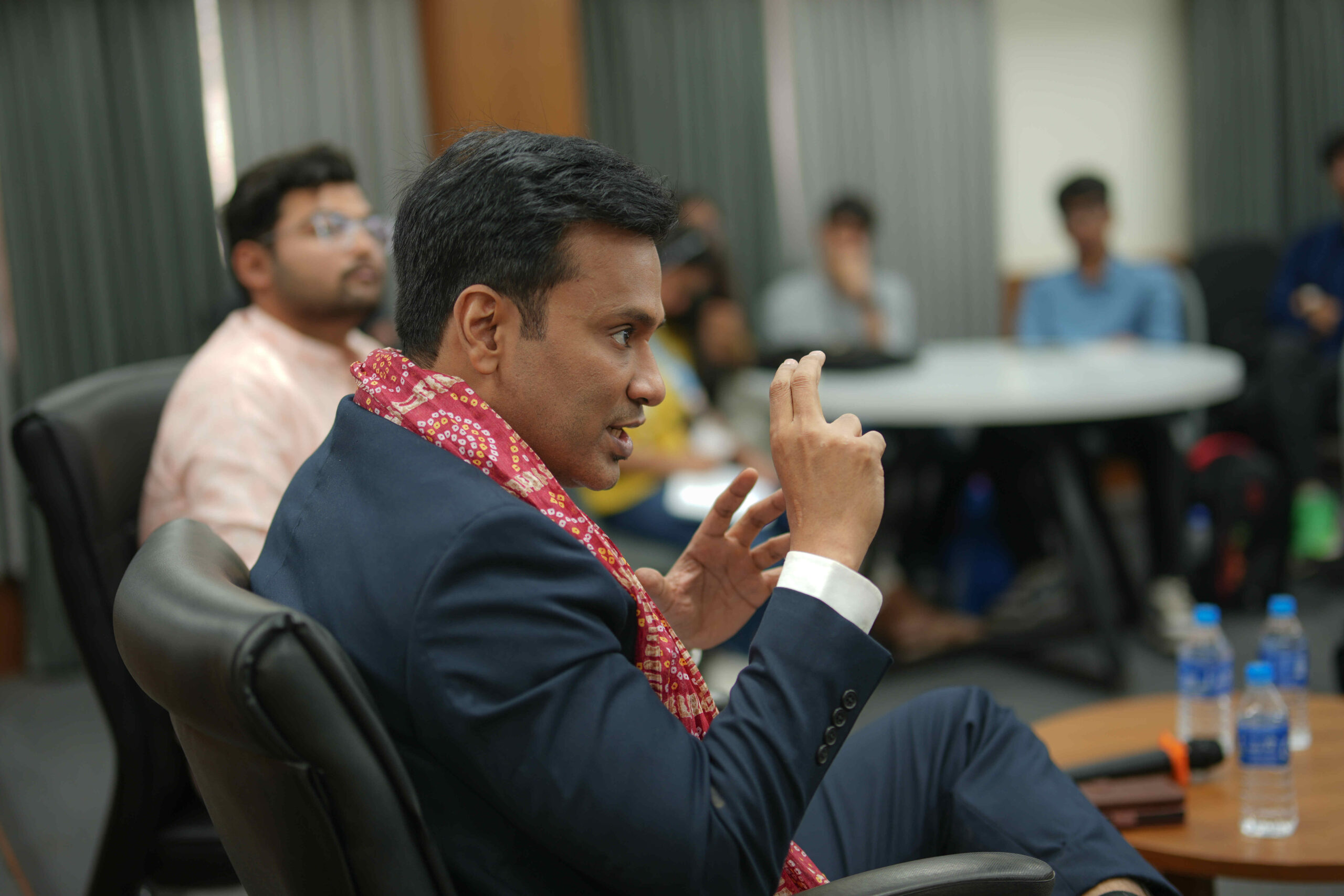
Dr. Debraj Shome‘s workshop at VLF – Vadodara Literature Festival 4.0 on January 29, 2026, did not begin the way medical education usually begins. There was no protocol, no hierarchy, no implicit instruction to be quietly attentive while authority delivered knowledge.
He walked in, looked at the medical students in the room, and asked – with a playfulness that was also genuinely curious – why they had chosen this field. Wasn’t an MBA more fun? Why were they here?
It was not small talk. It was the most important question in the room. He had asked it of himself at various points in a career that had taken him from surgical training through hospital administration, global patents – the QR678 hair growth factor is US-patented – and the direction of The Esthetic Clinics. What he had was a set of hard-won principles, and the workshop was an attempt to transmit them before the students in front of him had the experiences that would make the principles necessary.
He framed his relationship to medicine as looking at life through a ‘unique, almost artistic lens.’ The question he posed to the room – am I a profession, a vocation, or a social servant? – was not rhetorical. He was asking them to interrogate the frame through which they intended to practise.
The God Complex: What It Is and Why It Destroys Medicine
The session’s central argument was about the God Complex – the arrogance that accumulates in medical culture, particularly in surgical specialities, and that ultimately makes practitioners worse at the very thing they entered medicine to do.
Dr. Shome was specific about the mechanism. The God Complex does not begin with malice. It begins with the genuine difficulty of the work: surgeons who make consequential decisions under pressure, who are held to standards of precision that leave no room for error, who carry responsibility for outcomes that biology will ultimately determine regardless of their skill. The coping mechanism for this level of responsibility can become arrogance – the psychological defence of treating uncertainty as something beneath you rather than as the permanent condition of the work.
“Be kind,” he told the audience, “because people will forgive a human, but they will never forgive a god.” The practical implication is direct: the surgeon who maintains genuine humility – who acknowledges uncertainty to patients and families, who explains risk honestly, who treats the person on the table as a person rather than a case – builds a different quality of trust than the surgeon who projects infallibility.
He was equally direct about the biological argument for humility: a doctor cannot fight years of bad habits in a day. The patient who has managed diabetes poorly for a decade arrives at the hospital with decades of accumulated biology. Holding the surgical team responsible for the outcome of those decades is not accountability. It is displacement.
The Sula Wine Story: On Indian Medical Innovation
The workshop’s most memorable anecdote came when Dr.Shome addressed the persistent assumption in certain international medical communities that Indian medicine is derivative – that Indian doctors produce generic drugs and procedural variants, but not genuine original innovation.
He described a confrontation with a French doctor who made this assumption directly. Rather than arguing, Dr. Shome challenged him to a blind wine tasting. Three glasses, no labels. The French doctor praised the third glass enthusiastically – assumed it was European, almost certainly French.
It was Sula. An Indian wine.
The point was not about wine. It was about perception, prejudice, and the gap between assumption and reality. The QR678 hair growth factor that Dr. Shome co-invented is US-patented – a world-class medical innovation that originated in India, achieved international recognition, and reached patients globally. Indian medical innovation exists. The barrier to its recognition is primarily not its quality – it is cultural presumption. His broader instruction: ensure that what happens on a research bench eventually ends up helping the person on the hospital bed.
The Bhagavad Gita in the Operating Theatre
Dr. Shome’s use of the Bhagavad Gita as a framework for surgical ethics was among the session’s most philosophically rich and practically grounded passages.
The Gita’s central instruction to Arjuna – to focus on the action, not the fruit; to perform your duty without attachment to the outcome – translates precisely into a surgical ethical position. A doctor’s responsibility is the action: the diagnosis, the surgery, the prescription, the aftercare. The outcome is governed by biology, by the patient’s history, by factors that no degree of skill or intention can fully control.
This does not reduce the surgeon’s accountability – it clarifies it. Accountability for the action is complete and non-negotiable. Accountability for biology is neither possible nor appropriate. The confusion of these two things – holding doctors accountable for outcomes that biology determines – produces both the God Complex (the physician who pretends to control what cannot be controlled) and the murderer narrative (the family who holds the physician responsible for what biology determines).
“Biology is never sure, but your intent must be,” he said. “Stay human, stay kind, and remember that respect is earned, never demanded.” Practical principles for aspiring doctors from the workshop:
- Humility is not weakness – it is the clinical accuracy of acknowledging uncertainty
- Moral injury is systemic, not personal – recognise the difference between your failures and the system’s
- Explain every risk honestly before any procedure – respect is built on transparency
- Innovation must end in patient benefit – the bench and the bed are part of the same responsibility
- Stay human: technology can accelerate a process, but it cannot replace compassionate medicine
- Your intent must always be positive – that is what you are accountable for
Key Takeaway - What Keeps the Moral Compass Steady
The workshop’s interactive portion produced the exchanges students most wanted – direct, unguarded responses to the questions they had not been able to ask in more formal settings.
On handling vicious criticism: he acknowledged it exists, does not disappear, and must be navigated with discernment. Not every criticism of a medical outcome is evidence of error. Some are evidence of grief, of misunderstanding, of a cultural expectation that doctors can prevent death.
On the dopamine-driven pressure for cosmetic surgery among young people: he spoke about the practice of referring patients to counselling rather than proceeding with requested procedures. Some twenty-year-olds seeking surgery are responding to social media-driven insecurity rather than genuine medical need or informed choice. Sending them to counseling means some patients call him ‘mad.’ He is unbothered.
On the non-linear nature of a medical career – drawing from Steve Jobs: the dots only connect in hindsight. His path from surgery through administration through innovation through writing and public advocacy does not look planned from the inside. From the outside, retrospectively, it looks like a coherent expression of what he values. The session ended, as it began, with a question: not ‘what will you become?’ but ‘why are you here?’ – and the instruction to keep asking it, throughout a career that will continue to change.


