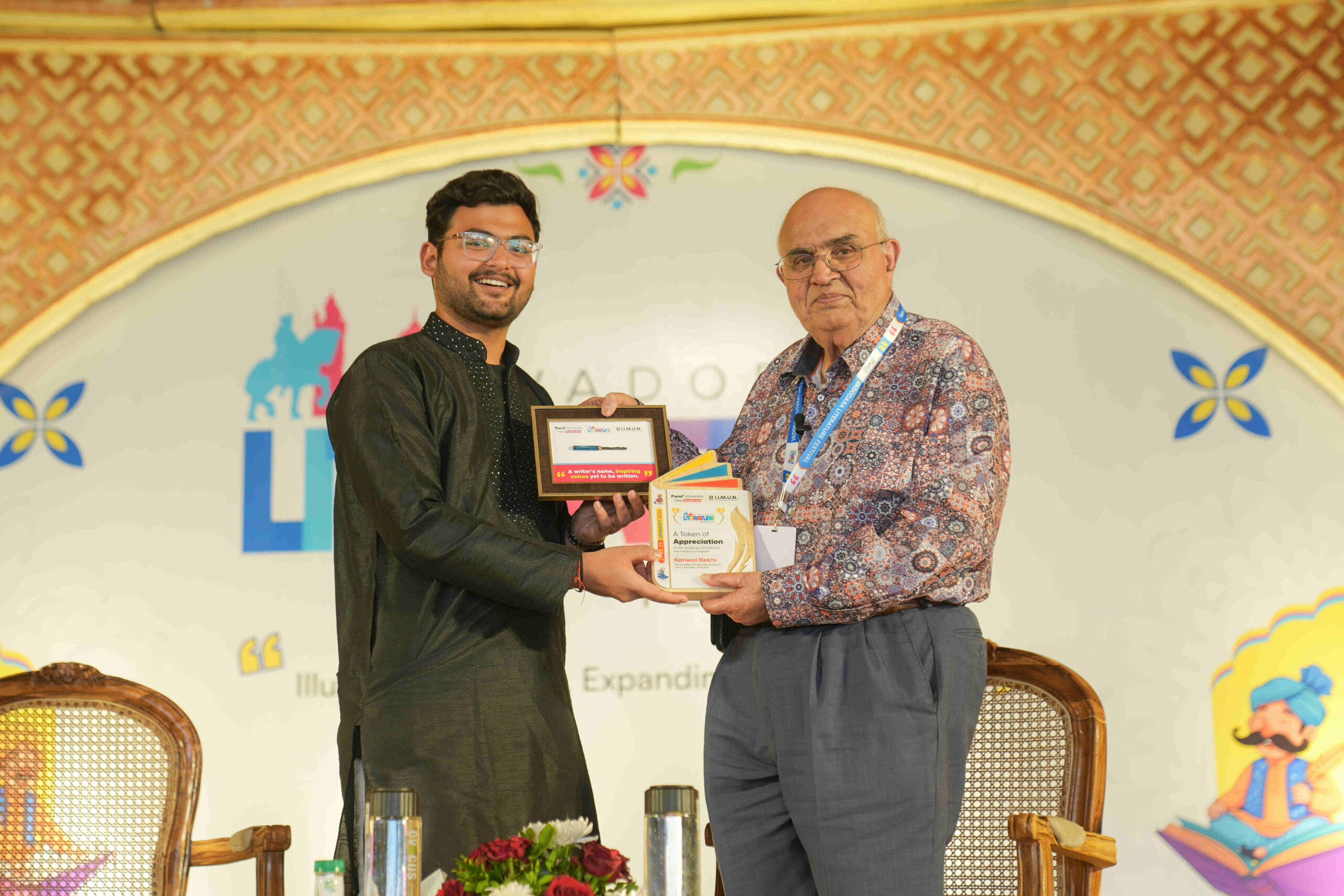
Before Silicon Valley became a destination for Indian engineers and entrepreneurs, before TiE – The Indus Entrepreneurs – existed as a global network for founder mentorship, before the arc that has placed Indian-origin CEOs at the helm of major global technology companies, there was a moment when all of this was not yet possible.
Kanwal Rekhi helped make it possible. In 1992, he became the first Indian-American to take a Silicon Valley company public. The significance of that milestone was not primarily financial – though it was that too. It was a proof of concept: that an Indian professional could not just work in American technology but could build and lead a company at the highest levels of the industry. He went on to co-found TiE, which became a global network supporting Indian entrepreneurs across generations, providing mentorship and funding to founders at every stage.
When Rekhi arrived at VLF – Vadodara Literature Festival 4.0 on January 28, 2026, for his session at Vivekananda Vedanta Bhavan, he arrived as something rare: a person who had actually done the things that are usually only discussed at sessions like this one.
The Session Nobody Expected
The students who gathered for Rekhi’s leadership session expected the conventional form: career advice, startup wisdom, the kind of structured framework for success that Silicon Valley has exported to every corner of the world where ambitious young people gather. What they got was something considerably more personal.
Rekhi spoke about his professional journey in ways that were deliberately non-linear – not a success narrative but a genuine exploration of what he had learned, and more specifically of what he had gotten wrong. He spoke about the difference between the ambitions you carry in your twenties and the values you actually live by in your sixties. He spoke about love – specifically, the relationships that had mattered to him and the way that professional ambition, left unchecked, can eat through the life you are supposedly building the career for.
And then – in one of the more memorable moments of VLF – Vadodara Literature Festival 4.0’s three days – he sang Mere Sapno Ki Rani to the audience. The choice of song was intentional. The old Hindi film number, with its images of longing and pursuit, is about wanting something you have not yet reached. For a man who has spent decades mentoring the next generation of Indian entrepreneurs, it was perhaps also a way of saying, “The dream is not the destination.” The dreaming is the point.
What TiE Actually Built – and Why It Matters for Students
The founding of TiE in 1992 was, in retrospect, one of the most consequential acts of diaspora institution-building in the history of Indian entrepreneurship. The organisation that Rekhi co-founded with a small group of Silicon Valley professionals has grown into a global network with chapters across five continents, hundreds of thousands of members, and a mentorship lineage that connects some of the most significant Indian-origin technology companies in the world.
What TiE built was not a funding mechanism or an alumni association. It was a culture – a set of practices and relationships that embodied the idea that mentorship is an obligation, not a favour. The professionals who had succeeded in Silicon Valley’s hostile early days had an obligation to return knowledge and access to those who came after them.
Rekhi’s own mentorship of Indian tech founders in the 1990s and 2000s – before the current generation of Indian-origin CEOs had names anyone outside the industry recognised – was part of this culture. He gave time, access, and honest feedback to entrepreneurs who needed to understand not just how technology businesses worked but how the cultural codes of American business operated, and how to navigate them without losing the perspective that being Indian gave them.
For students at VLF – Vadodara Literature Festival 4.0 – many of them building startup ideas, considering careers in technology, or wondering how to navigate the gap between Indian education and global opportunity – the TiE model offered a practical framework:
- Mentorship networks compound over time – find yours early and invest in it consistently
- The obligation to mentor is as important as the ambition to succeed
- Cultural perspective is an asset, not a liability – bring it into the work, don’t apologise for it
- Build institutions, not just companies: the most durable contributions outlast any single business
The Honest Parts: What Money, Success, and Accomplishment Don't Provide
The most durable element of Rekhi’s session was his willingness to speak honestly about what professional success does and does not deliver – a willingness that is rarer in this format than it should be.
He acknowledged that the ambitions driving a career in early-stage technology are real and legitimate. The desire to build something, to make something work, to compete and win – these are genuine motivations and they produce real results. But he also spoke about what happens after the results arrive, which is the question that most entrepreneurial conversations never get to.
Success provides resources. It provides options. It provides a certain kind of credibility that opens doors which were previously closed. What it does not provide – and what Rekhi said he had needed more than he had recognised at the time – is the quality of the relationships you build and the depth of the attention you give to the people who matter to you while you are building.
This is not an argument against ambition. It is an argument for carrying both things simultaneously – the drive to build and the awareness that what you are building is, ultimately, for the life you want to live, not instead of it. For students at the beginning of their professional journey, this reframe is valuable precisely because it arrives before the habit of deferring life becomes a personality trait.
The Song, the Room, and What It Meant
The moment Kanwal Rekhi sang Mere Sapno Ki Rani at VLF – Vadodara Literature Festival 4.0 will be retold, almost certainly, by students who were in the room. Not because it was technically accomplished. Because it was completely sincere.
A man who had built a company, co-founded a global institution, and mentored a generation of entrepreneurs stood in front of a room full of young Indians and sang a song about dreaming. The gesture said something about what his session had spent an hour arguing: that the professional achievements are real, but they are not the story. The story is what you love, what you pursue, and what you are willing to be honest about when the formal portion of the session ends.
For a festival that has consistently argued – through its programming, its speakers, its commitment to making intellectual life accessible beyond metropolitan boundaries – that literature and ideas are not separate from life but the place where life becomes most fully itself, the moment was fitting.
The students who were there left with more than career advice. They left with a question: What are your own sapne (dreams), and are you honest with yourself about whether you are actually pursuing them?


