Stroke ranks as India’s fourth leading cause of death and fifth leading cause of disability.
The financial impact is equally severe. According to Rehabveda’s market analysis, the global economic burden of stroke – including direct medical expenses, indirect costs, and informal caregiving – is projected at approximately $891 billion.
- One in four people globally will experience a stroke in their lifetime.
- A stroke occurs approximately every 30 seconds globally and every 40 seconds in India, per Rehabveda data.
- Most survivors face long-term paralysis, lost income, and reduced quality of life.
Source: Nature: Analyzing stroke burden in India using GBD data
Source: PMC: Stroke prevalence among older adults in North-East India
Why Traditional Rehabilitation Falls Short for Hand Recovery
Conventional stroke rehabilitation relies on physiotherapy – repeated physical exercises supervised by a therapist at a clinic. This approach works for large-muscle recovery (legs, arms) but consistently underperforms for fine motor hand function.
The reason is neurological, not muscular. After a stroke, the brain’s motor cortex – the region that sends movement commands to the hands – is damaged. Additionally, clinic-based rehab requires regular travel – a significant barrier for patients with mobility limitations. Hand function is typically the last movement capability restored after stroke, and for many patients, it never fully returns under conventional treatment.
Pro Tip:
For healthcare management students at Parul University, the gap between traditional rehabilitation outcomes and patient needs represents a market opportunity. Understanding why existing methods fail is the first step toward evaluating innovations like BCI-based rehab. Parul University’s health sciences and engineering programs provide the interdisciplinary foundation needed to work in this space.
How BCI Technology Activates Rehabilitation
The core principle is that when a person thinks about moving their hand, the brain produces measurable electrical activity, even if the stroke has severed the neural pathway that would normally execute that movement.
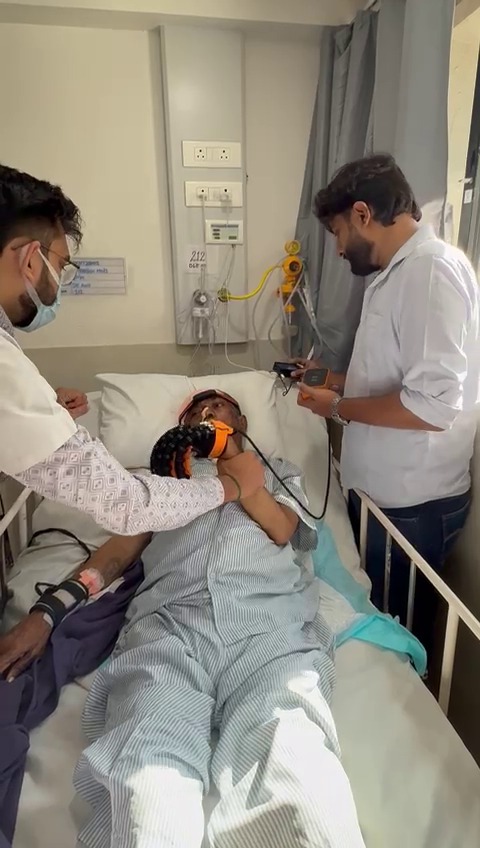
BCI rehabilitation works by closing the loop: the device detects the brain’s intention, executes the movement through a robotic aid, and the brain receives sensory feedback confirming the movement occurred. Over time, this feedback loop triggers neuroplasticity – the brain’s ability to form new neural connections and reroute motor signals around the damaged area.
EEG: Reading the Brain’s Electrical Signals
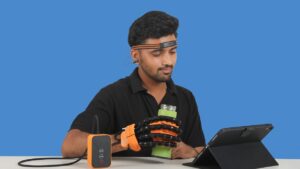
In Rehabveda’s system, dual-channel EEG sensors detect these patterns and transmit them wirelessly to an AI processing unit.
AI: Translating Intention into Action
The system adapts to each patient’s unique brain patterns over time, adjusting difficulty levels and repetition patterns based on progress.
Pneumatic Glove: Executing the Movement
It’s following this process – think, detect, move, feel. Each successful repetition reinforces the neural pathway, gradually restoring voluntary hand control.
Common Mistake:
| Assuming that stroke recovery has a fixed window. Neuroplasticity research shows that the brain can form new connections even months or years after a stroke. BCI-based rehabilitation leverages this principle – it is not limited to the acute post-stroke period. Rehabveda’s own FAQ confirms that recovery can occur even when the stroke happened years ago. |
Stroke Car in India & Globally!
India’s stroke rehabilitation infrastructure is concentrated in urban centres. Home-based BCI rehabilitation systems like Rehabveda’s R1 address this access gap by removing the need for frequent clinic visits while maintaining AI-monitored therapeutic rigour.
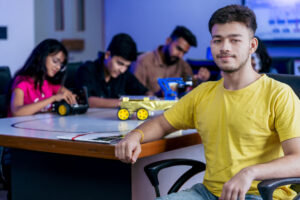
Backed by the institutional support systems like PIERC’s – Parul Innovation & Entrepreneurship Research Centre Startup Growth Pad at Parul University, it plays a direct role in accelerating the project by assisting them providing pitch deck support to end to end investor connections.
PIERC: Parul Innovation and Entrepreneurship Research Centre
Key Takeaways: Stroke Rehabilitation and BCI Technology
KEY TAKEAWAYS
- India’s stroke burden is large and growing – traditional rehab cannot address it alone.
- Hand recovery is the hardest post-stroke challenge because it requires neural retraining, not just muscle exercise.
- BCI technology closes the brain-to-hand feedback loop, triggering neuroplasticity.
- Rehabveda’s R1 System reports 80% patient improvement and clinically meaningful FMA score gains.
- Home-based BCI rehabilitation addresses India’s urban-rural access gap in stroke care.
FAQ - Stroke Rehabilitation and BCI Technology
What is BCI Technology?
It detects when a patient intends to move their hand and uses that signal to activate a robotic device that performs the movement, creating a feedback loop that retrains the brain.
Why is hand recovery so difficult after a stroke?
Stroke damages the brain's motor cortex, disrupting the neural pathways that control hand movement. Even when muscles remain functional, the brain cannot send the signals needed to activate them. Traditional physiotherapy exercises muscles but does not directly retrain the neural pathways.
What is the Fugl-Meyer Assessment?
The Fugl-Meyer Assessment (FMA) is a standardized clinical scale used globally to measure post-stroke motor recovery. The upper extremity section scores 0–66, with higher scores indicating better function. An 8-point increase - as reported by Rehabveda - is considered clinically meaningful
Is BCI rehabilitation available for home use?
Yes. Rehabveda's R1 System is designed for at-home use. The patient wears the EEG headband and pneumatic glove, with AI guidance provided through a mobile app. This removes the need for repeated clinic visits while maintaining monitored therapeutic structure.
Where can I learn more about health innovation at Parul University?
Parul University's PIERC (Parul Innovation and Entrepreneurship Research Centre) supports health-tech startups through its incubation and Growth Pad programs. The university's health sciences, engineering, and MBA programs provide interdisciplinary foundations for students interested in medical technology innovation.