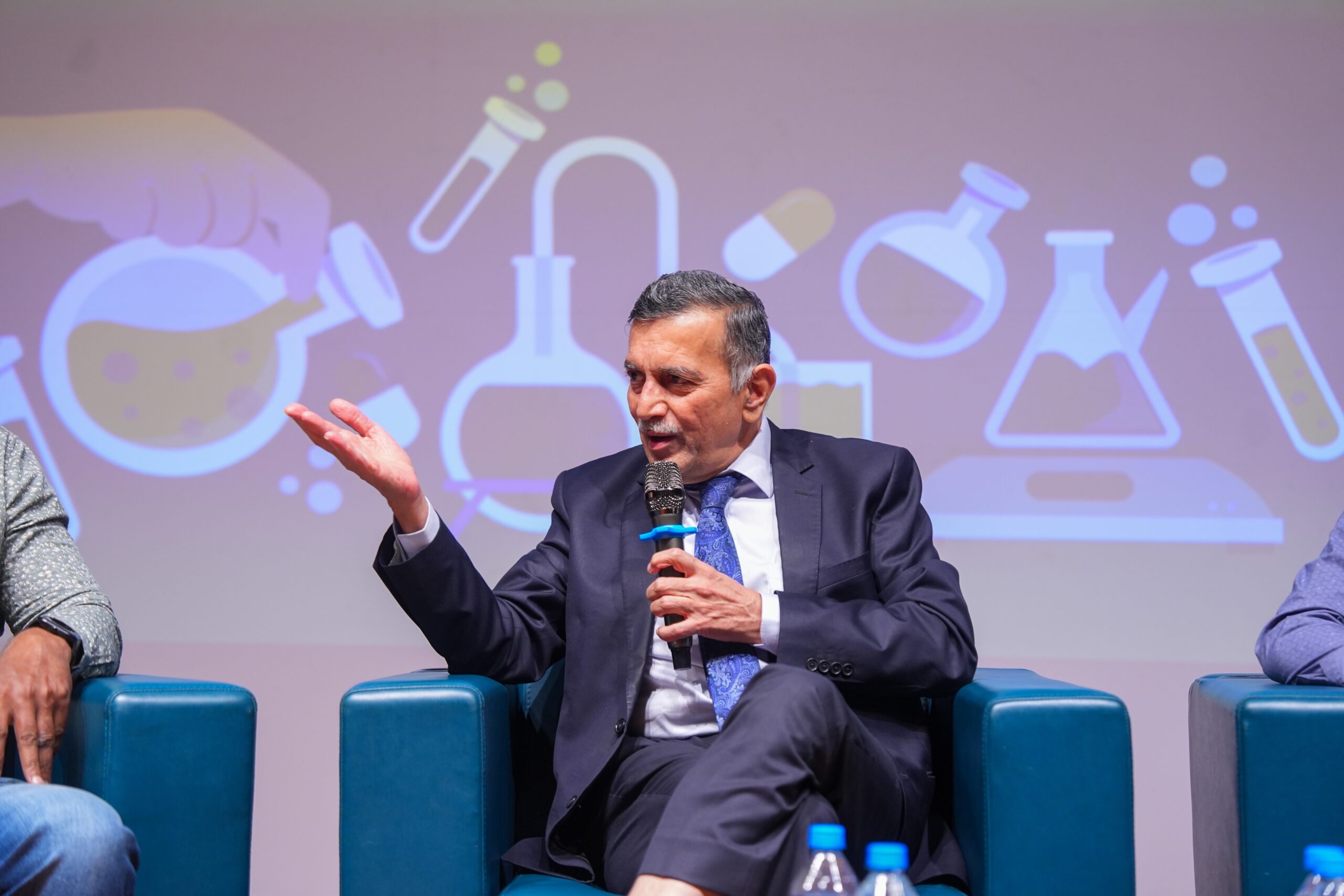
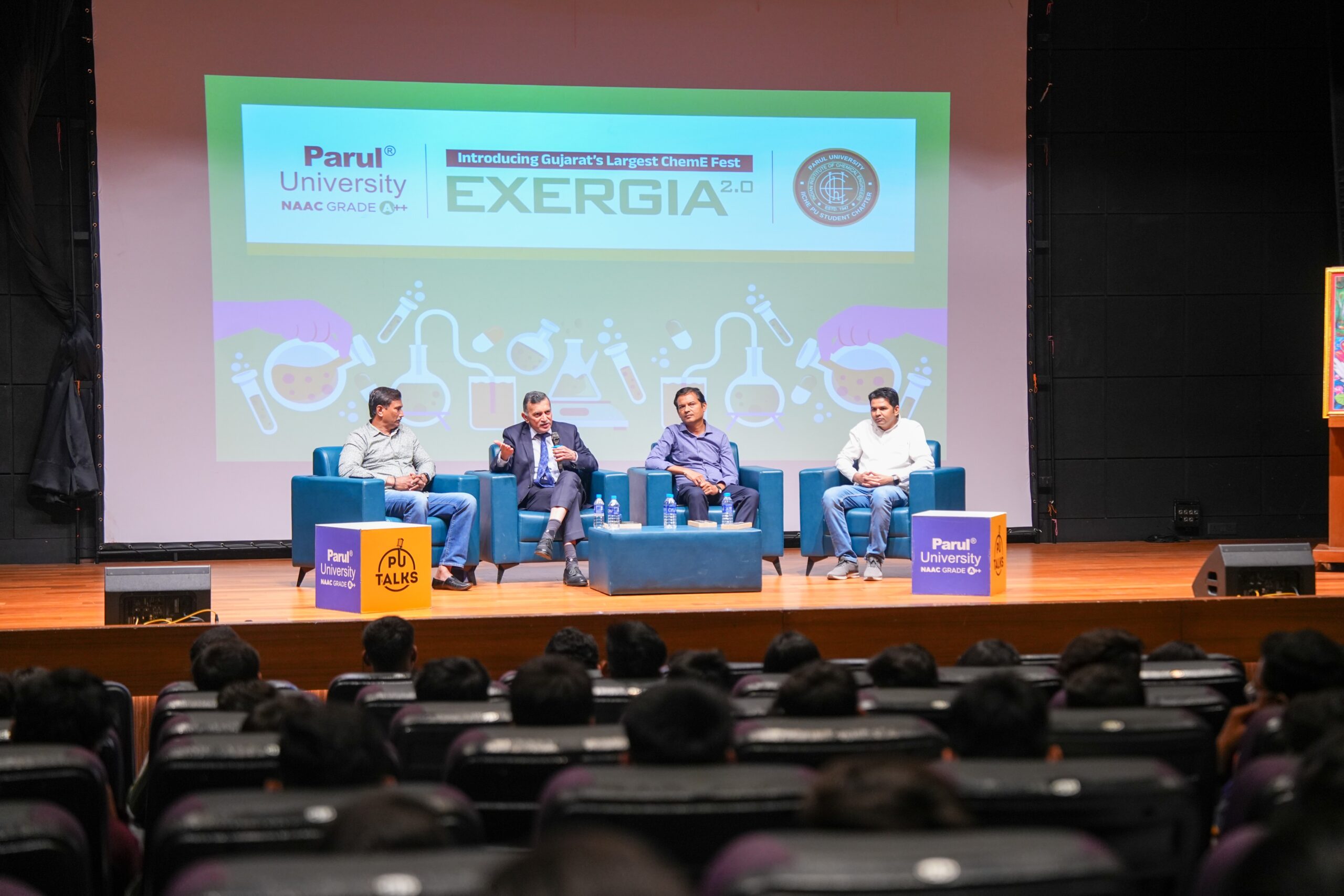
When a man who joined Indian Oil Corporation as a graduate apprentice engineer and retired as its Chairman after 38 years, having led the company through COVID-19 while supplying 26-27 lakh LPG cylinders daily to a locked-down nation, tells chemical engineering students to master their fundamentals – it carries weight. Shrikant Madhav Vaidya, former Chairman of Indian Oil Corporation (IOCL), IIT Bombay B.Tech Chemical Engineering, delivered the opening address at Exergia 2.0, the annual Chemical Engineering department fest at Parul University.
His keynote covered three themes: what is truly happening in the energy world, what leadership means in constrained transforming systems, and where young chemical engineers fit into this future. But it was his closing metaphor – connecting the thermodynamic concept of exergy to how students live their lives – that made the speech unforgettable.
Vaidya opened with a reality check. The global energy system today must achieve four simultaneous objectives: affordability, reliability, sustainability, and geopolitical resilience – and each pulls in a different direction. Reducing emissions introduces intermittency (renewables are not 24/7). Hydrocarbons provide density and stability. Green hydrogen requires entirely new infrastructure. Biofuels compete for feedstocks. Carbon capture introduces energy penalties.
The world consumes 300 million barrels of crude oil equivalent every day – crude oil as crude oil, coal converted to crude oil equivalent, and gas converted to crude oil equivalent. When we talk about energy transition, we are talking about replacing this enormous volume with alternative forms. The future is not binary – it is a multivariable optimisation problem. And that, Vaidya said, is fundamentally chemical engineering: mass and energy balance, reaction kinetics, heat integration, safety design, and thermodynamic limits – scaled to the size of a nation.
Leadership in Engineering: Judgment, Safety, and Systems Thinking
Judgment Under Uncertainty
In college, problems are well-defined. In industry, they are not. Markets shift, regulations evolve, field compositions change – yet decisions must be taken. Engineers must not only analyse but also decide. Decision-making under uncertainty is the core leadership skill.
Safety as a Core Value
Industrial failures do not begin dramatically. They begin with small ignored signals – an alarm bypassed, a deviation normalised, a shortcut justified. Production can be recovered, but an accident costs lives, property, and reputation. Leadership means refusing unsafe shortcuts even when nobody is watching.
Systems Planning
A plant is not an equipment – it is an interconnected ecosystem. Feedstock affects conversion, conversion affects utilities, utilities affect emissions, emissions affect regulations, and regulations affect economics. Nothing is done in isolation. The leaders of tomorrow will understand these interconnections.
The Exergy Metaphor: Why Your Career Is a Thermodynamic Problem
Vaidya returned to the fest’s theme – Exergia. In thermodynamics, energy is conserved, but exergy is different. Exergy is the useful work potential of a system relative to its environment. Energy may exist in abundance, but only a fraction is useful. The rest is lost to irreversibility, friction, inefficiency, and entropy.
He applied this directly to students’ lives: you possess energy – intelligence, youth, ambition. The world is full of opportunities. But how much of this will become useful work? How much will be lost to distraction, inconsistency, poor discipline, ethical shortcuts, and weak fundamentals? He cited a study showing that people in their age group spend 7-8 hours daily on their phones – and noted, with the audience laughing, that some students said it was more than 8 hours.
The difference between an average career and an exceptional one is not total energy – it is exergy. In engineering, irreversibility comes from friction and inefficiency. In life, irreversibility comes from compromise and distractions. His advice: reduce your internal irreversibilities, strengthen your discipline, strengthen your ethics, strengthen your fundamentals.
The 99-to-100 Degrees Analogy
Vaidya closed with a vivid example: water boils at 100 degrees Celsius. Until 99 degrees, water is just hot water. The moment you add one extra degree, water becomes steam – and steam can drive locomotives. Small incremental effort, from 99 to 100, changes everything. His message: do not spend your life being in hot water. Boil. Become steam. Do something worthwhile. At the end of life, he said, there should be no regret that ‘I should have done better.’ If you give 100% to whatever you are doing now, you will never have that regret.
Five Professional Disciplines – From the Former IOCL Chairman: 1. Depth in fundamentals. 2. Respect for scale. 3. Economic literacy. 4. Ethical backbone. 5. Courage to take responsibility when things go wrong. Do not chase designations – chase competence. Do not chase applause – chase credibility. Competence and reputation travel fast.
The Q&A: Geopolitics, Career Loyalty, COVID Leadership, and the Future of Petrochemicals
India's Crude Oil Sources and Geopolitical Resilience
Asked about the impact of geopolitics on crude oil sourcing, Vaidya explained India’s diversified supply: 20-25% from Russia, 40-45% from the Middle East, 10-15% from the Americas (USA, Brazil, Guyana), and 8-10% from West Africa. Indian refineries can process a variety of crudes, so if one source is disrupted, others compensate – ensuring energy security.
38 Years at One Company: Stuck or Fulfilled?
When a student used the word ‘stuck’ to describe staying at one company, Vaidya corrected it firmly. He was not stuck – he was fulfilled. Indian Oil has 11 refineries, each a different configuration. He moved across refineries, learning different systems. His advice: if your values match the company’s values, stay. Salary is secondary. Switching jobs constantly prevents you from becoming a subject matter expert. As the saying goes: a rolling stone gathers no moss.
Future of Petrochemicals
The world consumes approximately 102 million barrels of crude oil daily. Of that, 20% goes into petrochemicals – the non-combusted use. No molecule as versatile as carbon has been found for making petrochemicals. Whatever displaces the fuel part of crude oil, the petrochemical part will continue to exist for a very long time.
Technology in Energy
Green hydrogen, green ammonia, battery-powered vehicles – all are a game of technology. New technology must compete with existing fossil fuels. Whatever innovation emerges must be competitive and affordable. That is the role of technology in energy transition.
Responsibility vs Accountability
Vaidya distinguished the two: responsibility is what you do; accountability is what you answer for when things fail.
FAQs
What is Exergia at Parul University?
Exergia is the annual Chemical Engineering department fest at Parul University. Exergia 2.0 featured a keynote by former Indian Oil Corporation Chairman Shrikant Madhav Vaidya, covering energy transition, engineering leadership, and career advice for chemical engineering students.
Who is Shrikant Madhav Vaidya?
Former Chairman of Indian Oil Corporation (2020-2024), IIT Bombay B.Tech Chemical Engineering. He served IOCL for 38 years, joining as a Graduate Apprentice Engineer and rising to Chairman. He led the company through the COVID-19 pandemic.
What is the exergy metaphor?
Exergy is the useful work potential of a system. Vaidya applied it to life: you have energy (intelligence, youth, ambition), but how much becomes useful work versus being lost to distraction, poor discipline, and weak fundamentals? The difference between an average and exceptional career is not total energy - it is exergy.


