Accurate material characterisation begins with proper sample preparation and submission. At the Micro Nano Research & Development Center (MNRDC), advanced instruments such as SEM, XRD, and AFM operate at micro- and nano-scale precision. Because of this sensitivity, strict guidelines are followed for sample size, preparation, cleanliness, and handling to ensure reliable results and prevent equipment damage.
This guide explains how to correctly submit samples for Scanning Electron Microscopy (SEM), X-Ray Diffraction (XRD), and Atomic Force Microscopy (AFM), including acceptance criteria and common reasons for rejection.
Submitting Samples for SEM (Scanning Electron Microscopy)
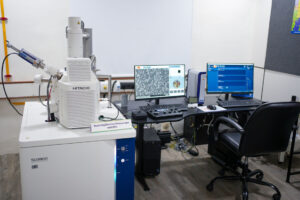
Scanning Electron Microscopy is used for surface morphology analysis and elemental composition (with EDS). Since it operates under a vacuum and uses an electron beam, proper preparation is critical.
Accepted Sample Types
- Solids
- Liquids (must be dried)
- Semi-solids (must be dried)
Only completely dried samples are allowed inside the SEM chamber.
Size & Mounting Requirements
- Samples are mounted on standard discs (commonly 50 mm or 125 mm).
- Solids are fixed using carbon tape.
- Liquids/semi-solids (after drying) are mounted using copper tape.
- Non-conducting samples require gold coating, with adjustable thickness based on need.
- The sample must fit securely on the mounting disc and remain stable during stage motion.
Environmental & Technical Conditions
- The SEM operates under vacuum (~5 minutes required for vacuum creation before operation).
- The chamber must remain closed to avoid atmospheric contamination.
- Power settings range:
- Solids: 5–30 kV
- Liquids/Semi-solids: 3–15 kV.
Rejection Criteria for SEM
A sample may be rejected if:
- It contains moisture.
- It releases vapours under vacuum.
- It is loosely powdered and cannot be fixed securely.
- It exceeds mounting disc limits.
- It is highly unstable under electron beam exposure.
- It contaminates the chamber.
Improperly dried liquid samples are the most common cause of rejection.
Submitting Samples for XRD (X-Ray Diffraction)
X-Ray Diffractometer is used to determine internal crystal structure, phase composition, and stress using Bragg’s Law (nλ = 2d sinθ).
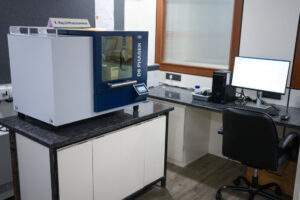
The D6 PHASER Benchtop XRD system is capable of analysing powders, solids, and thin films.
Accepted Sample Types
- Powders
- Bulk solids
- Thin films
Sample Preparation Rules
For Powders:
- Powder must be finely ground.
- The surface should be smooth and level in the sample holder.
- Clumped or uneven powders reduce diffraction quality.
For Bulk Solids:
- The surface must be flat to ensure proper X-ray interaction.
- Large or irregular pieces may require trimming.
For Thin Films:
- Clearly mention if GIXRD (Grazing Incidence XRD) is required for surface-sensitive analysis.
- For coating thickness and roughness studies, XRR must be specifically requested.
Size Limits
- Sample must fit within the benchtop stage area.
- Surface should remain stable during goniometer movement.
Rejection Criteria for XRD
Samples may be rejected if:
- Powder is too coarse.
- Sample height is uneven.
- Material is unstable under X-ray exposure.
- Surface is excessively rough or not flat.
- User fails to specify if thin-film mode is required.
Since XRD is non-destructive, chemical instability or safety hazards are the main rejection concerns.
Submitting Samples for AFM (Atomic Force Microscopy)
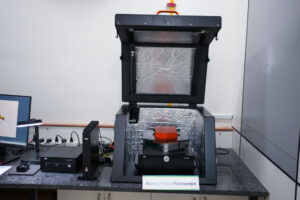
Atomic Force Microscopy provides nanoscale surface mapping, measuring roughness, grain size, and nano-mechanical properties.
The Core AFM uses a sharp tip (5–10 nm radius) mounted on a cantilever that scans surfaces line-by-line.
Accepted Sample Types
- Thin films (e.g., graphene films)
- Polymers
- Metals
- Semiconductors
- Biological solids
Loose powders must be compacted into flat tablets before testing.
Size & Surface Requirements
- Sample must have a flat surface.
- Standard scan area: approximately 10 × 10 µm.
- Surface should be smooth enough to prevent tip damage.
- Excessively rough or sharp samples may break the AFM tip.
Cleanliness Rules
- No oil, dust, or debris.
- No loose particles that may detach during scanning.
- No sticky or adhesive surfaces.
AFM tips are delicate and can expire quickly when used on conductive or magnetic samples.
Rejection Criteria for AFM
- Uneven or tilted surfaces.
- Moving or unstable particles.
- Highly adhesive or contaminated surfaces.
- Excessive roughness beyond instrument tolerance.
- Samples that cannot remain stable during line-by-line scanning.
General Submission Guidelines
Before submission:
- Clearly label the sample with identification details.
- Mention test requirements (SEM only, SEM+EDS, XRD, XRR, GIXRD, AFM mode).
- Provide material safety information.
- Ensure samples are clean, dry, and securely packaged.
Incorrect labelling, incomplete documentation, or unsafe materials may delay or reject testing.
Why Proper Submission Matters?
Advanced instruments like SEM, XRD, and AFM operate at micron- and nano-scale precision. Even minor contamination, moisture, or uneven mounting can distort results or damage sensitive components.
Following size limits, preparation standards, and cleanliness rules ensures:
- Accurate data
- Faster turnaround
- Instrument safety
- Reliable and reproducible results
Conclusion
Submitting samples correctly is the first and most important step in advanced material characterisation. By following the size limits, preparation standards, and rejection criteria outlined above, researchers and industries can ensure smooth processing and high-quality analytical results.
At MNRDC, precision begins before the test starts, with the way the sample is prepared and submitted.