Medical education in India has traditionally followed a model where students learn theory in classrooms, observe procedures in hospitals, and then – often with minimal independent practice – are expected to perform clinical procedures on real patients during their internship. The gap between what students know and what they can do has been a persistent challenge, particularly in emergency medicine, critical care, obstetrics, and surgical procedures.
The Pragya – Advanced Skills and Simulation Centre at Parul University was designed to close this gap. It provides a controlled, safe environment where students practice procedures repeatedly – building muscle memory, procedural confidence, and clinical decision-making skills – before they transition to real patient care. The centre is not a supplementary facility. It is integrated into the MBBS and PG curriculum, with its own dedicated training schedule, curriculum, and examination system.
How the Centre Is Structured: Three Tiers of Learning
The simulation centre uses a progressive learning model – students advance through three tiers of fidelity as their competence grows:
Low-Fidelity Simulation (Foundational Skills)
Simple, non-interactive models and task trainers are used for repetitive practice of core procedures. This is where students build procedural accuracy and muscle memory for suturing, IV cannulation, urinary catheterisation, intramuscular injections, and blood withdrawal. The focus is on getting the basic technique right before adding clinical complexity.
Medium-Fidelity Simulation (Integrated Skills)
Students practice moderately complex clinical skills in realistic environments that bridge basic task training and fully immersive scenarios. This tier develops integrated clinical competencies – combining multiple skills in a controlled instructional setting without the operational demands of the most advanced simulators.
High-Fidelity Simulation (Immersive Clinical Scenarios)
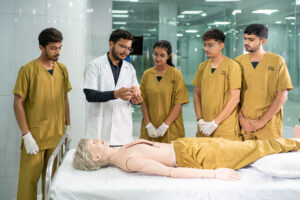
Computer-controlled mannequins replicate real clinical scenarios – patients who breathe, have palpable pulses, respond to medications, and can deteriorate or improve based on what the student does. These environments are fully integrated with audio-visual debriefing systems, allowing instructors to replay and review every decision a student made during the simulation.
All 14 Simulation Zones: What Each One Trains
The Pragya – Advanced Skills and Simulation Centre contains 14 distinct zones, each designed for specific clinical competencies:
Emergency Critical Care Unit 1 (APOLLO Simulator)
Houses APOLLO – Gujarat’s first high-fidelity computer-controlled patient simulator. Full physiological monitoring (ECG, BP, respiratory rate, O2 saturation), palpable pulses, realistic clinical sounds, supports advanced airway management, ventilation, CPR with feedback, and realistic medication responses. Training covers cardiac arrest algorithms, code blue management, respiratory distress, shock and trauma stabilisation, arrhythmia identification, and team coordination during emergencies.
Emergency Critical Care Unit 2 (ATLAS / i-Simulate)
Features ATLAS and i-Simulate platforms for dynamic, customisable clinical emergencies that respond to real-time student interventions. Training focuses on ACLS protocols, critically ill patient management, ECG recognition and rhythm management, and radiological decision-making.
Trauma Simulation Unit
Equipped with TrueMan Trauma, TruBaby (paediatric), intraosseous training devices, and advanced airway management stations. Students practise advanced airway interventions (LMA, ET intubation, surgical airway), needle decompression, chest tube insertion, massive haemorrhage control, and primary trauma survey across all age groups from neonates to adults. Training is aligned to ATLS (Advanced Trauma Life Support) protocols.
Advanced Obstetric and Neonatal Unit
Full-body birthing simulators, neonatal manikins (including cyanotic and preterm infants), fetal monitoring, and emergency response systems. Training covers all three stages of delivery, postpartum haemorrhage management, shoulder dystocia, breech delivery, eclampsia management, IUCD insertion, birth asphyxia recognition, and basic and advanced Neonatal Resuscitation Programme (NRP).
Hospital Simulation Units (ER, OT, ICU)
Recreates real-world Emergency Room, Operation Theatre, and Intensive Care Unit environments. The OT unit includes full sterile setup with surgical lights, anaesthesia workstation, and instrument stations. The ICU unit features mechanical ventilators, multipara monitors, CVP and central line insertion practice, and invasive pressure monitoring.
Ambulance Simulation Unit (ASU)
A complete replica of an emergency ambulance – inaugurated January 2025 by Gujarat’s Health Minister. Students train in patient assessment, stabilisation, and transport; emergency department communication; multi-casualty incident management; and skills including oxygen therapy, airway management, bleeding control, splinting, and patient monitoring under field conditions.
Additional Specialised Units
The centre also includes an Advanced Airway and Cardiac Unit (airway crisis management with i-Simulate mannequins), a Cardiac Diagnostic Unit (ECG machine, 2-D echocardiography, SimScope digital auscultation), a Minimal Access Surgery Unit (laparoscopic endo-trainers, Nursing PRO manikin), Radiography Unit (X-ray positioning, radiation safety), Optometry Unit (slit lamp, ophthalmoscopy, visual acuity testing), Task Training Areas I and II (CPR with real-time feedback, needle decompression, tracheostomy, chest tube drainage), and a 50-person Debriefing Unit for audio-visual review and structured team reflection.
American Heart Association International Training Centre
The Pragya – Advanced Skills and Simulation Centre is an authorised AHA International Training Centre. Certified instructors deliver CPR, First Aid and Emergency Response, BLS for Healthcare Providers, ACLS, and AHA Provider and Instructor Development Courses. Training uses high-fidelity manikins with real-time performance feedback – the same standard used in AHA centres globally. For MBBS students, this means internationally recognised life-saving certifications as part of their medical education.
32 Training Programmes: The Full List
The centre delivers 32 distinct programmes serving MBBS students, PG residents, AYUSH students, nursing students, and allied health professionals. These include Advanced Comprehensive Emergency Training, Advanced Trauma Emergency Training, Advanced Cardiac Support, Master Medico Training, Essentials of ICU, Cardiac Diagnostics, ECG Interpretation, Basic and Advanced Airway Management, Surgical Airway Management, Basic and Advanced Obstetrics and Neonatal Management, Pediatric Life Support, Clinical Examination in Cardiology, Suturing and Bandaging Techniques, Orthopaedic Procedures, Echocardiography Basics, Diagnostic Evaluation (X-ray/CT/ABG), Hospital Induction Training, Medi-Surgical Skills, Mechanical Ventilation, Hospital Infection Control, First Aid and Triage Management, Pre-hospital Ambulance Simulation Training, AHA BLS and ACLS, Faculty Development Programme, Clinical ToTs, Simulation Master-ToT, and customised training for external institutions.
Future Plans: Surgical Neuro and Cadaveric Simulation
The next phase of expansion, currently under development, is a Surgical Neuro and Cadaveric Simulation Unit. This will add neurosurgical simulation and cadaveric training capabilities – strengthening PG-level surgical education and positioning the centre as a comprehensive skills training facility from first-year MBBS to super-specialty surgical practice.
FAQ - Pragya - Advanced Skills and Simulation Centre, Parul University
1. Where is the simulation centre located?
3rd floor, Parul Institute of Medical Sciences and Research (PIMSR), Faculty of Medicine, Parul University, Vadodara, Gujarat 391760. Contact: pragyaskills@paruluniversity.ac.in | 63524 26934.
2. Is the simulation centre used for MBBS exams?
Yes. OSCE examinations and PG external assessments are conducted inside the simulation centre. It has its own dedicated curriculum for all medical UG and PG students.
3. What is the APOLLO simulator?
APOLLO is a highly advanced, computer-controlled high-fidelity patient simulator - described as the first of its kind in Gujarat. It supports full physiological monitoring, realistic clinical sounds, advanced airway management, and responds to medications and interventions in real time.
4. Can non-PIMSR students access the centre?
The centre delivers customised training programmes, Faculty Development Programmes, and Clinical Training of Trainers (ToTs) that may be accessible to external participants and institutions.