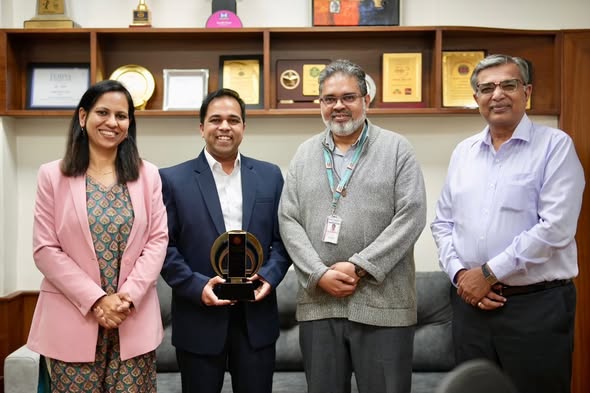
AHPI- Association of Healthcare Providers of India (AHPI) is one of the country’s leading representative bodies for hospitals and the healthcare sector. It works with the government of India, regulatory bodies, and accrediting organizations on healthcare policy. It also includes patient safety and quality standards. Every year the AHPI Global Conclave brings hospital leaders, clinicians, policymakers, and medical educators who are from India and recognised institutions under one roof.
This year, the theme of AHPI Global Conclave was ‘Empowering Hospitals as Pillars of National Wellbeing.’ It was conducted in Mumbai, and another award winner was CARE Hospital (multiple units honored for quality and patient-centric care). The awards are assessed by an independent technical committee and jury, based on objective criteria – this is not a self-nominated recognition, but an externally evaluated one.
For MBBS aspirants and their parents, an AHPI award is significant because it represents validation from India’s healthcare industry itself – the same hospitals and providers that will eventually employ medical graduates. When the industry says your training infrastructure is nationally excellent, that credibility transfers directly to the
students who train there.
The Award Category: Infrastructure and Facility with Its Functionality
Parul University’s medical college – formally known as Parul Institute of Medical Sciences and Research (PIMSR) – won the award in a specific category: Infrastructure & Facility with Its Functionality. The distinction is important. Many medical colleges in India have invested in equipment and buildings. This award does not just evaluate whether infrastructure exists – it evaluates whether that infrastructure is actively integrated into clinical education and whether it measurably improves student competency.
The infrastructure that was assessed is centered on the Pragya – Advanced Skills and Simulation Centre at Parul University – a 16,000 sq. ft. facility located on the 3rd floor of the medical college building. The center, operational since July 2022, is a demonstration lab along with routine clinical postings, it is all part of the MBBS and postgraduate curriculum. OSCE (Objective Structured Clinical Examination) assessments and PG external examinations are conducted inside its simulation environments.
What Parul University Built: The Pragya - Advanced Skills and Simulation Centre
The Pragya – Advanced Skills and Simulation Centre at Parul University replicates an entire hospital environment within 16,000 sq. ft. of dedicated training space. It features 14 distinct simulation zones covering the full spectrum of clinical training – from foundational procedures like suturing and IV cannulation to advanced emergency simulations with computer-controlled mannequins that respond to medications in real time.
The center houses APOLLO – described as the first high-fidelity computer-controlled patient simulator installed in Gujarat. APOLLO provides full physiological monitoring (ECG, blood pressure, respiratory rate, oxygen saturation), produces realistic heart, lung, and bowel sounds, supports advanced airway management, and simulates patient deterioration in response to interventions – allowing students to practice cardiac arrest management, respiratory distress protocols, and shock stabilization before they encounter these situations with real patients.
Additional facilities include two Emergency Critical Care Simulation Units, a Trauma Simulation Unit with pediatric and adult trainers, an Advanced Obstetric and Neonatal Unit with full-body birthing simulators, a Hospital Unit replicating ER/OT/ICU environments, an Ambulance Simulation Unit for pre-hospital emergency training, Cardiac Diagnostic and Airway units, a Minimal Access Surgery simulation, Radiography and Optometry units, and a 50-person Debriefing Unit for post-simulation review.
The center is also an authorized American Heart Association (AHA) International Training Center, meaning students receive globally standardized BLS (Basic Life Support) and ACLS (Advanced Cardiovascular Life Support) certifications with AHA-certified instructors during their MBBS training.
Why Parul University Won: The Skill-Embedded Learning Model
The AHPI award was not given for having equipment. It was given for how that equipment functions in day-to-day education. At Parul University’s medical college, the Pragya – Advanced Skills and Simulation Centre has its own dedicated curriculum for all medical undergraduates and postgraduates. This means:
- All routine clinical postings for MBBS and PG students are conducted at the simulation centre on a regular basis – it is not an occasional visit, it is part of the weekly schedule.
- OSCE examinations (a globally recognised format for assessing clinical competence) are conducted inside the simulation environments.
- External PG assessments happen at the centre – meaning even the final evaluation of postgraduate doctors uses the simulation infrastructure.
- Competency is measured through pre-tests, post-tests, OSCE, skill competitions, and a Simulation League – multiple assessment layers that track student progress.
- 32 distinct training programmes are delivered – from Advanced Comprehensive Emergency Training to Hospital Infection Control, AHA BLS/ACLS certification, and Faculty Development Programmes.
The result, according to faculty observations, is that students trained under this model are able to perform effectively in real clinical practice. Students do not encounter their first emergency, their first intubation, or their first cardiac arrest with a real patient – they encounter it in the simulation center first, where they can practice repeatedly, make mistakes safely, and build confidence.
Who Recommended the Award: Dr. Geetika Madan Patel
The nomination for the AHPI award was recommended by Dr. Geetika Madan Patel, Vice President of Parul University for Quality, Research, and Health Sciences, and Medical Director of Parul Sevashram Hospital. Dr. Patel holds an MBBS and MD in Community Medicine with Gold Medal from the Maharaja Sayajirao University of Baroda. Under her leadership, the medical education infrastructure at Parul University has been developed with a clear philosophy: one skilled medico can help limited patients at a time, but a network of skilled medicos can serve many – and field skills matter as much as textbook knowledge.
What This Means for Students Considering MBBS at Parul University
If you are evaluating medical colleges in Gujarat – whether through NEET counselling, management quota, or NRI quota – the AHPI award provides a specific, externally validated data point that goes beyond rankings and fees.
It tells you that:
- The clinical training infrastructure at Parul University is nationally recognised – not by a marketing agency, but by India’s leading healthcare providers’ association.
- You will train on high-fidelity simulators before working with real patients – a model that most private medical colleges in Gujarat do not offer at this scale.
- You will have access to AHA-certified BLS and ACLS training during your MBBS – certifications that are recognised internationally.
- Your clinical assessments (OSCE, externals) will happen in simulation environments – meaning the infrastructure is not decorative; it is integral to your evaluation.
- The attached Parul Sevashram Hospital (750+ beds, NABH accredited, 1,100+ outpatients daily) provides the real clinical complement to simulation-based training.
Parul University’s medical college (PIMSR) was established in 2016, is approved by the National Medical Commission (NMC), and offers 150-200 MBBS seats and 54 MD/MS seats. The university itself holds NAAC A++ accreditation and is ranked among the Top 50 in India under the NIRF Innovation Ranking 2024.
FAQ - Parul University AHPI Excellence in Medical Education Award 2026
What award did Parul University's medical college receive in 2026?
Parul University's medical college (PIMSR) and its Pragya - Advanced Skills and Simulation Centre received the Excellence in Medical Education Award 2026 from the Association of Healthcare Providers of India (AHPI) in the category of Infrastructure & Facility with Its Functionality, presented at the AHPI Global Conclave in Mumbai.
What is AHPI?
The Association of Healthcare Providers of India (AHPI) is India's leading representative body for hospitals and healthcare providers. It works with the government on healthcare policy, patient safety, and quality standards. The AHPI Global Conclave is its annual event recognising institutional excellence.
What is the Pragya - Advanced Skills and Simulation Centre at Parul University?
It is a 16,000 sq. ft. medical simulation facility with 14 units - including Gujarat's first high-fidelity APOLLO simulator, trauma and obstetric simulation, an Ambulance Simulation Unit, and AHA International Training Centre certification. It is integrated into the MBBS and PG curriculum at Parul University.
Is Parul University's medical college NMC approved?
Yes. Parul University's medical college (PIMSR) is approved by the National Medical Commission (NMC), offers 150-200 MBBS seats and 54 MD/MS seats, and is affiliated with Parul University (NAAC A++).
Who is Dr. Geetika Madan Patel?
Dr. Geetika Madan Patel is Vice President of Parul University (Quality, Research & Health Sciences) and Medical Director of Parul Sevashram Hospital. She holds an MBBS and MD in Community Medicine with Gold Medal from the Maharaja Sayajirao University of Baroda.


