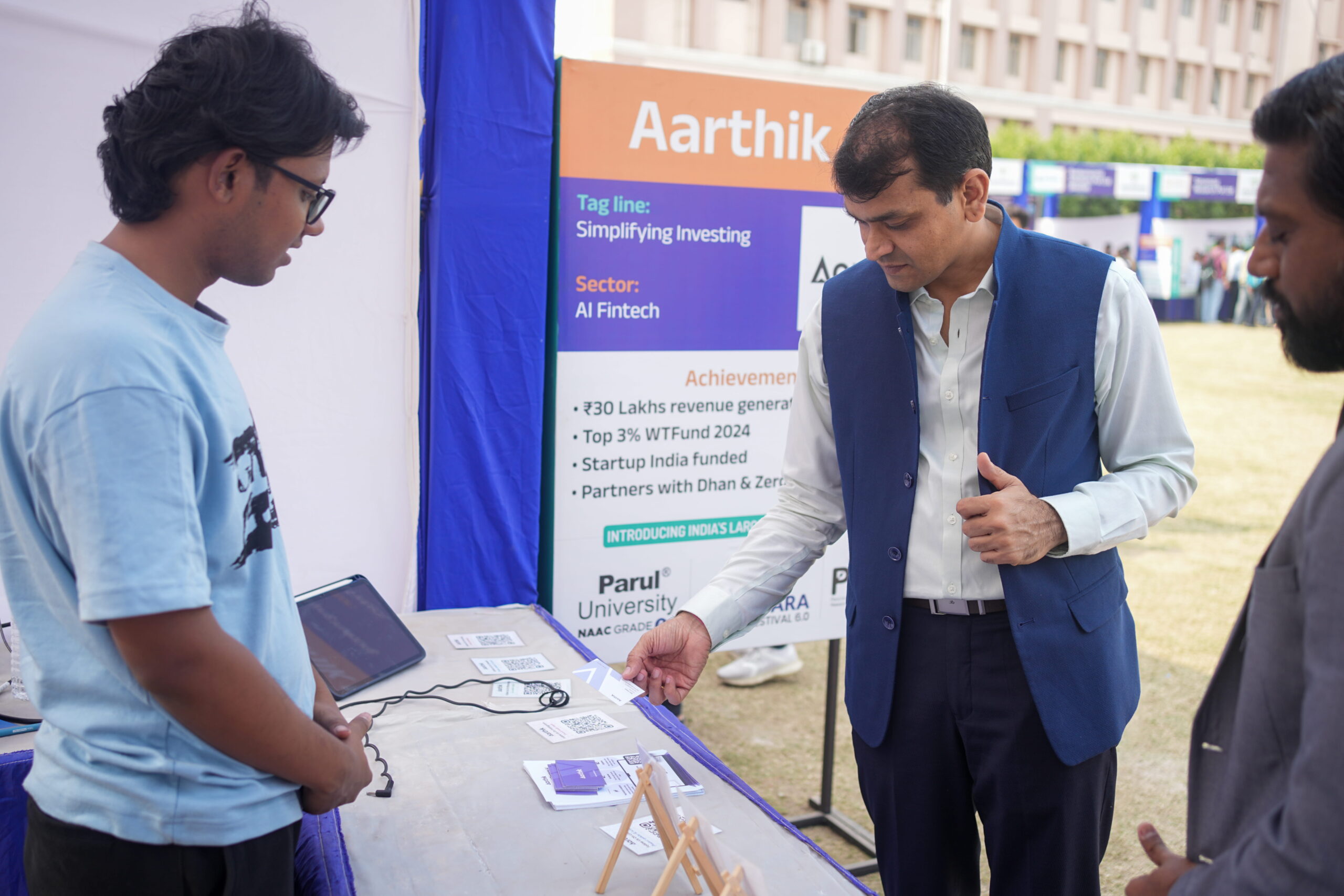
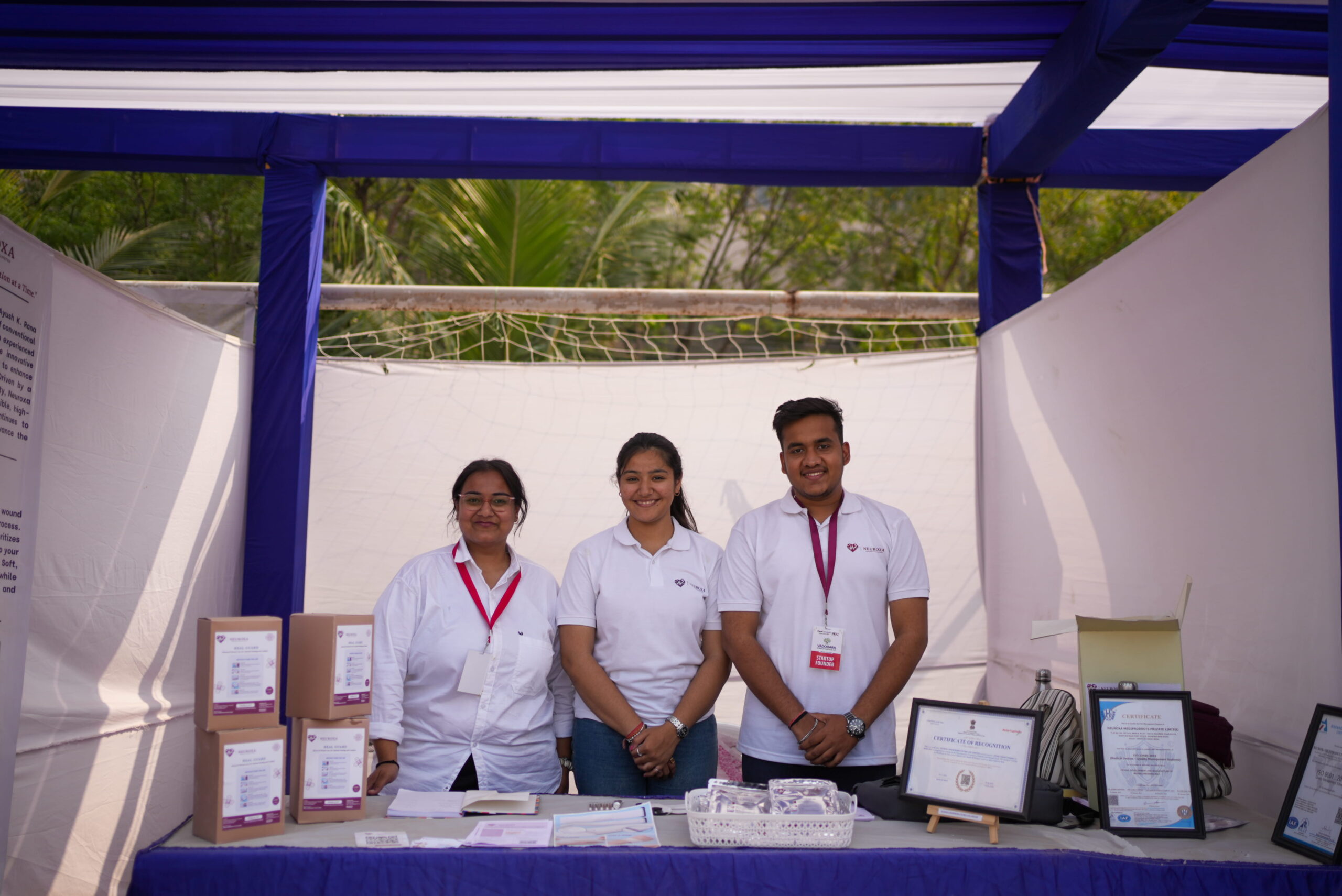
Young founders building and scaling startups inside campus incubation spaces and hostel rooms before graduation.
The placement season has started. Big names were coming to campus. Amazon, Infosys, TCS. Six-figure packages. Job security. The path every parent expected.
Three Parul University students sat in their hostel room, watching classmates prepare for interviews. They’d decided to skip the placement season entirely.
Not because they couldn’t compete. Their grades were solid. Their technical skills were strong. They’d probably land decent offers.
They were skipping placement because they’d spent the last six months building AnyTrip, a transparent flight booking platform that was already generating revenue.
“My parents think I’m crazy,” one founder admitted during their VSF – Vadodara Start-up Festival 6.0 presentation ten months later. “But we’d generated ₹2.8 crore. Hard to call that crazy.”
That decision choosing to build something over accepting placement represents a fundamental shift happening in Indian higher education.
The Placement Pressure Nobody Talks About
Indian universities run on placement statistics. Higher placement percentage = better rankings = more applications = more revenue.
This creates intense pressure:
- Parents measure success by company name and salary package.
- Professors encourage “safe” career paths.
- Peers compete for the most prestigious offers.
- Alumni networks revolve around corporate positions.
Entrepreneurship becomes what you do if placement fails.
Except the students at VSF – Vadodara Start-up Festival 6.0 weren’t placement failures. They were students who recognized that the “safe” path might actually be riskier than building something themselves.
Story 1: The Publishing Platform That Beat Placement Offers
Anurag Sundarka had options. With his background, corporate offers would have come.
He chose differently.
ZebraLearn started from personal frustration with publishing industry barriers. First-time authors couldn’t get published. The system favored established names over quality content.
The conventional path:
- Accept corporate offer
- Gain “experience”
- Build savings
- Then maybe start something
Anurag’s actual path:
- Build ZebraLearn during college
- Generate ₹10 lakh revenue (2022)
- Scale to ₹3.05 crore (2023)
- Reach ₹10.7 crore (2024)
- Appear on Shark Tank Season 4
- Secure ₹1 crore investment from Ritesh Agarwal
- Employ 38 people
- Sell 10,000-20,000 books monthly
“The ‘experience’ I would have gained in a corporate job wouldn’t have been as valuable as what I learned building ZebraLearn,” Anurag explained at VSF – Vadodara Start-up Festival.
His risk: Skipping placement season, facing uncertain income, working without a safety net.
His reward: Building ₹10.7 crore company, creating 38 jobs, solving real problems for thousands of authors.
Which was actually riskier?
Story 2: The Travel Startup That Chose Transparency Over Job Security
The three AnyTrip founders watched the placement season unfold around them. Friends celebrating offers. Parents asking about their applications.
They hadn’t applied anywhere.
“Everyone thought we were making a terrible mistake,” they shared at VSF – Vadodara Start-up Festival. “Even we weren’t 100% sure. But we’d found something that worked.”
What worked: showing transparent flight pricing in industry built on confusion.
Traditional placement thinking:
- Get placed
- Save money
- Then start something “when ready”
Their actual timeline:
- Start in 2024 during college
- Launch platform March 2025
- Generate ₹2.8 crore by January 2026
- Grow to 30-person team
- Earn recognition as top 15 travel-tech startup in Gujarat
Ten months from launch to ₹2.8 crore.
Could they have achieved that working corporate jobs? Could they have stayed connected to the problem they were solving? Could they have maintained the energy and focus required?
Their risk: No job offer, no income certainty, no clear path.
Their reward: Building sustainable business, proving market viability, creating career opportunities for 30 people.
Story 3: The Solar Revolution That Started With Chemistry Project
Yash Tarwadi could have easily transitioned from a Chemical Engineering degree to a stable corporate role.
He chose to solve solar adoption problems instead.
His college desalination project received an SSIP grant of ₹2 lakh. Then ₹30 lakh from Gujarat government. The project worked.
Conventional next step: Leverage this into good placement, build a corporate career, maybe return to entrepreneurship later.
Tarwadi’s actual step: Start Solnce Energy during college, build India’s first online bidding platform for solar installations.
The decision meant:
- No placement safety net
- Uncertain income
- Complete responsibility for outcomes
But it also meant:
- Building from government co-working space to 2,000 sq. ft. office
- Receiving UNDP grant and Piyush Goyal award
- Presenting at GITEX Global 2023 in Dubai
- Attracting UK licensing interest
- Creating business model serving thousands of customers
“People ask if I regret skipping placement,” Tarwadi noted. “I ask them if they regret not building something that matters.”
Story 4: The Mental Health Platform That Couldn't Wait
Priyanshi Rathore saw placement as the default path. Good grades. Technical skills. She’d get placed.
But she’d also seen classmates struggling with mental health issues without access to help. Stigma prevented them from seeking support. Privacy concerns stopped them from opening up.
Standard approach: Get placed, build savings, then maybe work on social impact projects later.
Priyanshi’s choice: Build Eternia immediately while still experiencing the problem.
The platform provides completely anonymous mental health support. No data storage. No tracking. No privacy breaches.
Skipping placement meant financial uncertainty. Starting Eternia meant immediate impact.
Students started using it. Not because it was required. Because it solved the real problem they were living with.
SSIP grant recognition followed. User growth continued.
“Mental health crises don’t wait for convenient timing,” Priyanshi explained. “Neither could my solution.”
Story 5: The Rug Innovation That Competed With Consulting Offers
Samrath Singh Nagpal and Harnaam Kaur had marketable skills. Consulting firms would have hired them. A safe career path existed.
They chose to build EasyRugs instead.
The decision faced fierce opposition. Parents were worried. Friends questioned their judgment. Placement coordinators suggested “being practical.”
They persisted:
- Spent 8-9 months developing innovative rug prototypes
- Fought with manufacturers who didn’t understand their vision
- Solved logistics nightmares
- Built website and brand from scratch
- Positioned as affordable luxury
Result: Shark Tank India Season 4 investment of ₹35 lakh for 5% equity from Aman Gupta and Vineeta Singh.
“A consulting job would have paid well,” Samrath acknowledged. “But it wouldn’t have let us build something we actually believed in.”
The Common Thread: Timing Matters
All these founders made similar calculation:
Later = Lost Context
The problems they were solving weren’t abstract market opportunities. They were frustrations they experienced daily.
Anurag understood publishing barriers because he couldn’t get published.
AnyTrip founders hated confusing flight pricing because they booked flights frequently.
Tarwadi recognized solar adoption problems while researching power sources.
Priyanshi saw mental health needs among immediate peers.
EasyRugs founders shopped at décor exhibitions personally.
Waiting meant losing proximity to the problem.
Five years in a corporate job wouldn’t sharpen these insights, it would dull them. They’d have different problems, different contexts, different perspectives.
Now = Maximum Energy
College students have energy levels that won’t repeat. No mortgage pressure. No family obligations. No lifestyle expectations.
They can work 80-hour weeks. Sleep in offices. Eat instant noodles. Sprint intensely.
That energy doesn’t increase with corporate experience, it decreases with life responsibilities.
Campus = Unique Infrastructure
PIERC provided resources that wouldn’t be available later:
- Free co-working space (saves ₹20,000+ monthly)
- Mentorship without consulting fees
- Peer testing environment with 65,000+ students
- SSIP grants and university funding
- FABLAB prototyping facilities
- Networking events and investor access
After graduation, these resources disappear. Replacing them externally costs lakhs.
Risk = Actually Lower
Counterintuitively, skipping placement might be less risky than it appears.
Worst case scenario for student founders:
- Startup fails
- They’ve learned valuable capabilities
- They get placed in next cycle or apply directly to companies
- Experience building something real becomes resume strength
Worst case scenario for placement:
- Accept job that’s wrong fit
- Spend years gaining “experience” in role that doesn’t leverage strengths
- Watch startup ideas become someone else’s companies
- Eventually leave to start something, but with more financial obligations
What Parents Don't Understand (But Should)
The founders at VSF – Vadodara Start-up Festival 6.0 shared common experience: parental concern.
Parents see:
- No job offer
- Uncertain income
- Risky path
Parents don’t see:
- Revenue validation
- Market traction
- Capability development
- Option value
Anurag’s parents: “Get a job first, then start something.”
Anurag’s reality: Already generating ₹10 lakh revenue. The job would have been a step backward.
AnyTrip founders’ parents: “Why skip placement? Your friends are getting placed.”
AnyTrip reality: Already built platform generating ₹2.8 crore. Corporate salary couldn’t compete.
The disconnect stems from different risk calculations:
Parents’ generation: Job = security, entrepreneurship = risk
Current reality: Job = single income source (which can disappear), entrepreneurship = revenue from customers (which validates market need)
What PIERC Did Differently
Traditional university approach to entrepreneurship:
- Optional club activities
- Weekend workshops
- Annual competitions
- Theoretical case studies
PIERC's approach:
- Dedicated incubation center and startup studios with professional management
- Co-working space spread across multiple cities.
- ₹14.53 crore distributed in actual funding at idea stage
- Mentorship from successful entrepreneurs and Investors
- Programs supporting idea through growth stages
Result: Students who choose building over placement have infrastructure supporting that choice.
Not just encouragement—real support:
- Physical workspace to build every day, not just meet occasionally.
- Financial capital to prototype, validate, and hire early.
- Expert guidance from founders and operators who’ve done it before.
- A peer community that keeps you accountable and moving faster.
- Event opportunities that convert into customers, partners, and funding.
This infrastructure makes “building over placement” a viable option instead of an impossible dream.
The Data: What Happened to Students Who Chose Building
PIERC has supported 250+ startups since 2015. Not all succeeded. Many failed.
Career outcomes for founders who chose building over placement:
Category 1: Successful Entrepreneurs
Built sustainable companies. Generated revenue. Raised funding. Created jobs. Examples: ZebraLearn, AnyTrip, Solnce Energy, EasyRugs, and many more.
Category 2: Eventually Placed (With Better Outcomes)
The startup didn’t scale as hoped. Joined companies in product management, business development, and strategic roles. Startup experience made them more attractive hires, often at senior levels than fresh graduate placement would have offered.
Category 3: Serial Entrepreneurs
The first venture didn’t work. Applied learnings to second attempt. Some on their third or fourth venture now.
Category 4: Hybrid Approach
Joined companies while continuing venture on side. Eventually transitioned full-time when traction proved viability.
Common thread: None regretted choosing to build over accepting immediate placement.
Even failed startup founders developed capabilities that accelerated whatever they did next.
The Capabilities That Transfer to Any Career
Whether student founders ultimately run companies or join them, they develop:
- Problem identification – Recognizing genuine needs versus perceived ones
- Hypothesis testing – Validating assumptions before committing resources
- Resource management – Doing more with less, prioritizing ruthlessly
- Cross-functional thinking – Understanding how decisions ripple across organization
- Ambiguity navigation – Operating effectively without detailed instructions
- Failure recovery – Extracting lessons from setbacks, maintaining resilience
These capabilities make someone valuable in any role.
The ZebraLearn founder who joins a publisher brings product innovation.
The AnyTrip founder in corporate brings customer obsession.
The failed startup founder brings execution discipline.
All are better prepared than they would have been skipping the attempt.
When Building Makes More Sense Than Placement
Not every student should skip placement season. But for some, building makes more sense:
- You’ve validated revenue – Already have paying customers. The market is telling you something works.
- You’re solving personal frustration – Deep connection to a problem ensures sustained motivation.
- You have a strong co-founder(s) – Team shares work, distributes risk, provides support.
- Infrastructure exists – University provides space, funding, mentorship to support attempts.
- Energy is high – You’re willing to work intensely for an extended period.
- Downside is limited – Failure wouldn’t be catastrophic. Learning would be valuable regardless.
- Timing matters – Problem is relevant now. Waiting would lose context.
If multiple factors align, “build now, place later if needed” might be smarter than “place now, build later if ever.”
The Question Nobody Asks Until It's Too Late
Five years from now, which will you regret more:
Skipping placement to build something that might not work?
Or
Accepting placement, watching someone else build the thing you thought about but never attempted?
The VSF – Vadodara Start-up Festival 6.0 founders chose to avoid the second regret.
- Anurag chose building over placement. Result: ₹10.7 crore company.
- AnyTrip founders chose building over placement. Result: ₹2.8 crore in 10 months.
- Tarwadi chose building over placement. Result: Recognized solar innovation.
- Priyanshi chose building over placement. Result: Mental health platform serving students.
- EasyRugs founders chose building over placement. Result: Shark Tank investment.
None of these outcomes were guaranteed.
All required risk. All faced uncertainty. All dealt with parental concern and peer pressure.
But all chose to attempt something real rather than accept the default path.
Your Decision Point
If you’re currently a student facing this choice:
Placement offers certainty. Known salary. Clear path. Parental approval.
Building offers uncertainty. Unknown income. Unclear trajectory. Questions from everyone.
But placement offers certainty about the wrong things.
You’ll certainly have income. But will you certainly develop capabilities you value?
You’ll certainly have a title. But will you certainly work on problems you care about?
You’ll certainly follow a proven path. But will you certainly avoid regret later?
Building offers uncertainty about short-term outcomes but clarity about long-term development.
You might fail. But you’ll certainly learn.
You might struggle. But you’ll certainly grow.
You might face doubt. But you’ll certainly know you tried.
The students at VSF – Vadodara Start-up Festival 6.0 chose uncertainty over certainty.
They built companies. Generated revenue. Created jobs. Developed capabilities.
Some will run those companies forever.
Some will eventually join corporations.
Some will try different ventures.
All chose to be builders instead of just employees.
And that choice made during college, supported by infrastructure, executed with energy created options placement couldn’t provide.
Your turn to choose.
Frequently Asked Questions (FAQs)
1. Is it risky to skip campus placements for a startup?
Yes, but calculated risk during college is often lower due to minimal financial obligations and strong institutional support.
2. What if the startup fails?
Most founders still gain valuable experience and often secure stronger career opportunities afterward.
3. Does PIERC support students who skip placements?
Yes. PIERC provides incubation, grants, mentorship, and workspace to student founders building during college.
4. Can I start building while still sitting for placements?
Yes. Many founders begin part-time before fully committing once revenue validation appears.
5. How do I know if I should choose building over placement?
If you have revenue traction, strong co-founders, infrastructure support, and conviction — building may offer higher long-term leverage.
PIERC accepts startup support applications year-round: pierc@paruluniversity.ac.in | www.pierc.org.
VSF – Vadodara Start-up Festival 6.0 took place January 21-23, 2026, at Parul University, Vadodara.
Build from your ideas. Scale it globally!


