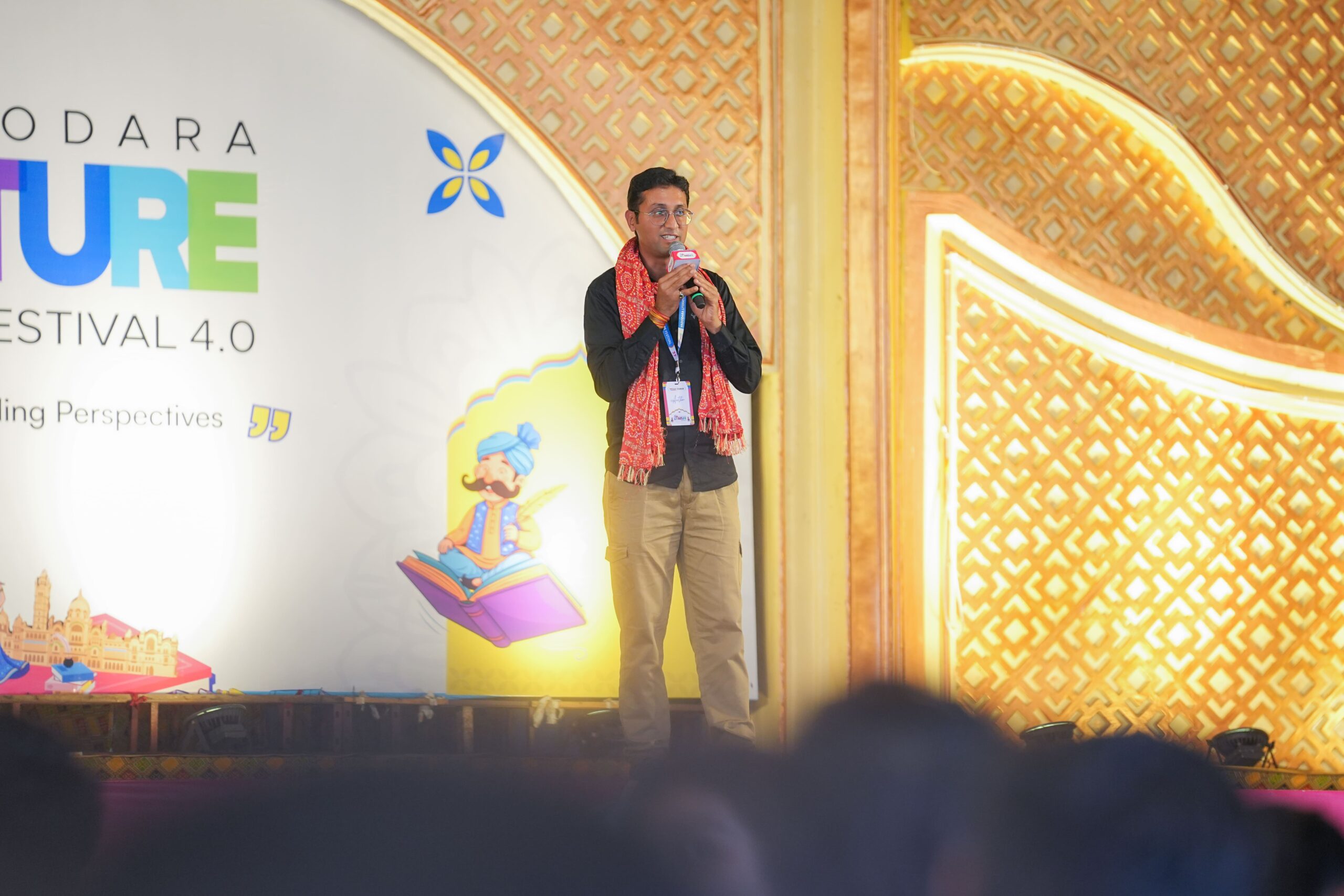
By any standard measurement of success at a literature festival, Ekagra Sharma’s VLF – Vadodara Literature Festival 4.0 presence was exceptional. He performed on Day 1 at the Central Auditorium, returned on Day 2 at Tagore’s Shantiniketan, and appeared again on Day 3.
His three appearances at VLF 4.0 were the clearest evidence yet that this revival has arrived in Gujarat .This is the fact that organisers of literature festivals across India have discovered and that cultural commentators have been slow to fully articulate: the spoken-word poetry revival in India is not a niche phenomenon. It is one of the most significant shifts in how young people engage with literature in a generation – and Ekagra Sharma, with his emotionally direct, youth-centric, accessible-yet-rooted approach, is among its most compelling practitioners.
What Shayari Does That Nothing Else Does
To understand why Ekagra Sharma‘s sessions at VLF – Vadodara Literature Festival 4.0 drew the specific response they did – spontaneous applause, shared laughter, the particular silence of an audience recognising something they had felt but not been able to name – it helps to understand what shayari is doing at a functional level.
Shayari is not a decoration. It is compression. A well-crafted sher (couplet) or nazm (lyric poem) takes an emotional experience that typically requires paragraphs of prose to approximate and delivers it in two lines that land with physical force. The reason this works is formal: the constraints of shayari – metre, rhyme, the obligation to satisfy both meaning and sound – force the poet toward precision. Every word earns its place or is replaced by a word that earns its place. The result is language that has the density of lived experience rather than the diffuseness of its description.
For a generation that lives in an environment of content abundance and attention scarcity, this compression is not a limitation. It is an advantage. A couplet takes thirty seconds to hear. Its emotional resonance can last the rest of the day. The economy of means is exactly what makes shayari suited to the present moment – and what makes the genre’s persistence across centuries, through every shift in media and culture, make sense.
Themes That Landed: Love, Hostel Life, and Radha-Krishna
Ekagra Sharma’s VLF – Vadodara Literature Festival 4.0 performances moved across three primary thematic territories, each of which connected with the student audience in a different register.
Love and relationships occupied the largest portion of the performances – and occupied it with a specificity and emotional honesty that distinguished his approach from the generic romantic. He explored affection, longing, vulnerability, and unspoken feelings in ways that were sensitive and relatable without being sentimental. The romance in shayari tradition is not about a comfortable feeling. It is about the precise emotional states that comfortable feeling cannot describe: the specific texture of waiting, of loving someone you cannot tell, of the moment between speaking and not speaking. His audience recognised these states because they were living in them.
Hostel life and student experience provided the sessions’ most actively joyful passages. This is shayari functioning as a social mirror – the poet showing an audience an accurate image of their own experience, and the audience responding with the pleasure of being seen. Several students later described these passages as the moments they felt most ‘at home’ in VLF – Vadodara Literature Festival 4.0’s full three-day programme.
Radha-Krishna devotional poetry provided the spiritual dimension of the performances – a thread connecting the contemporary intimacy of his other work to the centuries of bhakti poetry, of spiritual longing expressed through the vocabulary of human love, that forms one of Indian literature’s deepest roots. The eternal bond of Radha and Krishna in his rendering was not mythological distance. It was love as devotion beyond material boundaries – a way of pointing toward the nature of feeling that exceeds what romantic language can accommodate.
The Mechanism of the Live Room: Why the Crowd and the Poet Need Each Other
One of the defining features of Ekagra Sharma’s performance style is continuous audience interaction. He maintained dialogue with the audience throughout each session – encouraging responses, creating an open environment, asking the room to complete lines, to respond to prompts, to share what landed and what didn’t.
This is not a performance technique in the superficial sense. It reflects the fundamental nature of shayari as a form that was always meant to be experienced communally. The mushayara – the traditional gathering at which poets perform for audiences who respond in real time – is the ancestral context from which contemporary spoken-word poetry in India descends. The audience is not passive. They are participants: their responses shape the energy of the performance, which shapes the poet’s choices in the next moment. The room is a living instrument.
What Ekagra Sharma demonstrated at VLF – Vadodara Literature Festival 4.0 – across three separate appearances – was that this instrument still functions, that young people who are described as culturally disconnected from traditional literary forms are, in the right conditions, capable of extraordinary attentiveness and emotional participation. The condition that creates this is not nostalgia for a tradition they have not lived. It is the experience of having their own feelings named, in language that is precise enough to be true.
Shayari, Social Media, and What the Algorithm Cannot Replace
The spoken-word poetry revival that Ekagra Sharma represents has a paradoxical relationship with social media. On one hand, platforms like Instagram and YouTube have been crucial vectors for contemporary shayari reaching audiences it would not have reached through traditional publishing or festival circuits alone. Short-form video is, in format terms, surprisingly compatible with shayari – a two-minute performance of a well-crafted set of couplets can reach millions of viewers in the same way that a well-crafted musical performance can.
On the other hand, what the VLF – Vadodara Literature Festival 4.0 audiences were responding to in Ekagra Sharma‘s sessions was precisely what social media cannot replicate: the experience of being in a room with a poet and with other people who are feeling what you are feeling, at the same time, without mediation. The communal recognition that makes a live shayari session electric is not transferable to a screen. You can watch it, but you cannot be in it. And ‘being in it’ – the full, embodied, shared experience of literature performed in real time – is what literature festivals exist to provide, and what makes them irreplaceable despite the abundance of content available anywhere and everywhere.
The fact that Ekagra Sharma’s three VLF – Vadodara Literature Festival 4.0 sessions drew full rooms across three days is, in this context, a kind of evidence: the things that screens cannot give are precisely the things people will travel to a campus in Vadodara, in January, to receive.


