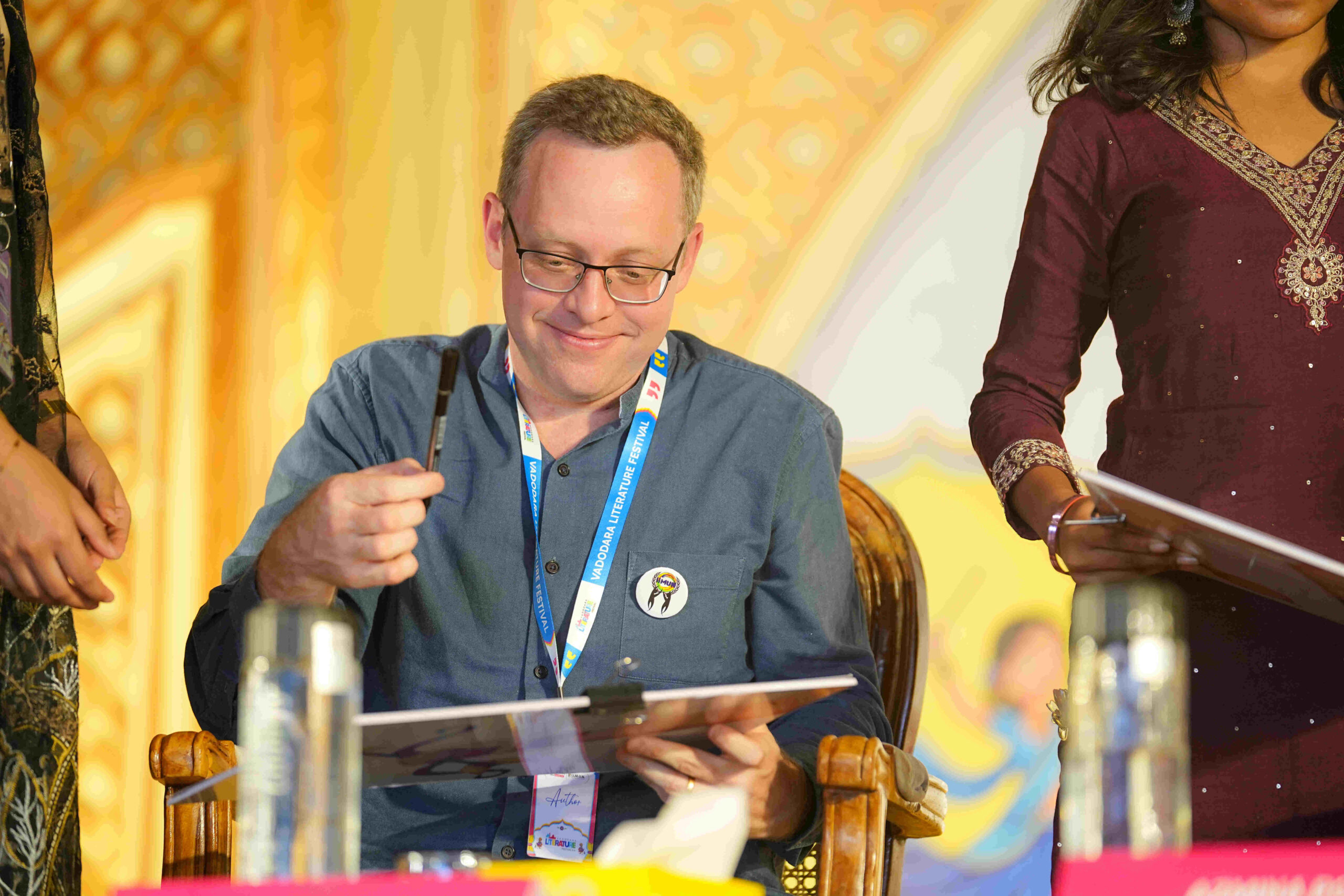
The session at Vivekananda’s Vedanta Bhavan on January 29, 2026, brought together three practitioners whose work shares a preoccupation that their disciplines do not always name directly: what does it mean to make something original in a world that is simultaneously accelerating and forgetting?
Robert Stephens is a principal at RMA Architects in Mumbai and the author of Bombay Imagined: An Illustrated History of the Unbuilt City – a book that took years to compile and documents nearly two hundred unrealised plans for Mumbai across over a century. Sanjay Kumar is the author of This Garden of Weeds – a novel that follows a Delhi businessman and his daughter into the volatile, hypocritical world of contemporary art collecting. Azmina Poddar is the author of Designers Are Oxymorons: 16 Open Secrets for Designers to Navigate in the Uncertain World of GenAI – a book that takes on the question most design professionals are quietly anxious about: what does a human designer offer in an era when AI can generate convincing visual work in seconds?
The session placed these three books, and the sensibilities behind them, in conversation with an audience of students who were navigating their own versions of the same question: what do I offer that cannot be replicated, and how do I build a practice around it?
Bombay Imagined: When Ideas Do Not Die
Robert Stephens arrived in Mumbai at eighteen. He came as an outsider – no prior image of the city, no intellectual or cultural baggage about what it was supposed to mean. He simply walked around. He found things that amazed him. He kept finding things.
The book that emerged from this decades – long engagement with the city is not a conventional architectural history. Bombay Imagined documents the plans that were never built: the underground rail networks proposed in the 1920s, the reclamation projects that would have remade the shoreline, the civic visions that fell to finance or politics or simple institutional inertia. Two hundred unrealised plans, each representing a moment when the city could have become something different from what it is.
The question his wife asked him every morning during the writing – doesn’t revisiting these unrealised things make you feel bored or depressed? – was, he said, the wrong question. His answer was consistent: it made him very happy. Because the book’s real argument is not about failure. It is about the persistence of ideas. Every unrealised plan he documented represents a thought that was fully formed, seriously considered, and then not executed – but not erased. The idea of the underground rail proposed in the 1920s still exists. It can still be read, still be considered, still inspire a new proposal. “Ideas never die,” he told the audience. “You can witness and admire an old idea. The idea of creating that thing is still alive in people.”
TFor students who had been told, in various sessions across VLF 4.0, about failure and incompleteness and the first stair that is never the destination – this was a complementary argument from an entirely different discipline. Your unbuilt things are not lost. They are available for whoever comes next.
This Garden of Weeds: On Making Art in a World That Monetises It
Sanjay Kumar’s novel This Garden of Weeds takes its title from a metaphor he offered the VLF 4.0 audience: weeds are among the easiest things to take care of. They are natural. They grow without being cultivated. They are, in a certain light, the most honest form of growth – unmanaged, unrewarded by the system that tends more prized plants, but persistent.
The novel follows Delhi businessman Salil Gupta and his daughter Nupur as they launch a reality show auction with a one – million – dollar prize, drawing bohemian, ambitious, and rebellious artists into a chaotic contest marked by drugs, social activism, and family tensions. It culminates in a fatal twist that exposes the greed and hypocrisy beneath the art world’s public vocabulary of authenticity and transgression.
What Kumar was arguing at VLF 4.0 through the novel – and directly, in conversation – was that the art world, like every other world that has been successfully marketised, has developed a language of radical authenticity that functions as cover for deeply conventional ambitions. The artist who performs rebellion while pursuing institutional validation is not unusual. They are, in many cases, the norm. The question the novel poses is whether genuine creative work – work that actually means something beyond its market value – is possible inside the systems that art now inhabits.
His advice to aspiring creative practitioners was built from this analysis: live an interesting life first. Cultivate genuine curiosity. Experience things. Then write. The artist who has nothing to say except commentary on other art will eventually run out of material. The artist who has lived with attention will never run out. And his instruction on time, directed particularly at students in a generation conditioned to expect rapid results: “Time is like cooking slow food. To make it more and more tastier we have to keep that food cooked overtime. A fine wine tastes best when preserved for a long time.” Slow down. Let things develop. Memories are handcuffs – let the past go, and use what you have learned.
Designers Are Oxymorons: What Human Creativity Offers in the Age of GenAI
Azmina Poddar’s contribution to the session addressed the question that was present, implicitly or explicitly, in every creative – career discussion at VLF 4.0: what does a human creative practitioner offer that AI cannot provide?
Her answer, encoded in the title of her book, is that designers are inherently contradictory – they work within constraints while pushing against them, they serve clients while advocating for users, they use systems while questioning systems. This productive contradiction is not a bug in the designer’s practice. It is the practice. And it is, precisely, what AI cannot replicate: not because AI lacks technical skill, but because AI does not have genuine stakes in the outcome. The designer who is asking a real question – about how people will experience a space, a product, an interface – is asking from within a human life that will be affected by the answer. That embeddedness is irreplaceable.
She also spoke about the importance of asking questions – good questions, questions that feel foolish before they are asked, questions that turn out to matter. “Why is this design like this? What was the idea and thought of that designer? What is the purpose of developing science in this direction?” Curiosity that is willing to look uninformed is, in her account, the essential fuel of genuine creative development. The designer who is too careful about appearing already – knowledgeable stops learning the moment they stop asking.
Her practical advice for the aspiring designers and creative professionals in the audience:
- Always protect a space and time for thought without distraction – wherever that space exists for you
Observe everything: the street, the crowd, the object, the process – creative intelligence is built from attentive observation
- Not giving up is itself a skill – it is cultivated through persistence, not discovered in inspiration
- Fear diminishes through experience, not through waiting – take up opportunities even when underprepared
- Be unique and different, not a copy – comparison with others obscures the specific value you actually carry
- Embrace being an outsider: it sharpens perspective and fuels the originality that insiders cannot see
Mumbai as Curriculum: What a City Can Teach
One of the session’s most distinctive passages came from Robert Stephens’s reflection on what Mumbai had taught him across the decades he had spent in it – and what any city, experienced with attention, offers that no formal education can replicate.
He described Mumbai as endlessly fascinating, unpredictable, and full of contrasts. He described his early experience of the city as a period of radical openness: arriving with nothing to lose, no intellectual or physical baggage, able to find himself quickly precisely because there was nothing accumulated in the way. He described the local trains of Mumbai as his ‘corner’ – the space where he let his mind process without interference from the noise and pressure of professional life.
The instruction to students was implicit but clear: the city you inhabit, if you allow yourself to experience it with genuine attention rather than navigating it instrumentally toward the next destination, is one of the best teachers you will ever have. Every interaction, every observation, every encounter with the unexpected is material. The question is whether you are awake enough to notice it. Robert Stephens arrived in Mumbai at eighteen with nothing. He left with two hundred unrealised plans for the city – and a book that argues, page by page, that none of the ideas in those plans were ever really lost.


