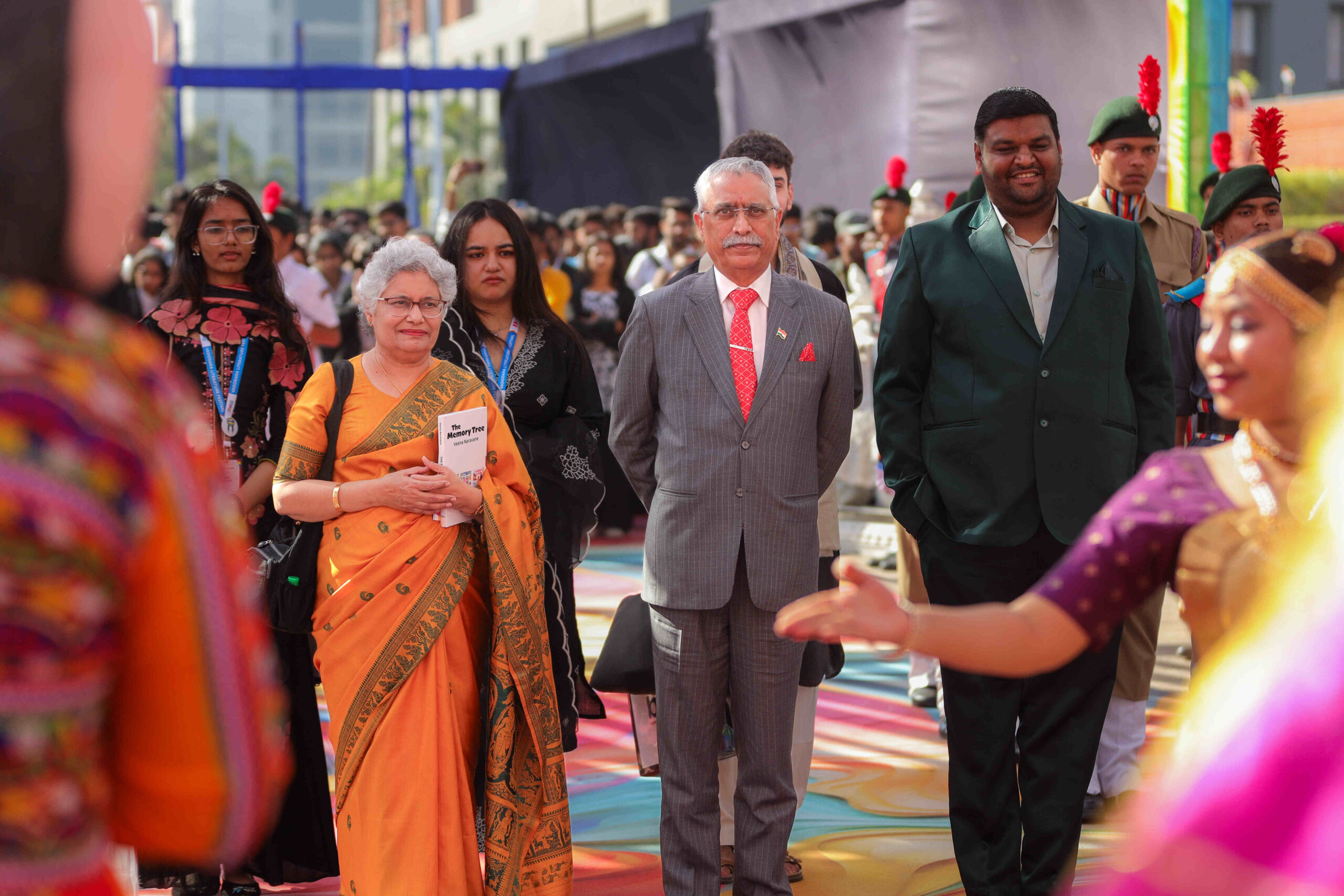
There is a gap in children’s publishing that Veena Naravane identified before she wrote a word of The Memory Tree. Publishers, she told the audience at VLF – Vadodara Literature Festival 4.0’s session on January 28, 2026, tend to avoid children’s books about grief and sorrow on the assumption that young readers cannot handle them – that introducing children to loss through fiction will produce more harm than the books can address.
The absence of books about children’s grief does not protect children from grief. It leaves them without the tools to process what they are already living. That gap is what The Memory Tree was written to fill.
There is a gap in children’s publishing that Veena Naravane identified before she wrote a word of The Memory Tree. Publishers, she told the audience at VLF – Vadodara Literature Festival 4.0’s session on January 28, 2026, tend to avoid children’s books about grief and sorrow on the assumption that young readers cannot handle them – that introducing children to loss through fiction will produce more harm than the books can address.
The absence of books about children’s grief does not protect children from grief. It leaves them without the tools to process what they are already living. That gap is what The Memory Tree was written to fill.
The Specific Grief of Military Children
Naravane’s focus at VLF – Vadodara Literature Festival 4.0 was on the particular emotional challenges faced by children in military families – a population whose experience sits at the intersection of national pride and personal loss in ways that most literature does not acknowledge.
When a child from a military family loses a parent in service, the consequences extend beyond the immediate grief. The family must leave the accommodation provided by the service. The child must say goodbye to friends, to a school, to the familiar rhythms of a life built around a specific posting. The comfort zone is dismantled along with everything else.
Compounding this is a social expectation that the children of military families should be strong – should demonstrate the values their parents served to uphold. This expectation is not always wrong. But it can become a barrier to the expression of grief that children need to engage in. A child who is told, implicitly or explicitly, that their strength is expected, may suppress the sadness that needs to be acknowledged before it can be integrated. “Other people might think they must be very brave and strong,” she told the audience. “But at some point it is not true – because they might be feeling very sad and aloof at that moment of their life.”
How The Memory Tree Works: Stories, Pictures, and Guidelines for Adults
The Memory Tree was designed with children’s developmental reality at its centre. Stories in simple, accessible language – no vocabulary that would require a dictionary. Illustrations, because young readers form emotional connections with visual content that they often cannot form with text alone. Characters who are children navigating what the readers are navigating.
But the book also includes a second audience: the adults and caregivers who are with these children. Naravane included guidelines for parents, teachers, and caregivers – practical instructions for how to be a safe person for a grieving child, how to create an environment where the child feels free to share what they are experiencing without shame or suppression.
For teachers specifically, she offered a diagnostic framework: a child who has recently lost a family member and who is withdrawing from activities and conversation needs something different from the standard classroom expectation. The teacher who can identify this, create space for the child’s emotional reality, and allow expression rather than demanding performance may do more developmental good in a semester than any formal curriculum.
She also described activities for children: journalling, keeping objects that connect them to the person they have lost, finding forms of expression that allow grief to move rather than accumulate. “If they don’t express,” she said, “all that feeling will be stored in their heart, and at one point it will come out in completely different forms – like too much anger, or not wanting to talk to anyone.”
Imagination, Fiction, and the Power of Stories to Create Other Worlds
Beyond the specific subject of grief, Naravane’s VLF – Vadodara Literature Festival 4.0 session was a sustained argument for the value of reading and fiction – particularly for young people whose attention is increasingly competed for by short-form content that cannot do what a story does.
This capacity – to inhabit another perspective genuinely – is not a luxury skill. It is the foundation of empathy, of communication, and of every relationship and professional collaboration that requires understanding people whose experience differs from your own.
Naravane distilled her advice for aspiring writers into the following:
- Originality is everything – authenticity comes from lived experience, not from copying others
- Put your feet in your character’s shoes – feel their reality before you write it
- Writing is the expression of emotion – start with what you have genuinely felt
- The hardest part of a story is the ending – it leaves the deepest impression on readers
- Reading builds vocabulary, imagination, and the capacity to understand others – it is soul food
Key Takeaway - Career Advice That Begins With Purpose
Naravane’s closing advice to students was not about military careers or writing careers specifically. It was about the prior question: purpose. “Always do what you want and what you love,” she told the audience. “Never do things which compromise your own happiness.”
She offered a framework for making that choice sustainable: identify your purpose first. Not your career, but your purpose – what you are here to contribute. Once the purpose is clear, the career is simply the path that aligns with it. A person whose purpose is to teach finds that the career of teaching is not a limitation but an expression. A person whose purpose is to heal finds medicine not as a competition but as a calling. Career, she said, is the way of living a life – not a destination, but a direction. Choosing it intentionally, from a position of genuine self-knowledge, is the work that festivals like VLF – Vadodara Literature Festival 4.0 are designed to help students begin.


