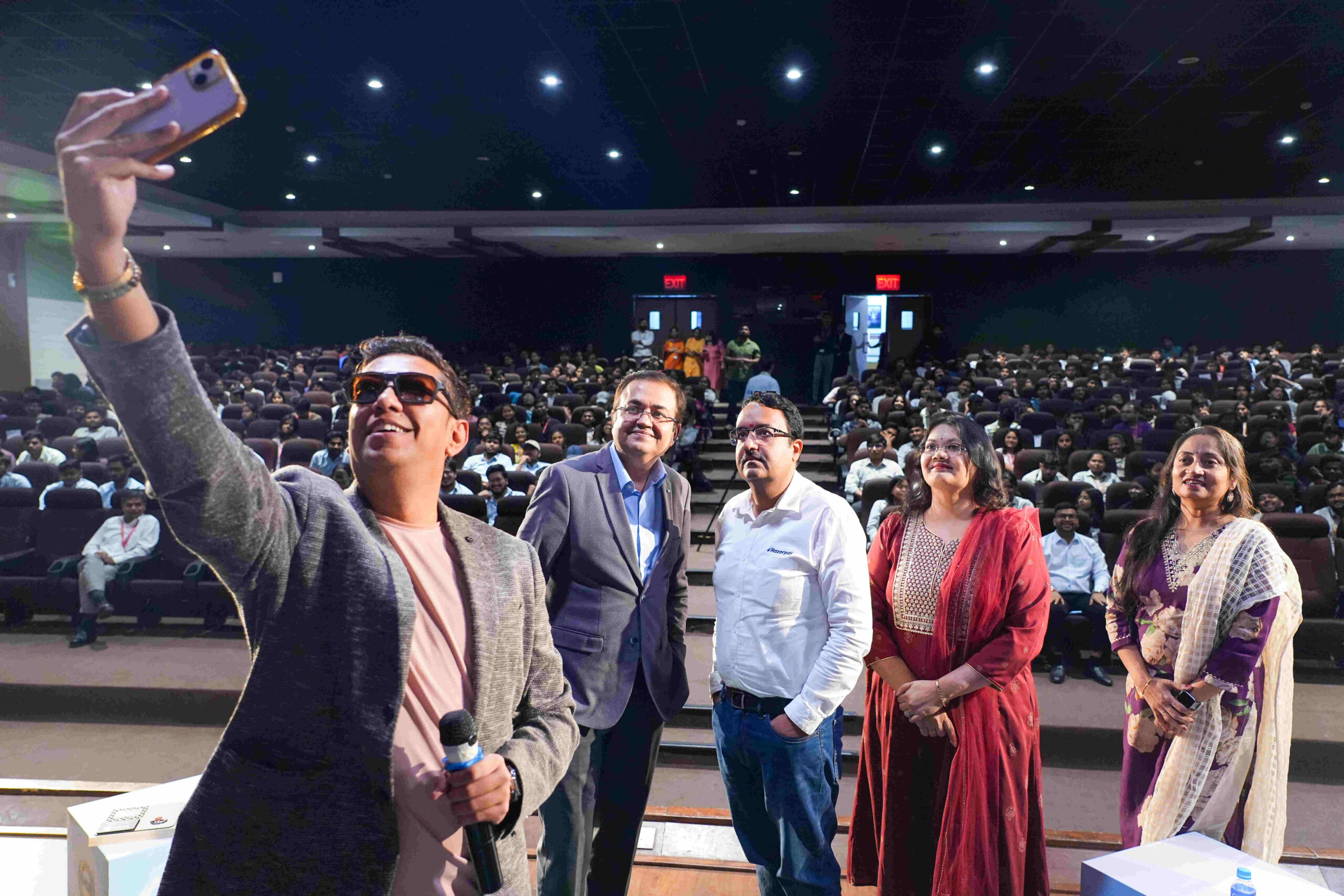
Leadership advice from textbooks ages fast. What makes the Udyam Fest 2026 sessions at Parul University different is specificity – each speaker anchored their advice in decisions they made in actual roles at actual companies. These are not motivational abstractions. They are operational principles tested under real business pressure.
Parul University’s Exposure-to-Execution Bridge – its three-stage model of exposure, engagement, and execution – is designed to ensure students do not just hear leadership advice but act on it within the same festival through Q&A sessions and student-run stalls.
Lesson 1: Perseverance Outranks Talent - Sundeep Singh, Accenture
Sundeep Singh did not open with corporate strategy. He opened with a personal admission: during his FIITJEE coaching days after tenth grade, he skipped classes for three months, chose cricket over textbooks, and scored 2 out of 25 on an exam. The moment he handed that paper to his father, and received silence rather than anger, something shifted.
His father’s principle: owning mistakes takes more courage than avoiding them. That idea became Singh’s operating system. When asked about how he defines success, he said perseverance. His goal is to complete or run daily 21 km runs after Diwali pollution. It is a wake-up call and was the physical proof of the principle: –
● Show up consistently; be present because it matters more than brilliance on any single day.
● Self-discipline compounds; be strict with your morning rituals because they directly affect professional performance.
● Motivation: Internal motivation satisfies you more than external validation.
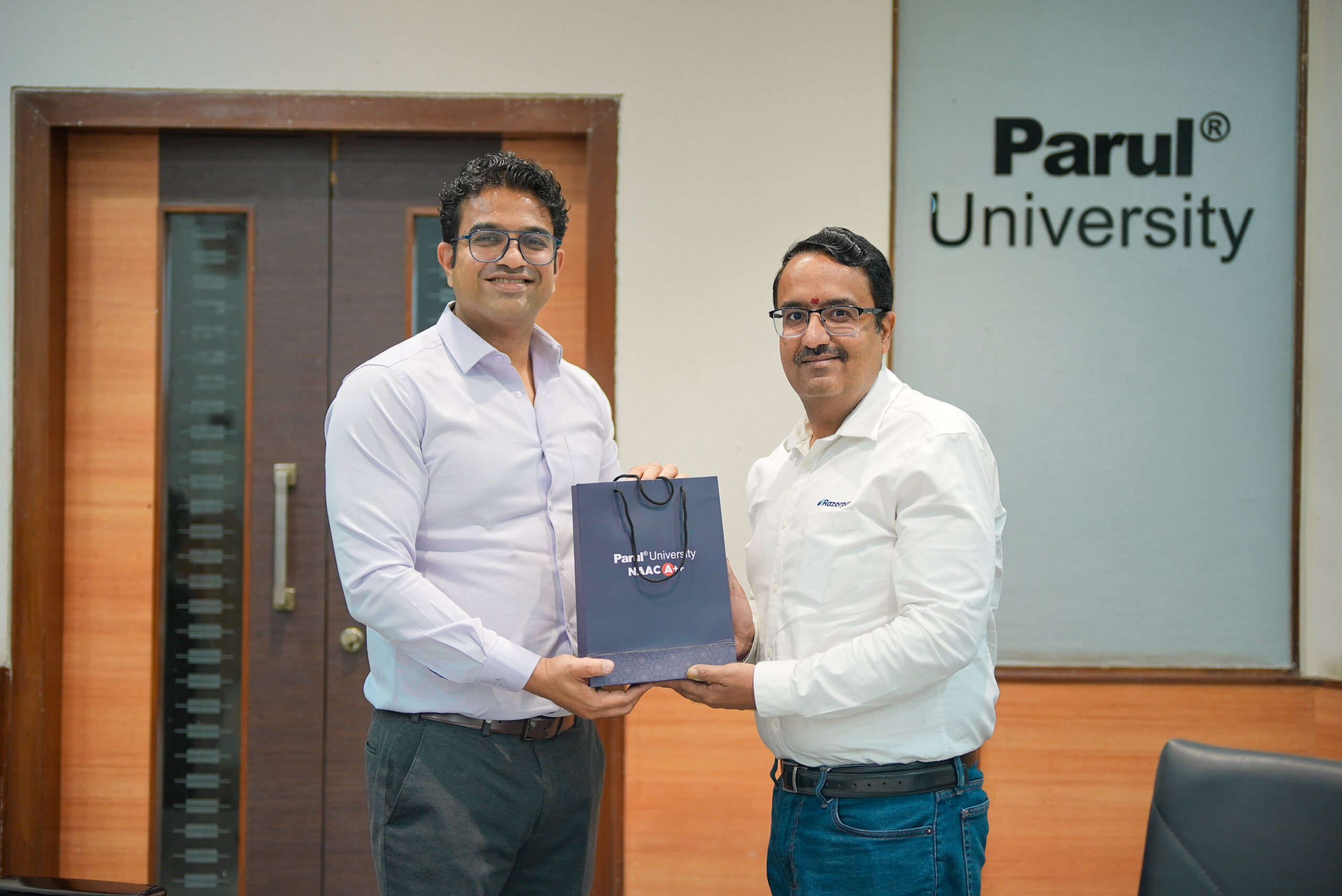
Lesson 2 : Compliance Is a Growth Accelerator, Not a Burden - Vijay Thakral, Razorpay
Many students think of compliance as a cost. But this is how Vijay Thakral reframes it: companies that put regulatory policies – RBI rules, PCI-DSS standards, and ISO benchmarks – from day one scale faster because they avoid costly retroactive fixes.
He also pointed out a behavioural insight about UPI integration: when money takes digital form instead of physical form, people tend to overspend without realising it. The lesson for future business leaders is that product design carries psychological consequences that compliance teams must anticipate.
Pro Tip:
If you are studying fintech or digital payments, learn the compliance frameworks (PCI-DSS, ISO 27001) alongside the technology. Employers in this space value candidates who understand both sides. Parul University’s MBA fintech electives address this dual-skill need.
Lesson 3: Financial Literacy Before Financial Risk - Sunil Ramrakhiani, BSE
Sunil Ramrakhiani presented a striking shift: India took nearly thirty years to reach approximately 3.8 crore investors. Post-COVID, approximately 25 lakh new investors join every month. A quarter of them are under thirty. Some mutual fund accounts belong to infants just one month old.
His warning: Enthusiasm without literacy creates losses. Day trading and options trading without knowledge lead to predictable damage. His operating rule, drawn from Warren Buffett: save first, spend what remains. He encouraged students to view and have investment as a discipline and not as a trend.
Lesson 4: Hire for Attitude, Develop for Skill - P.V. Ramana Murthy, IHCL
Murthy’s career was majorly based in IHCL (Tata Group) and Hindustan Coca-Cola as CHRO.
His central argument: the traditional talent acquisition looks like – degree, GPA, and interview script but misses the traits that actually predict performance. That is emotional intelligence, communication quality, and attitude towards uncertainty matter more
He segmented talent into tiers – top 20–25% for higher rewards, the middle tier for development, and the rest for foundational support – but insisted that everyone carries talent in some form: natural ability, emotional strength, acquired expertise, or unconscious capability.
- Humility is a leadership strength. Authoritative leadership risks narcissism.
- “People before profit” must be a real operating principle, not a slogan.
- Multinational companies fail to embrace local culture and not impose headquarters norms.
| Common Mistake: Students often over-optimise for GPA and certifications while neglecting communication, emotional intelligence, and relationship-building. Murthy’s message was clear: credentials open the door, but attitude determines how far you walk through it. |
Lesson 5: Data Is the New Sunshine - Mukesh Jain, Capgemini India
Mukesh Jain’s session started with a phrase: “Data is the new sunshine.” Organizations that understand their data, or we say customer behavior, market trends, and operational inefficiencies, dominate. While those who ignore it lose opportunities. He mentioned Uber as an example of data-literate companies that outperform.
Jain also shared his educational journey: financial constraints prevented him from completing higher studies. But he returned later. His point was logical: there is no age to restart; you can go back to where you left from, and education is not something that has an age limit till twenty-two. Students have access to unlimited learning resources that earlier generations lacked; the only constraint is whether they choose to use them.
- Learn tools like Python and algorithmic basics. Even if your degree is not offering or having a technology portion, there are skills that one should learn to stay updated.
- AI will not replace jobs and you – it will upgrade them, making them more efficient. Upgrade skills accordingly.
- Build a LinkedIn profile: Make yourself visible on professional platforms like LinkedIn and engage with industry leaders, share your ideas, and create connections.
Lesson 6: Own Your Mistakes First, Then Delegate - Neeraj Agarwal, Tata Projects
Neeraj Agarwal believes in a different leadership type: “Become accountable before giving authority. If a leader cannot own a mistake publicly, delegation falls apart because the team does not trust the decision-maker.” He set out how different it is to work in the infrastructure during extreme weather, with varied teams and tight deadlines, where trust is not a soft concept but an operational requirement.
He rejected autocratic management outright. In complex environments, he said, leaders must be predictable, patient, and deliberate in communication. He strongly advised students to make relations with labor and frontline workers, not just peers and superiors.
Lesson 7: Think Global, Start Local - Suresh Goel, Bikanervala
Suresh Goel’s question gave the conversation a new direction: if McDonald’s can come to India, why can’t we take the Indian brands global? Bikanervala’s trajectory – from a single Chandni Chowk shop in 1952 to a global packaged food and restaurant brand – is his answer.
He broke down what matters in the packaged food business: shelf life, taste, quality, health impact, and fragrance. He stressed that technology and consumer data profiling separate brands that scale from brands that stagnate. For students, his message was that to build a brand, it is necessary to understand your own product deeply before spending on marketing.
Key Takeaways: Leadership Lessons from Udyam Fest 2026
KEY TAKEAWAYS
● Showing up daily outperforms occasional brilliance in every industry.
● Compliance frameworks accelerate business growth when embedded from the start.
● Financial literacy must lead to mindful investment; enthusiasm alone creates risk.
● Attitude and emotional intelligence are important parts of the selection process that put less weight on academic credentials.
● Data literacy and AI fluency are non-negotiable skills for all management graduates.
Who This Article Is For
- Master’s and bachelor’s graduate students preparing for campus placements and industry interviews.
- Early-career professionals seeking leadership frameworks from practicing off-campus and executive roles.
- Parents evaluating the quality of industry exposure at Parul University.
- Faculty designing leadership modules or inviting guest speakers.
FAQ - Leadership Lessons from Udyam 2026
What leadership styles were discussed at Udyam 2026?
Speakers covered adaptive leadership (Sundeep Singh), humility-based leadership (P.V. Ramana Murthy), accountability-first delegation (Neeraj Agarwal), situational leadership (Suresh Goel), and continuous-learning leadership (Mukesh Jain). Autocratic models were explicitly rejected by multiple speakers.
Did any speaker share personal failure stories?
Yes. Sundeep Singh described scoring 2 out of 25 after skipping coaching classes. Mukesh Jain shared that financial constraints initially prevented him from completing higher education. Both used these experiences to reinforce perseverance and lifelong learning.
How is Udyam different from a standard guest lecture?
Udyam runs across three days with multiple speakers, interactive Q&A, and a student-run stall marketplace. It follows Parul University's Exposure-to-Execution Bridge model, combining passive learning with active application within the same event.
Which companies were represented at Udyam Fest 2026?
Accenture, Razorpay, Bombay Stock Exchange (BSE), Indian Hotels Company Limited (IHCL/Tata Group), Hindustan Coca-Cola, Capgemini India, Tata Projects, and Bikanervala. Speakers held CTO, COO, CHRO, MD, CBO, and CEO-level positions.
Can non-management students attend Udyam Fest?
Yes. While the core audience comprises MBA and BBA students, the 2026 edition included participants from nursing, engineering, and other disciplines. The stall marketplace on Day 2 drew attendance from across Parul University's campus.


