Civil engineering has always been at the heart of nation-building. From highways and bridges to smart cities and water management systems, infrastructure development depends heavily on skilled civil engineers. For many engineering aspirants, securing a role in the public sector or a PSU (Public Sector Undertaking) is a prestigious and stable career goal. A BTech in Civil Engineering provides a strong technical and analytical foundation for entering these highly competitive government and PSU roles, especially through exams like GATE.
Let’s explore how a BTech Civil Engineering degree prepares students for public sector opportunities and why it remains one of the most strategic career paths in India.
Strong Technical Foundation in Core Civil Engineering Subjects
A BTech in Civil Engineering equips students with in-depth knowledge of core subjects that are essential for PSU and government examinations. These include:
- Structural Engineering
- Geotechnical Engineering
- Environmental Engineering
- Transportation Engineering
- Water Resources Engineering
- Engineering Mathematics
- Strength of Materials
- Fluid Mechanics
- Engineering Mechanics
These subjects form the backbone of competitive exams like GATE, which is the primary gateway for recruitment into many PSUs such as ONGC, NTPC, BHEL, IOCL, HPCL, and various state-level public works departments.
Since PSU recruitment exams test conceptual clarity and problem-solving ability, the rigorous academic training during BTech prepares students to handle analytical and numerical questions effectively.
Preparation for GATE and Competitive Examinations
One of the most important pathways into PSUs for civil engineers is through the Graduate Aptitude Test in Engineering (GATE). A BTech Civil Engineering curriculum closely aligns with the GATE syllabus, covering technical subjects and engineering mathematics in detail.
During the course, students develop:
- Conceptual clarity in engineering principles
- Numerical problem-solving skills
- Application-based analytical thinking
- Time management for technical exams
Many PSUs shortlist candidates based on GATE scores, followed by group discussions and personal interviews. Therefore, the structured and comprehensive learning approach in BTech helps students build confidence for competitive exams.
Practical Training and Field Exposure
Public sector roles in civil engineering require not only theoretical knowledge but also a practical understanding of infrastructure projects.
A BTech programme includes:
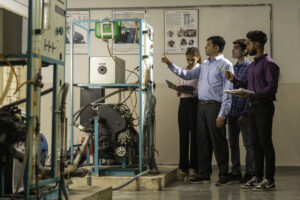
- Laboratory work (materials testing, soil mechanics, fluid labs)
- Surveying practical sessions
- Construction site visits
- Mini and major projects
- Internships in construction or government departments
This exposure allows students to understand real-world applications of structural design, foundation analysis, project management, and quality control. Such practical knowledge becomes highly valuable during PSU interviews and job roles, where engineers must oversee large-scale infrastructure projects.
Understanding Public Infrastructure and Development Projects
Civil engineers working in PSUs and government sectors often handle:
● Highway and bridge construction
● Dam and irrigation projects
● Metro rail and railway infrastructure
● Urban planning and smart city development
● Water supply and sanitation systems
● Power plant civil structures
A BTech Civil Engineering degree introduces students to design codes, safety regulations, environmental standards, and project planning methodologies that are crucial in public infrastructure projects.
Through subjects like construction management and environmental engineering, students also gain insight into sustainable development practices, an essential requirement in modern government projects.
Exposure to Design Codes and Standards
PSU roles demand adherence to strict national and international standards such as IS codes and safety regulations. During BTech studies, students learn how to:
● Apply structural design codes
● Analyse load calculations
● Design reinforced concrete and steel structures
● Evaluate soil stability
● Ensure environmental compliance
This technical training ensures graduates are prepared to handle compliance-heavy public sector assignments.
Development of Project Management and Leadership Skills
Public sector civil engineers often manage large teams, budgets, and timelines. A BTech programme develops:
● Planning and scheduling skills
● Technical documentation abilities
● Team coordination experience
● Cost estimation and project analysis knowledge
Subjects related to construction planning and management introduce students to project lifecycle management, risk assessment, and quality assurance, skills that are crucial in PSU roles.
Stability and Career Growth in the Public Sector
One of the main attractions of PSU roles is job stability, structured career progression, and attractive salary packages. Civil engineers recruited through GATE into PSUs can work in organisations such as:
● National Thermal Power Corporation (NTPC)
● Bharat Heavy Electricals Limited (BHEL)
● Oil and Natural Gas Corporation (ONGC)
● Indian Oil Corporation Limited (IOCL)
● Hindustan Petroleum (HPCL)
● Public Works Departments (PWD)
● Railways
● Metro Corporations
These roles often include benefits such as housing allowances, pension schemes, medical coverage, and long-term job security.
A strong B.Tech. foundation increases the chances of securing such prestigious roles.
Higher Education Pathways for PSU Aspirants
Many civil engineers choose to strengthen their PSU prospects by pursuing higher studies after BTech, such as:
- MTech in Structural or Geotechnical Engineering
- Specialisation in Environmental or Transportation Engineering
- Research-based postgraduate programs
Advanced education enhances technical expertise and may improve career progression within government organisations.
Nation-Building and Social Impact
Civil engineers in public sector roles contribute directly to national development. Whether constructing highways, managing flood control systems, or designing urban infrastructure, their work impacts millions of lives.
A BTech Civil Engineering degree instils a sense of responsibility toward public safety, sustainability, and ethical engineering practices, qualities essential for government roles.
Why BTech Civil Engineering Remains a Strategic Choice ?
Despite rapid advancements in AI and automation, civil engineering remains fundamentally essential because infrastructure development cannot be replaced by technology alone. Smart tools assist engineers, but planning, analysis, and decision-making still rely on human expertise.
A B.Tech. in Civil Engineering prepares students with:
● Strong theoretical knowledge
● Practical engineering skills
● Competitive exam readiness
● Infrastructure project exposure
● Leadership and management abilities
These competencies make graduates well-suited for public sector and PSU careers.
Conclusion
A BTech in Civil Engineering is more than just a technical degree; it is a gateway to stable, impactful, and prestigious careers in the public sector and PSUs. Through strong academic foundations, practical training, and alignment with competitive exams like GATE, students are well-prepared to secure roles in national infrastructure development.
For students aiming to serve the nation while enjoying professional growth and job stability, BTech Civil Engineering continues to be one of the most rewarding and strategic career choices.