TECHNOLOGY STACK
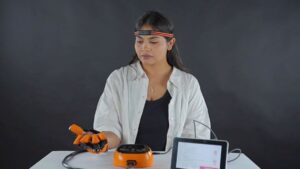
● Component 1 – EEG Headband – Dual-channel sensors detect motor-imagery brain signals
● Component 2 – AI Control Unit – Proprietary Neuro-AI Engine decodes signals into movement commands
● Component 3 – Pneumatic Glove – Micro-air chambers move fingers in sync with brain signals
● Feedback Loop – Think → Detect → Process → Move → Feel → Reinforce
● Adaptation – AI adjusts difficulty, resistance, and repetition based on patient progress
● Platform – Neuron mobile app – session tracking, guided exercises, cognitive activities
Post-stroke hand rehabilitation requires solving three problems simultaneously: reading the brain’s movement intentions (even when neural pathways are damaged), interpreting those intentions accurately enough to generate useful commands, and physically moving the hand in a way that creates sensory feedback the brain can learn from.
Each component of the R1 addresses one of these three problems. Removing any single component breaks the rehabilitation loop. The EEG alone cannot move a hand. The glove alone cannot respond to brain signals. The AI alone cannot bridge the gap without input from both sides. This interdependence is what makes BCI rehabilitation fundamentally different from conventional physiotherapy devices.
Component 1: The EEG Headband - Reading Motor Imagery
Electroencephalography (EEG) records electrical activity produced by neurons firing in the brain. The R1’s headband uses dual-channel EEG sensors positioned over the motor cortex – the brain region responsible for planning and executing voluntary movements.
When a stroke patient imagines moving their hand (motor imagery), the motor cortex produces characteristic electrical patterns. These patterns are faint – measured in microvolts – and mixed with noise from muscle movement, eye blinks, and ambient electrical interference. The headband’s noise-filtering algorithms isolate genuine motor-imagery signals from background noise and transmit the cleaned data wirelessly to the AI unit.
The non-invasive design means no surgery, no implants, and no clinical supervision required during use – enabling home-based rehabilitation.
Component 2: The AI Control Unit - Decoding Intention
The AI processing unit runs Rehabveda’s proprietary Neuro-AI Engine. Its function: decode the brain’s electrical signals into specific movement commands (open hand, close hand, grip) within milliseconds.
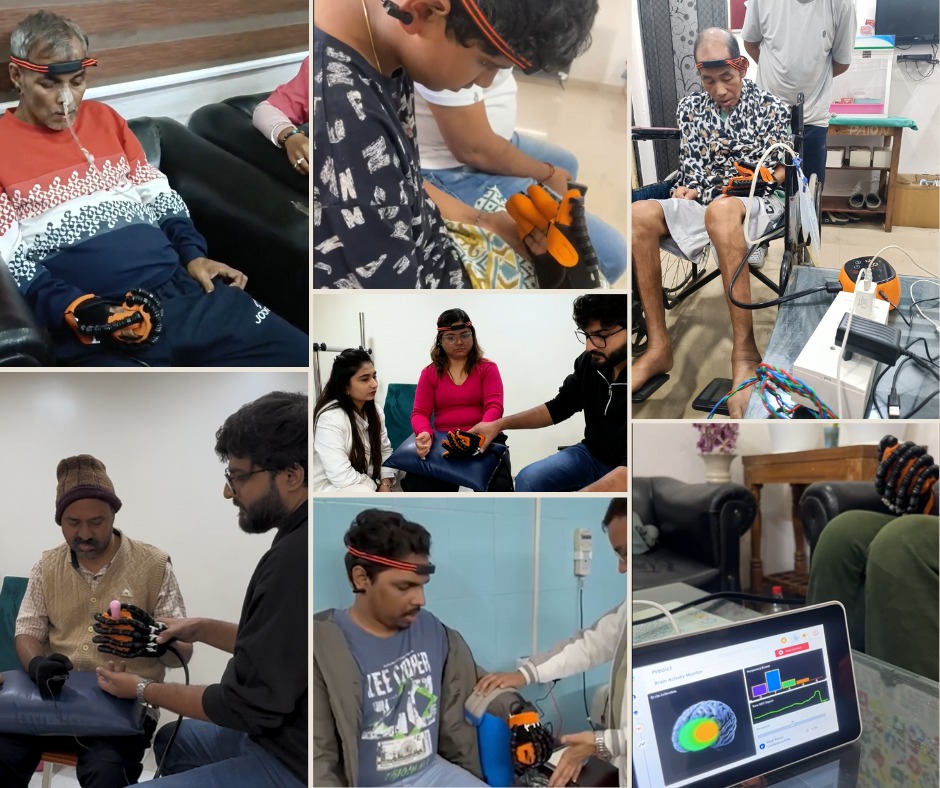
The engine uses pattern recognition algorithms trained on motor-imagery datasets. When it identifies a valid movement intention, it generates a command and sends it to the pneumatic glove. A built-in touchscreen interface allows patients and caregivers to monitor each session in real time.
Adaptive Difficulty Scaling
The AI does not apply a fixed protocol. It tracks the patient’s performance across sessions and adjusts three variables: signal threshold (how strong the brain signal needs to be to trigger the glove), movement resistance (how much effort the glove requires from the patient’s residual muscle function), and repetition count (how many cycles per session). This progressive difficulty model mirrors physical therapy’s principle of progressive overload – but applied to neural, not muscular, training.
Pro Tip:
For engineering and computer science students at Parul University interested in AI for healthcare: the pattern recognition algorithms behind BCI systems combine signal processing, machine learning, and real-time embedded systems. PIERC’s – Parul Innovation & Entrepreneurship Research Centre incubation programs support students building projects in this intersection of AI and medical technology.
Component 3: The Pneumatic Glove - Executing Movement
The robotic glove converts decoded brain signals into physical hand movements using pneumatic (compressed-air) actuation. Micro-air chambers embedded in each finger section inflate and deflate in precise sequences, moving the patient’s fingers in real time with their brain signals.
Pneumatic actuation was chosen over electric motor actuation for safety and biomechanical reasons: air pressure provides a compliant (soft) force that mimics natural hand mechanics, reducing the risk of injury. The glove does not force movement – it assists movement that the brain has initiated through thought, making it active-assisted exercise rather than passive motion.
The Neural Feedback Loop: Why Repetition Produces Recovery
The R1’s rehabilitation mechanism is not the glove itself – it is the closed feedback loop that the three components create together:
- The patient thinks about moving their hand (motor cortex activation).
- The EEG detects the electrical signal (sensory input).
- The AI decodes the signal and sends a command (processing).
- The glove moves the hand (motor output).
- The patient sees and feels their hand moving (sensory feedback to the brain).
- The brain registers the successful movement (neural pathway reinforcement).
Each completed cycle strengthens the neural connection between motor intention and motor execution. Over hundreds of repetitions across weeks of use, the brain builds new pathways around the stroke-damaged area – a process called neuroplasticity. This is why BCI rehabilitation can produce results even years after the original stroke.
The Neuron App: Session Management and Progress Tracking
The R1 System pairs with Neuron – Rehabveda’s AI-enabled mobile application available via monthly subscription (₹1,000/month). The app provides four core functions:
- Neurofeedback training: Real-time visualisation of brain signal strength during sessions.
- Guided therapeutic exercises: Structured rehabilitation protocols adapted to the patient’s progress level.
- Cognitive activities: Supplementary brain training exercises beyond motor rehabilitation.
- Progress tracking: Session-by-session data on signal quality, movement success rate, and Fugl-Meyer-aligned improvement metrics.
| Common Mistake: Assuming that BCI rehabilitation is purely a hardware product. The AI software and mobile app are where personalisation, adaptation, and long-term tracking happen. The hardware captures and executes – the software learns and improves. This is why Rehabveda’s subscription model exists alongside the device sale. |
Intellectual Property and Regulatory Status
Rehabveda has filed a patent application (No. 202521010955) covering its BCI rehabilitation system. The company has initiated the FDA 510(k) approval process for US market entry and is pursuing UL and ISO certifications for global distribution. The device carries CDCSO certification in India.
For medtech startups, the regulatory pathway – from patent filing through certification to market approval – is often the longest and most capital-intensive phase. PIERC’s – Parul Innovation & Entrepreneurship Research Centre Startup Growth Pad at Parul University supports this phase through strategic advisory, investor access, and ecosystem networking.
Key Takeaways: How the Rehabveda R1 Works
KEY TAKEAWAYS
- Three components (EEG, AI, glove) solve three distinct problems in post-stroke hand recovery.
- The neural feedback loop – not any single component – is the rehabilitation mechanism.
- Adaptive AI adjusts difficulty based on patient progress, mimicking progressive overload.
- Pneumatic actuation provides safe, compliant force matching natural hand mechanics.
- The Neuron app adds neurofeedback, guided exercises, and longitudinal progress tracking
Who This Article Is For
• Engineering and AI students evaluating BCI as a career or research direction.
• Healthcare professionals assessing the R1 for clinical or home-based patient use.
• Investors conducting technical due diligence on Rehabveda’s product architecture.
• Parul University students exploring PIERC – Parul Innovation & Entrepreneurship Research Centre incubated health-tech innovations.
Related Queries
• How does EEG-based motor imagery detection work?
• What is a pneumatic robotic glove for stroke rehabilitation?
• How does AI adapt rehabilitation difficulty for individual patients?
• What certifications does Rehabveda hold for its R1 device?
• What medtech startups does PIERC – Parul Innovation & Entrepreneurship Research Centre at Parul University support?
FAQ - Rehabveda R1 Technology
Does the patient need technical training to use the R1?
No. The R1 is designed for at-home use by patients and caregivers without technical backgrounds. The EEG headband is worn like a headband, the glove fits over the hand, and the Neuron app provides guided instructions. The AI handles all signal processing automatically
How does the AI know what the patient intends to do?
The AI uses pattern recognition algorithms trained on motor-imagery EEG datasets. When the patient thinks about moving their hand, the motor cortex produces characteristic electrical patterns. The Neuro-AI Engine matches these patterns to movement commands (open, close, grip) within milliseconds.
Why pneumatic actuation instead of electric motors?
Pneumatic (air-pressure) actuation provides soft, compliant force that mimics natural hand mechanics. This reduces injury risk compared to rigid electric motors and allows the glove to assist movement rather than force it - a critical distinction for therapeutic effectiveness.
Can the R1 work for patients who had a stroke years ago?
Yes, according to Rehabveda. Neuroplasticity - the brain's ability to form new neural connections - operates throughout life, not just in the acute post-stroke window. BCI rehabilitation leverages this by providing the repeated stimulus needed to trigger new pathway formation.
What data does the Neuron app track?
The app tracks brain signal quality per session, movement command success rate, session duration and frequency, and progress metrics aligned with the Fugl-Meyer Assessment framework. This data is available to patients, caregivers, and treating clinicians.