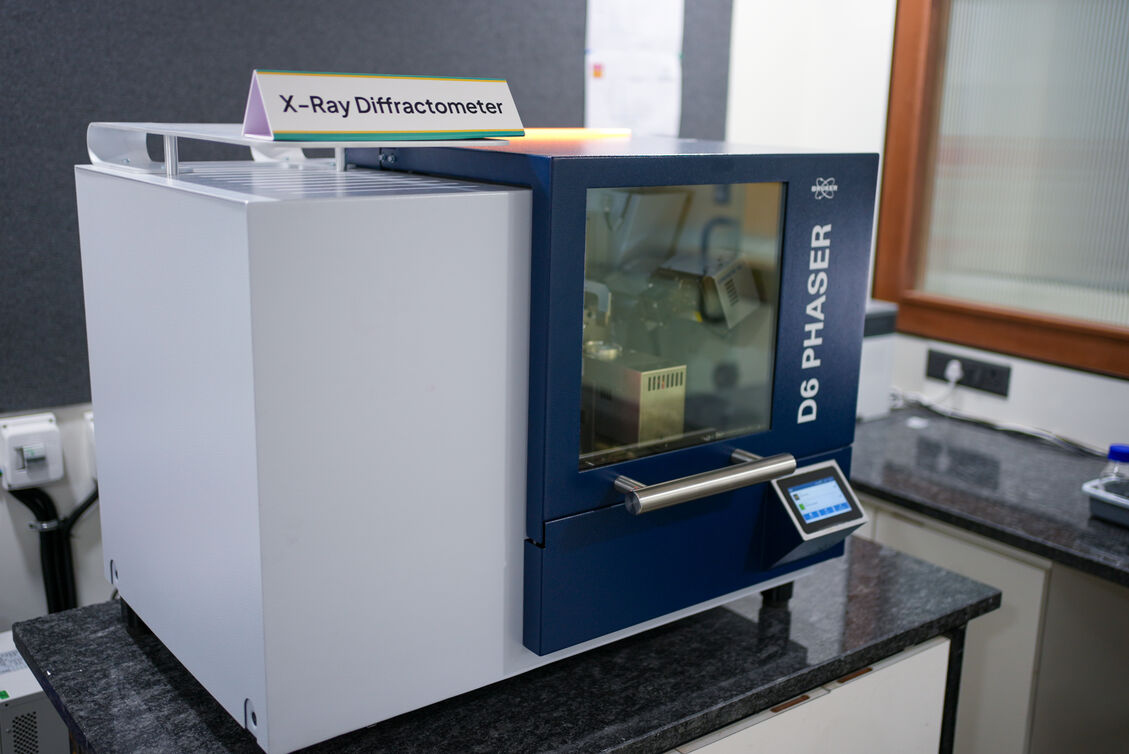
X-Ray Diffraction (XRD) testing has become an essential analytical technique for understanding the internal structure of materials. In Gujarat, advanced XRD testing services are available at the Micro-Nano R&D Centre (MNRDC), equipped with the powerful D6 PHASER Benchtop XRD system. This facility enables precise phase identification, crystal structure analysis, and thin-film characterisation for industrial and research applications.
Unlike surface-based techniques, XRD allows scientists and engineers to look deep inside a material, revealing how atoms are arranged and how that arrangement affects performance, durability, and quality.
What is XRD Testing?
X-Ray Diffraction is a non-destructive analytical technique used to determine the atomic structure, chemical composition, and physical properties of crystalline materials.
While a microscope examines the outer surface, XRD studies the internal “skeleton” of a solid. It works by directing X-rays at a material and measuring how those rays scatter when they interact with regularly spaced atomic planes.
The technique is based on Bragg’s Law (nλ = 2d sinθ). This mathematical relationship connects the X-ray wavelength, diffraction angle, and spacing between atomic layers. When X-rays hit a crystal at specific angles, they produce strong diffraction peaks that form a unique pattern, often described as a material’s “fingerprint.”
About the D6 PHASER XRD System
The D6 PHASER is a compact, high-performance Benchtop XRD instrument imported from Germany. Despite its size, it delivers advanced analytical power typically associated with large laboratory systems.
Key Technical Highlights
- Standard scan range: 10°–80° (2θ)
- Position Sensitive Detector (LYNXEYE XE-T) for rapid data capture
- Internal liquid cooling system to maintain thermal stability
- Two power modes:
- 600 W (standard performance)
- 1200 W (high-power mode for faster scans)
- Fail-safe safety mechanism (X-rays cannot be generated if the door is open)
The system combines speed, accuracy, and safety, making it suitable for routine as well as advanced material characterisation.
What Can XRD Testing Reveal?
XRD services at MNRDC provide detailed insights into:
1. Phase Identification
Determines which crystalline phases are present in a material. This is critical for metals, ceramics, battery materials, and pharmaceuticals.
2. Crystal Structure
Identifies whether a material has cubic, hexagonal, or other lattice arrangements using Miller indices (hkl).
3. Crystallite Size
Peak width analysis helps estimate nano-scale crystal size.
4. Internal Strain
Peak shifts indicate whether atoms are compressed or stretched, which is useful in analysing aerospace and manufacturing components.
5. Material Purity
Using the PDF-4 database, the system matches diffraction peaks against over one million reference patterns to confirm material identity.
Advanced Capabilities
1. Continuous PSD Fast Mode
The Position Sensitive Detector captures multiple diffraction angles simultaneously, enabling faster scans without sacrificing resolution.
2. TOPAS Software (Rietveld Refinement)
TOPAS uses advanced mathematical modelling to refine diffraction patterns and provide quantitative phase analysis. Instead of simple peak matching, it calculates exact structural parameters for highly accurate results.
3. GIXRD (Grazing Incidence XRD)
For ultra-thin coatings, regular XRD may detect mostly the base material. GIXRD solves this by directing the beam at a very low angle (<1°), focusing only on the surface layer.
4. X-Ray Reflectivity (XRR)
XRR is an add-on technique for thin-film analysis. It measures:
- Thickness (1–500 nm)
- Surface roughness
- Layer density
Sample Types Accepted
The XRD facility supports a wide range of materials, including:
- Powder samples
- Solid metal pieces
- Thin films
- Polymers
- Semiconductor layers
- Soil and clay samples
- Battery electrodes
- Pharmaceutical drug powders
Samples are flattened or properly mounted to ensure consistent diffraction results.
Step-by-Step XRD Testing Process
Sample Preparation:
The sample is levelled and placed in a holder to ensure uniform X-ray exposure.
Beam Generation:
High-speed electrons strike copper to generate Cu Kα X-rays.
Scanning:
The goniometer moves the X-ray source and detector across different angles.
Diffraction & Detection:
Constructive interference occurs at specific angles, forming peaks.
Graph Formation:
The system generates an Intensity vs 2θ graph, essentially a digital barcode of the material.
Analysis & Reporting:
Software interprets peak positions, widths, and shifts to deliver a comprehensive report.
Why Choose XRD Testing at MNRDC?
Non-Destructive Testing
XRD does not damage or alter the sample. Materials remain intact for further analysis.
Fast Turnaround
Continuous PSD fast mode enables high-quality results within minutes.
Industrial-Grade Accuracy
The integration of PDF-4 and TOPAS ensures reliable and publication-ready results.
Process Optimization
XRD supports before-and-after comparisons to evaluate treatment processes such as heat treatment or mixing optimization
Applications Across Industries
- Pharmaceuticals: Drug form validation and dissolution quality checks
- Electronics: Thin-film and semiconductor layer verification
- Construction: Cement quality and structural material analysis
- Energy: Battery material phase monitoring
- Aerospace: Alloy deformation analysis
- Environmental Testing: Detection of hazardous crystalline substances
Conclusion
XRD testing in Gujarat, powered by the D6 PHASER system at MNRDC, delivers advanced internal material characterisation with speed, precision, and reliability.
From phase identification to thin-film analysis, this facility supports industries and innovators with non-destructive, high-accuracy insights into material performance.
With cutting-edge instrumentation, advanced software integration, and comprehensive reporting, the XRD services at MNRDC stand as a premier solution for crystal structure and phase analysis across multiple sectors.