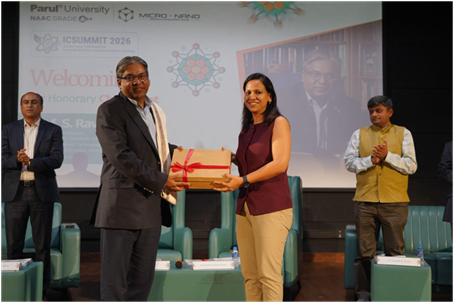
The Summit on Sustainable Technology was conducted on 13th and 14th February 2026. Prof. S. Ravi P. Silva, Interim Director of the Institute for Sustainability and Director of Advanced Technology Institute, University of Surrey, UK, was invited as the chief guest. On visiting, he expressed his gratitude and shared his experience of interacting with young minds in such an eventful environment.
What Is the Purpose of the Event?
The purpose of the event was to discuss innovations in micro and nanotechnologies in alignment with the evolving world. The summit emphasized learning, research, and innovation, promoting sustainable solutions for environmental safety and the efficient utilization of resources.
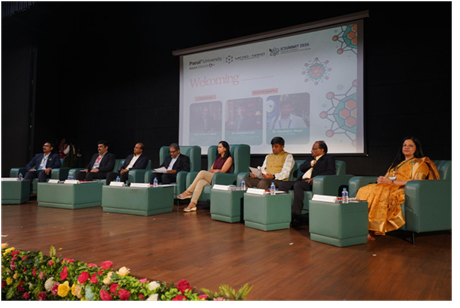
The event was divided into two days. It began with the Inaugural Session, featuring the quote:
“The future belongs to those who believe in the beauty of their dreams and have the courage to engineer them at the atomic scale.”
The session was held from 10:00 AM to 11:00 AM. The main highlight was the spirit of the participants, who were enthusiastic, curious, and passionate. The Central Auditorium was filled with minds eager to innovate for the future.
How Can These Innovations Bring Change?
Prof. S. Ravi P. Silva strongly believes that there is no Planet B, and it is our responsibility to protect Earth. To safeguard the planet, he emphasized the need for sustainable discoveries, particularly in the fields of micro- and nanotechnologies. With this motto, he shared the impact of his innovations through various dimensions.
Gaining Insights From History
Earth was formed nearly 4.6 billion years ago. Drawing insights from history, the professor reflected on how far humanity has come and how recent developments have contributed to global warming.
The core philosophy of his address revolved around four interconnected pillars:
- Protecting our planet through environmentally conscious innovation
- Powering a stable economy through sustainable technologies
- Ensuring a healthier and fairer future through accessible solutions
- Building a liveable and prosperous society through responsible development
He stated that the aim is to achieve the United Nations Sustainable Development Goals.
The Global Impact
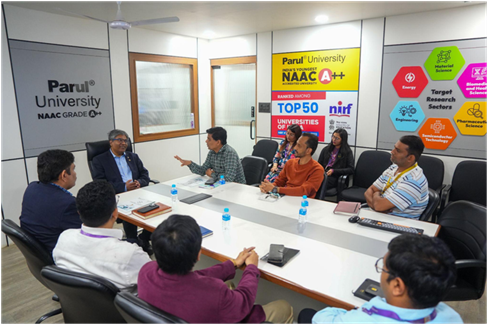
Prof. Silva highlighted his pioneering research and collaborations, including advanced technological applications with Hyundai (VBX6 project), large-area Carbon Nanotubes (CNTs), and nanoelectronic innovations transforming industries globally. He spoke about internal processors achieving speeds nearly 35 million times faster, operating at approximately 5.6 GHz, and the development of plastic electronics for flexible, low-cost devices.
Advanced Technologies Impact
Prof. Silva introduced several revolutionary technologies that captivated the audience:
- Triboelectric Nanogenerators (TENGs): Based on contact electrification principles, these devices convert mechanical energy into electrical energy. Applications include biomedical sensing, wearable pressure sensors, in-home health monitoring, and energy-harvesting devices.
- Smart & Soft Materials: He discussed adaptable materials for wearable devices, artificial body parts, smart energy distribution systems, and circular product life cycles where sustainability is embedded in design from inception.
- Graphene & Advanced Materials: His exploration of revolutionary materials included graphene as “all-seeing eyes” for advanced sensing, nano-barriers for spacecraft, Chemical Vapour Deposition (CVD) techniques, perovskite-based materials, and advanced X-ray materials for imaging.
Energy Shift for the Future- Prof. Kaushal A. Desai
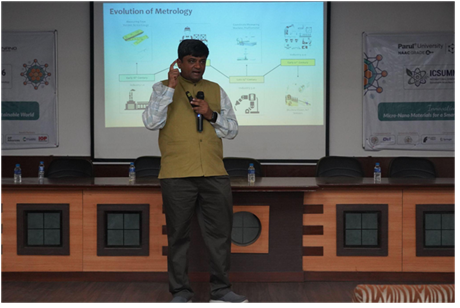
Prof. Kaushal A. Desai began this session with the question:
“What sustains life on Earth, and how do we solve the energy crisis?”
He addressed this by explaining how smart nanomaterials improve renewable energy efficiency. Micro-scale innovations can optimize energy storage and distribution, while open innovation ecosystems can accelerate sustainable solutions. This next wave of global innovation, based on scientific and humanitarian analysis, will act as a motivating force for a sustainable future.
Dr. Kaushal A. Desai, Dean (R&D) & Professor, Department of Mechanical Engineering, IIT Jodhpur, an academician and researcher specializing in advanced materials engineering, micro and nanofabrication techniques, and sustainable mechanical system design, was also part of the summit.
Sustainability in Manufacturing: A Multidimensional Framework
He connected manufacturing technologies with the United Nations Sustainable Development Goals (SDGs) through three dimensions:
- Economic Dimension (SDG 8):Promotion of circular manufacturing systems, value creation through efficient production models, resource optimization to reduce waste, and long-term economic resilience.
- Social Dimension: Manufacturing systems must be designed with human dignity and safety at the core.
- Environmental Dimension (SDG 12 & 13): Responsible manufacturing processes, reduced carbon footprint, waste minimization, and energy-efficient production lines.
He emphasized “meeting present needs without compromising the ability of future generations to meet their own needs.”
Case Study Real World Scenario
Prof. Desai presented a case study on an MSME producing tapered rollers critical components in bearing systems. He explained the importance of precision, how minor surface defects can cause major mechanical failures, and the need for automated inspection systems.
Parul University’s Excellence by Dr Geetika Madan Patel
Dr. Geetika Madan Patel, Vice President and Medical Director at Parul University, shared valuable insights on the research infrastructure and innovation ecosystem at the institution. She quoted:
“Excellence is not a destination but a continuous journey of innovation, collaboration, and unwavering commitment to research.”
She mentioned how the university envisions contributing to the growing India. The nation currently holds the 38th rank in the Global Innovation Index. She confidently expressed her aspiration for becoming the leading university in innovation in tech.
A technical paper presentation competition was held, covering innovative topics aligned with sustainability and research-driven impact.
The competition embodied the true spirit of ICSUMMIT 2026 – innovation rooted in sustainability, research aligned with societal impact, and young minds ready to lead future technological revolutions.
He further introduced a sustainable approach to graphene synthesis using plant leaves. The process involved sun drying of fallen leaves, KOH activation, and carbonization at around 700°C to produce graphene powder. This method demonstrated how agricultural waste can be converted into nano-biochar materials for applications such as dye degradation, supercapacitors, and energy storage. The discussion reinforced that innovation and sustainability can progress together.
2D Materials and the 2026 – 2030 Vision
The session then expanded to other 2D materials such as MoS₂, WS₂, and layered nanomaterials for sensing and energy applications. He discussed their potential in functional battery electrodes, gas and alcohol sensing, ultra-sensitive strain sensors, wearable electronics, and remote health monitoring systems. Integrating graphene with AI-enabled sensing technologies, he emphasized how parameters like sweat composition, temperature, and strain can be measured from the skin, reflecting the future direction of smart nano-enabled systems.
From Healthcare to Military Applications
He shared his vision of utilizing waste to develop products that can serve advanced sectors, including defense.
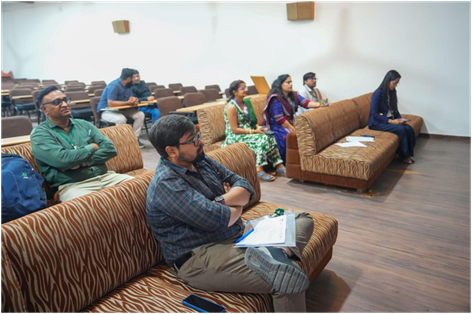
Day 2, The Presentation Day
Day 2 witnessed the results of failed trials, persistence, and the hard work of participants.
“The greatest discoveries often begin not in prestigious laboratories, but in the curious minds of students willing to question everything.”
Presentations were evaluated by invited judges, and participants were assessed based on their technical and presentation skills. Students appeared more confident and less nervous as they presented their research.
Key highlights included:
- Precision in Atomic Engineering
- Engineering Meets Optimization
- Nano Synergy for Cleaner Air
- Engineering for Humanity
- Chemistry with Purpose
- Agriculture Reinvented
- Turning Waste Into Energy
- Biology Meets Nano
These themes demonstrated that ideas are endless, and “The next generation of researchers is not preparing to lead. They are already beginning.”
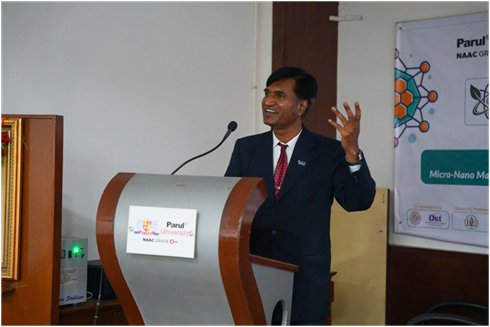
Afternoon Keynote Session- Prof. (Dr.) Dattatray J.
The afternoon plenary session was led by Prof. (Dr.) Dattatray J. Late, Professor at Universidade Federal de Lavras (UFLA), Brazil, associated with Universal AI University, Karjat, India, and a Ramanujan Research Award recipient.
An internationally recognized researcher in advanced nanomaterials, 2D materials, and energy-related nanotechnology, his session covered:
Artificial Leaf: When Science Imitates Nature
He discussed artificial photosynthesis and how solar energy can be harnessed to split water into hydrogen and oxygen.
“If nature can do it, why can’t we engineer it?”
Electronic Tongue – Where Nanotechnology Meets AI
Graphene – The Material That “Should Not Exist”
When he began discussing graphene, the tone of the session became philosophical. He explained how graphene was once believed to be unstable, something that “should not exist.” Yet today, it is seen as a material that could shape the future of technology.
He described graphene as a platform for innovation and introduced techniques like Chemical Vapour Deposition (CVD) and E-beam lithography. He also highlighted how scientists can work at an extremely small scale, with precision as fine as 3 nanometers.
Graphene from Plant Leaves – Science with a Conscience
He further introduced a sustainable approach to graphene synthesis using plant leaves. The process involved sun drying of fallen leaves, KOH activation, and carbonization at around 700°C to produce graphene powder. This method demonstrated how agricultural waste can be converted into nano-biochar materials for applications such as dye degradation, supercapacitors, and energy storage. The discussion reinforced that innovation and sustainability can progress together.
2D Materials and the 2026 – 2030 Vision
The session then expanded to other 2D materials such as MoS₂, WS₂, and layered nanomaterials for sensing and energy applications. He discussed their potential in functional battery electrodes, gas and alcohol sensing, ultra-sensitive strain sensors, wearable electronics, and remote health monitoring systems. Integrating graphene with AI-enabled sensing technologies, he emphasized how parameters like sweat composition, temperature, and strain can be measured from the skin, reflecting the future direction of smart nano-enabled systems.
From Healthcare to Military Applications
He shared his vision of utilizing waste to develop products that can serve advanced sectors, including defense.
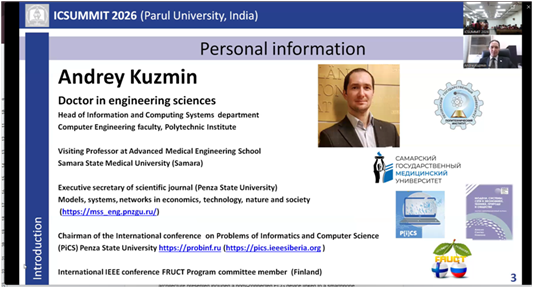
Evening Plenary Online Session - Prof. (Dr.) Andrey Kuzmin
The plenary online session was conducted virtually and delivered by Prof. (Dr.) Andrey Kuzmin, Professor in the Information and Computation Systems Department at Penza State University, Russia.
An expert in biomedical engineering, medical information systems, and digital healthcare technologies, his session focused on bioimpedance-based health monitoring and mobile medical platforms.
Digital Healthcare and mHealth Ecosystems
He began with an overview of digital healthcare trends, highlighting wearable devices, mobile health (mHealth) systems, electronic medical records, and machine learning-based medical data analysis. He explained how smartphones now function as portable computational platforms within cloud-based telemedicine ecosystems, transforming traditional doctor–patient interaction models.
Mobile ECG Monitoring – Engineering for Cardiology
A major segment of his talk addressed wearable ECG monitoring systems. He discussed portable ECG devices with reduced leads, wireless transmission through Bluetooth and Wi-Fi, and real-time as well as offline signal processing via smartphones. He emphasized challenges such as signal filtering, artifact removal, energy efficiency, and patient safety. The architecture presented included a body-connected ECG device linked to a smartphone, which transmits data to remote servers for physician or AI-assisted analysis.
ECG and Bioimpedance Integration – Beyond Conventional Monitoring
He then introduced the integration of ECG systems with bioimpedance measurement technologies. This combined approach enhances cardiovascular diagnostics by providing more comprehensive physiological data. He shared insights from laboratory prototypes developed at his university, focusing on compact hardware design, Bluetooth communication modules, and Android-based medical software platforms.
Bioimpedance in Oncology – Advancing Breast Health Monitoring
Extending beyond cardiology, he discussed the application of electroimpedance spectroscopy in oncology, particularly in breast health monitoring. This non-invasive technique analyzes electrical properties of tissues for early detection and diagnostic support.
Process Mining in Medical Information Systems
In the concluding part of his session, he introduced process mining as an additional analytical framework in healthcare IT. By analyzing medical workflows and patient data streams, process mining enables improved efficiency, better decision-making, and enhanced healthcare delivery systems.
Through his session, Prof. Kuzmin demonstrated how biomedical engineering, mobile computing, and intelligent data systems are converging to shape the future of personalized and preventive healthcare.
Conclusion
Towards the end of the conference, it was evident that students and participants were inspired to work in the micro and nano domain and bring innovations to the surface level. They believed their work could contribute to a more sustainable world and help build a better future.


