The International Conference on Sustainable Micro-Nano Materials & Innovative Technology (ICSUMMIT 2026) represented a landmark academic gathering that positioned Parul University at the forefront of cutting-edge materials research. Anchored in the theme of creating a smarter and sustainable world through innovative micro and nano technologies, the conference assembled an extraordinary constellation of researchers, academicians, industry experts, and emerging scholars from across the globe.
The conference had a single question in focus; not how do we do it (i.e., what can we do) because to solve our critical environmental and technological challenges, the atomic age already has the answers. The answer emerged clearly. We’re already doing it.
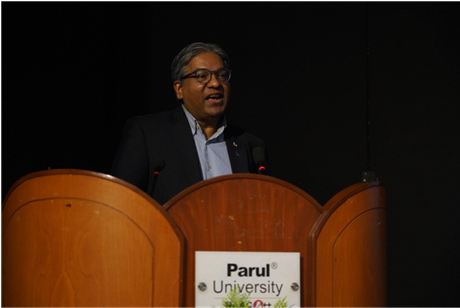
Prof. Silva's Opening Address
“There is no Planet B.”
Prof. S. Ravi P. Silva, University of Surrey, gave the keynote address. As the Director of the Advanced Technology Institute and one of the distinguished professors in nanoelectronics research, his message was not without weight. The existence of this planet is 4.6 billion years old. Industrial activity has disrupted its climate systems in merely two centuries.
His solution centred on materials engineering at the atomic level. The technologies he presented are already in operation:
- Triboelectric nanogenerators are applied in the conversion of mechanical movement to electrical energy.
- Graphene-based sensors reach the molecular level of detection.
- Nano-barrier type of materials for advanced aerospace applications.
His partnership with Hyundai has resulted in 5.6GHz running processors, which is a 35-million-fold increase in processor speed. This demonstrates exponential rather than incremental advancement.
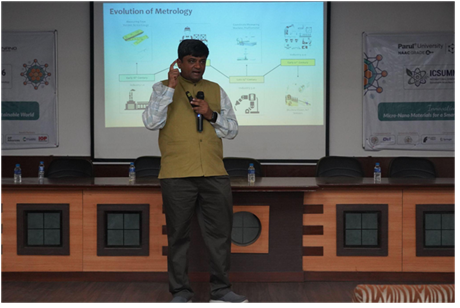
Defining Sustainable Manufacturing
Prof. (Dr.) Kaushal A. Desai, Dean (R&D) & Professor in Department of Mechanical Engineering, IIT Jodhpur, discussed how to develop using a sustainability framework in manufacturing that was emission-free from conventional rhetoric. His approach identified three essential dimensions:
- Economic sustainability – Value creation, no environmental degradation.
- Social sustainability – Worker safety & empowerment.
- Environmental sustainability – Reduction in carbon emissions and waste that can be measured.
His case study examined vision-based inspection systems in bearing component manufacturing. A single microscopic surface defect can trigger complete mechanical failure. Nano-scale precision eliminates material waste, energy and production failure.
Application of zero-defect manufacturing principles showed sustainability as a measurable result and not an abstract goal.
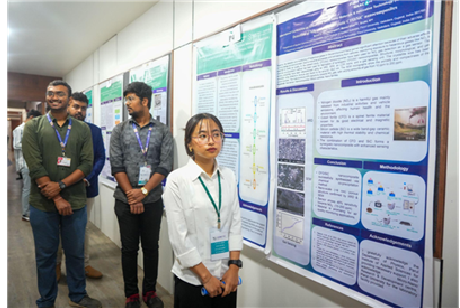
Student Research Presentations
The Day 2 poster session showcased exceptional work from undergraduate researchers. B.Tech students presented research that typically appears at the graduate level. Expert judges posed demanding questions about methodology and results. Student presentations included:
- Co-doped TiO2 thin films – Spin coating at 4000 rpm with controlled optical property tuning
- Friction stir welding optimisation – Achieved 154.91 N/mm² tensile strength through Taguchi methodology
- CFO/SiC nanocomposite sensors – Demonstrated 45% sensitivity for NO2 detection across 10-200 ppm range
- CNT-enhanced solar desalination – Increased clean water production efficiency by 30.50%
- Bio-synthesised nanoparticles – Produced antibacterial silver particles from plant waste materials
These students demonstrated complete understanding of their research. They articulated complex material science principles with clarity and confidence. The quality of undergraduate research at this conference exceeded standard expectations.
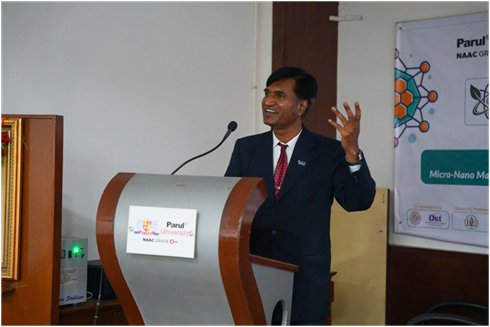
Graphene Synthesis and Applications
Prof. (Dr.) Dattatray Late Professor, Universidade Federal de Lavras (UFLA), Brazil & AI Universal University, India addressed graphene development and applications. Graphene presents a theoretical paradox. Early calculations suggested the material should be too unstable to exist. Yet graphene has become foundational to numerous emerging technologies.
His presentation included a practical synthesis method from agricultural waste:
- Collect fallen tree leaves
- Complete drying process
- Apply KOH chemical treatment
- Heat to 700°C
- Extract graphene powder for supercapacitor applications.
This process transforms waste material into advanced energy storage components.
Additional applications discussed:
- Electronic tongue systems – AI-integrated sensors for food safety assessment
- Strain-based emotion detection – Wearable sensors that monitor physiological responses
- Printed graphene textiles – Continuous health monitoring integrated into fabric
Nanotechnology applications now extend beyond traditional physics into artificial intelligence, medical diagnostics, and agricultural systems.
Conference Outcomes
India holds 38th Rank in Global Innovation Index. Dr Geetika Madan Patel stated the institution’s objective to make India reach single-digit rankings. The quality of research presented supports this trajectory.
The closing ceremony recognised outstanding presentations and innovative research. PhD candidates received validation for extended research efforts. The faculty observed strengthening institutional research culture.
The undergraduate participants demonstrated particular significance. Students entered with limited presentation experience and departed with strengthened research confidence and expanded career perspectives.
Working at the atomic scale produces disproportionate impacts. Research presented at Parul University this February confirmed that future technologies are not theoretical projections but current developments advancing at the nanometer scale.
P.S. Reactions You Can’t Miss!
Jay Shah
I always look forward to being part of such summits. It answers so many questions we have about sustainable innovations and future technologies. The faculties were great and highly insightful. Thank you, Parul University, for such a well-organised event.
Riya Patel
Attending this summit was truly inspiring. The discussions on sustainability and innovation were practical and forward-thinking. The faculty was great and made every session engaging.Grateful to Parul University for this wonderful platform.
Arjun Mehta
This summit gave me clarity on emerging sustainable solutions and industry trends. Every session added real value. The faculty was great and extremely knowledgeable. Thank you, Parul University, for hosting such an impactful event.


